 Heralds of the Gospel Magazine, Vol. 20, nº 227, September 2026
 Heralds of the Gospel Magazine, Vol. 20, nº 226, August 2026
 Heralds of the Gospel Magazine, Vol. 20, nº 225, July 2026
 Who are the Heralds of the Gospel?
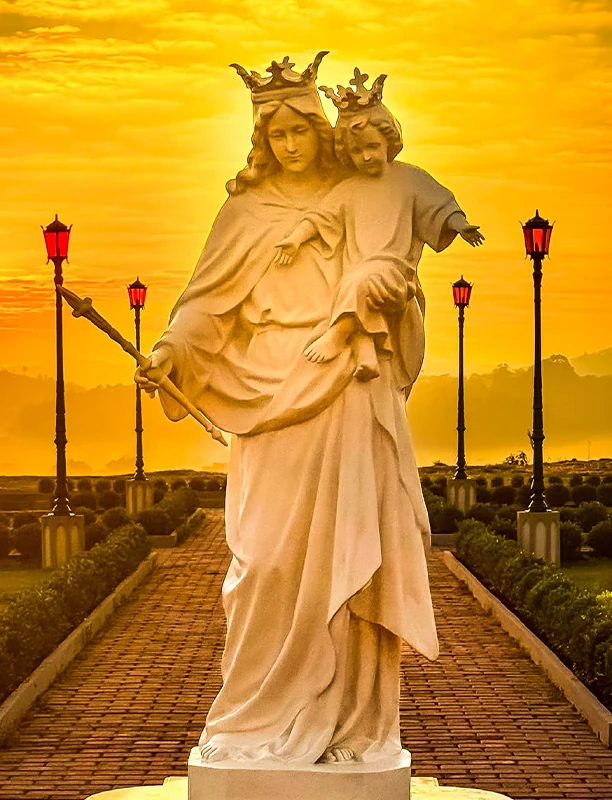 Help of Christians
 Christmas Carols








A multitude of tender mercies
Have mercy on me, O God, according to Thy great mercy. The idea expressed by this opening phrase is that of the sinner talking to God. This is King David, who has sinned and turns to the Lord asking for mercy and forgiveness. But he does not just ask for forgiveness according to God’s mercy; he asks for it according to God’s “great mercy”. As if to imply that his sin is so serious that, without great mercy, it cannot be forgiven. It is a way for the sinner to humble himself and declare that he knows that only through exceptional goodness will he be forgiven. And according to the multitude of Thy tender mercies blot out my iniquity. God is merciful and has a multitude of mercies lying dormant within Him. Faced with the contrite sinner kneeling in His presence, He sees everything that is going on in his soul. It is a contrast: God, who has a multitude of mercies, and the sinner, who has many iniquities. The many iniquities – so to speak – will not be absolved in view of a certain repentance on the part of the sinner, for this would not be in proportion to the offence committed. Forgiveness will come according to the multitude of God’s mercies.In the midst of the darkness, a forgiven soul’s whiteness shines
Wash me yet more from my iniquity, and cleanse me from my sin. For I know my iniquity, and my sin is always before me. A beautiful phrase in which he recognizes the evil, the wrong, the criminal nature of the action he has done, so that all day long – like a phantom – the thought of the evil he has committed haunts him. His sin is before him all the time, like an accuser before the accused.
Pages of the “Psalter of St. Louis” - National Library of France, Paris
“Blot out all my iniquities”
To my hearing Thou shalt give joy and gladness: and the bones that have been humbled shall rejoice. Turn away Thy face from my sins, and blot out all my iniquities. The wording of this request is interesting. The psalmist says, “Turn away Thy face from my sins,” not, “Turn Thy face from me.” As if he were pleading: “Cleanse my face, so that you may look at it without nausea, without horror, so that it may be a reflection of Your supreme beauty.” Create a clean heart in me, O God: and renew a right spirit within my bowels. Cast me not away from Thy face; and take not Thy holy spirit from me. Restore unto me the joy of thy salvation, and strengthen me with a perfect spirit. He asks for a perfect spirit. Not petty, small, banal, everyday things. Not to be a mediocre and trivial man, concerned only with his little biscuit, his snack, his slippers, his comfort. The mediocre man does not have this magnanimous spirit of which the Psalm speaks.
of the wrong he has done, but he turns to God,trusting in His great mercy
“The repentance of St. Peter” by Juan van der Hamen - Royal Monastery of the Incarnation, Madrid (Spain)
A retribution to God: doing apostolate
I will teach the unjust Thy ways: and the wicked shall be converted to Thee. To my ears the Latin phrase – et impii ad te convertentur – is superb. In other words, men of evil life and evil doctrine will turn to You, O God, they will be converted. It is a promise made: to repay by giving God a converted world. In my opinion, it has great beauty. If someone has ever done wrong – and who has never done wrong? – the solution is to kneel down, ask Our Lady for forgiveness and say to her: “I will fight for the triumph of your Reign, I will teach the wicked your ways and they will convert to You. You will dominate the world, O my Mother, because I will fight for You, and all the strength that You give me will be inexorably spent in conquering it.”The sacrifice pleasing to God
O Lord, Thou wilt open my lips: and my mouth shall declare Thy praise. For if Thou hadst desired sacrifice, I would indeed have given it: with burnt offerings Thou wilt not be delighted. God is not satisfied with mere material offerings, such as the sacrifice of a lamb or a dove. First of all, a sacrifice of one’s own soul is required, the sacrifice of something that must be renounced. And until this renunciation is made, peace with God is not established. An example. The Divine Commandment prescribes that men practice chastity. Without this virtue, especially necessary in the contemporary world, there can be no sacrifice pleasing to the Lord. Let us imagine, however, that a false prophet suddenly appeared, with a false revelation, and proclaimed: “God recognizes that humanity has reached such a degree of decadence that it can no longer offer Him the sacrifice of maintaining chastity. Then, in His infinite goodness, He declares: ‘I forgive men and allow them to continue being impure, on the condition that they kill fifty thousand oxen and cows from all continents, at the foot of Mount Sinai, a place of extraordinary symbolism.’” There is no doubt that people would offer the fifty thousand head of cattle immediately. Not only because of the ease in gathering them from all over the world, but above all because this way they would not be making the sacrifice of their souls: they would not need to renounce vice or become pure. Then comes the explanation: A sacrifice to God is an afflicted spirit: a contrite and humbled heart, O God, Thou wilt not despise. Material donations can and should be made even by sinners, when they have the resources to do so. If a rich man takes part of his fortune to give as alms, this gesture obviously increases God’s benevolence towards him. However, it does not satisfy the Creator, as the psalmist states: “with burnt offerings Thou wilt not be delighted.” Then we understand the meaning of these verses: God accepts monetary gifts, sacrifices, and alms, but He is not satisfied with all of this. What He wants from man is “a contrite and humble heart.”Contrition and attrition
What does “contrite” mean? Catholic language, always very precise, distinguishes contrition from attrition, which are profoundly different forms of repentance for our sins. Through contrition, the sinner repents of his faults because, by virtue of an action of grace in his soul, he considers how much they offend God, how bad this injury is, because God is who He is, and he is determined to sin no more, in such a way that, even if there were no hell, this sinner would no longer commit infidelities, because God exists.
Dr. Plinio in December of 1993
Prefigure of the Reign of Mary
Deal favourably, O Lord, in Thy good will with Sion; that the walls of Jerusalem may be built up. Then shalt Thou accept the sacrifice of justice, oblations and whole burnt offerings: then shall they lay calves upon Thy altar. Among other interpretations, there is here a prefigurement of the Reign of Mary foretold by St. Louis Grignion de Montfort. How delightful it is for us to imagine the beauty of that Marian era, when the Holy Church will shine like a city whose walls have been fortified! High walls, magnificent walls, with battlements and barbicans surrounding donjons and colossal mansion towers, all arranged in immense splendour. And at that time, when men have contrite and humbled hearts, God will also accept material gifts. Then will be the time when fortunes will be gladly used to purchase precious stones in the East and precious woods from Brazil in order to make furniture for churches, to adorn monstrances, to honour the Blessed Sacrament, to exalt and super-glorify the altars of Jesus and Mary… God will accept these offerings because they will be presented by contrite and humbled hearts. ◊Taken from: Conference. São Paulo, 25/5/1994