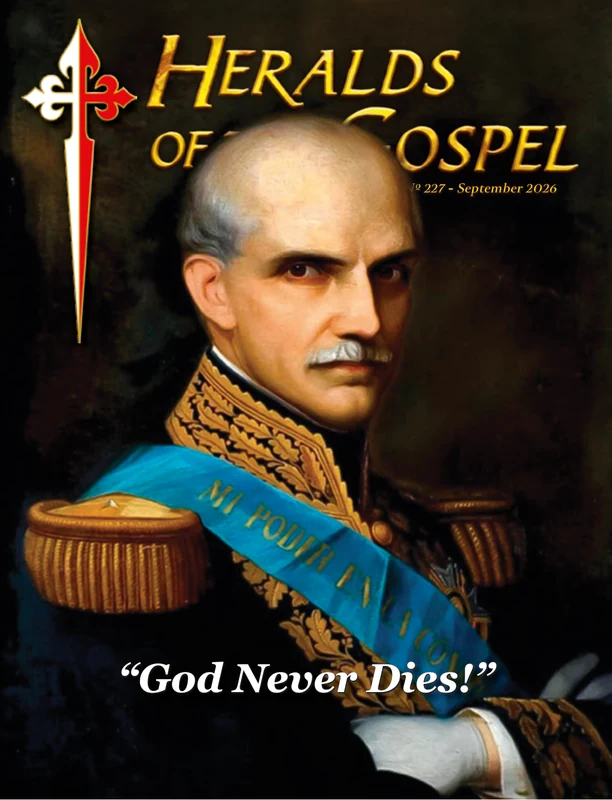
 Heralds of the Gospel Magazine, Vol. 20, nº 227, September 2026
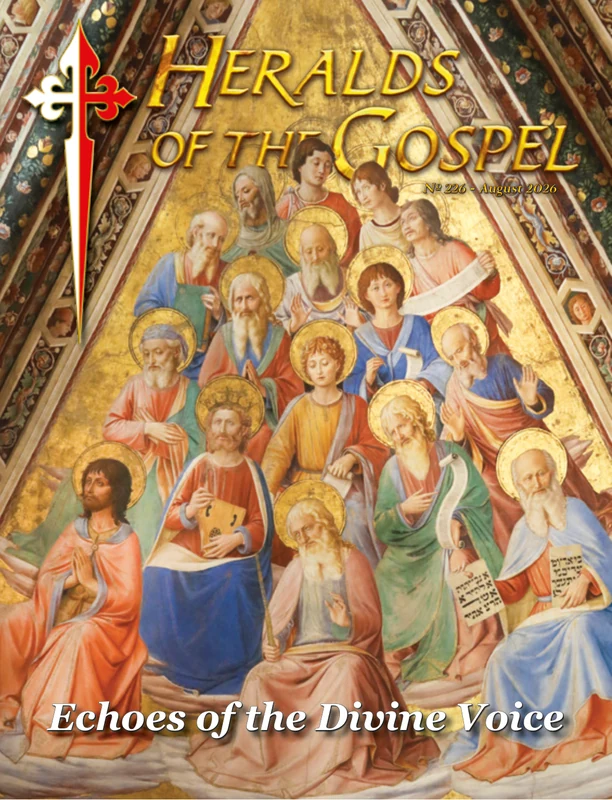 Heralds of the Gospel Magazine, Vol. 20, nº 226, August 2026
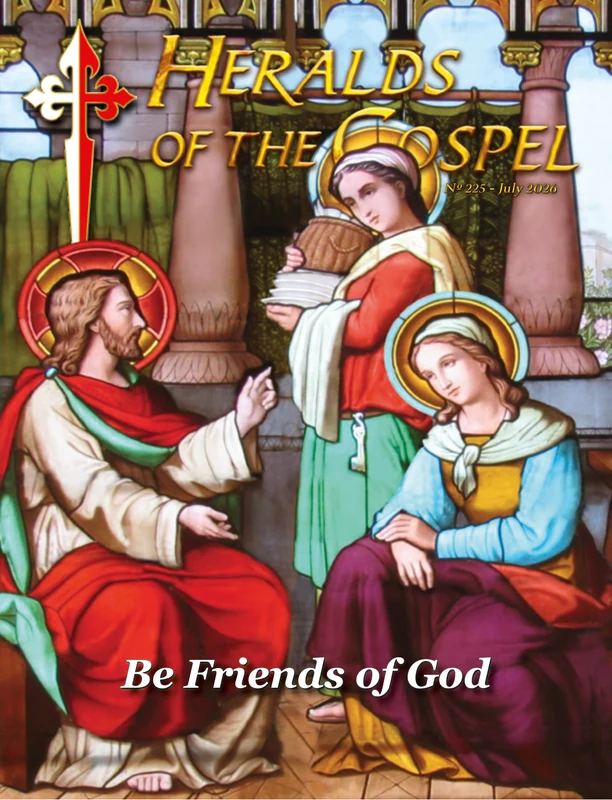 Heralds of the Gospel Magazine, Vol. 20, nº 225, July 2026
 Who are the Heralds of the Gospel?
 Help of Christians
 Christmas Carols






In ancient paganism, prophecy was an obscure function, frequently associated with esoteric rites, diviners, magic, and occultism, due not only to the mysterious atmosphere surrounding it, but also to the familiarity with which its practitioners regarded certain forces alien to the visible world.
This is how all the peoples of antiquity submitted to authentic spokespersons of the devil, servants of religions that were – sometimes more, sometimes less – terrifying and inhuman.
All peoples… except one: Israel, the chosen race, the little flock of the true God. There, yes, there true prophets were to be found.
They were figures completely consecrated to the mission of being symbolic men, bearers of the messages of the Lord of Hosts, heralds of punishments and rewards, of rebukes and promises; in a word, they were men who personified, so to speak, the thought and desires of God.
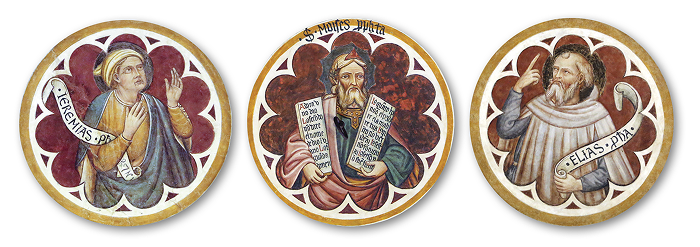
We need only remember St. Elijah, a prophet who arose like fire, whose words burned like a torch.
Having brought ruin upon kings and been “ready at the appointed time, it is written, to calm the wrath of God before it breaks out in fury, to turn the heart of the father to the son, and to restore the tribes of Jacob” (Sir 48:10), he foresaw nothing or almost nothing about the future.
However, at the Transfiguration of the Lord on Mount Tabor, Moses appeared, representing the Law, and Elijah, prophecy, as a synthesis of the entire Old Testament.
Whoever, therefore, peruses the pages of the Old Testament realizes that being a prophet is more than predicting the future.
The voice of God to His people
Christian tradition calls a prophet the one who speaks in the name of God, the interpreter through whom He communicates His designs and truths to the people.
This is what we find, for example, in the Book of Exodus. Despite several attempts to liberate Israel from Egyptian oppression, the enslavement of the Hebrews intensified.
Faced with failure, Moses cries out to God: “Behold, I am of uncircumcised lips; how then shall Pharaoh listen to me?” (Ex 6:30). And the Lord answers him: “See, I make you as God to Pharaoh; and Aaron your brother shall be your prophet” (Ex 7:1).
These words make it very clear that a prophet is one who serves as the voice of the Most High.
More than half of the books of the Old Testament narrate events surrounding the lives of the prophets.
In them, theology has been able to find ample material upon which to base explanations about prophecy – often unknown to a large part of Catholics in our days.
It therefore seems appropriate to bring up this vast and important topic, studying it above all in the light of a great luminary of Catholic theology, St. Thomas Aquinas.
The gift of prophecy in the words of the Angelic Doctor
First, we must consider that the gift of prophecy is part of those graces called gratis datæ, and refers both to the knowledge of future events and to the discernment of spirits and mysteries that transcend the common truths of Faith.1
The Angelic Doctor divides prophecy into three categories: predestination, foreknowledge, and denunciation.
The first refers to those prophecies that must necessarily be fulfilled, as they are predisposed by God to be; the acts of men do not influence the outcome, since divine designs are immutable.
This category of prophesy consists of a revelation of what the Almighty will accomplish. As examples, we can recall the announcements concerning the coming of the Messiah in the Old Testament.
While in this type of prophecy the individual is given to know what God will do, in foreknowledge he contemplates future events determined by the decisions of human beings.
This includes, for example, the messages concerning wars or invasions during the time of the kings of Israel.
Finally, the prophecy of denunciation is that which announces the consequences of present acts, without eliminating the possibility of change as long as there is conversion and repentance on the part of men.
Jonah’s announcement of the destruction of Nineveh, which resulted in the contrition of the Ninevites, is a typical example of this kind of prophecy.
Scripture then points out: “When God saw what they did, how they turned from their evil way, God repented of the evil which He had said He would do to them; and He did not do it” (Jon 3:10).
However, as we said above, prophecy goes beyond simply looking at future events, and extends to everything that is useful and needs to be known for salvation.
The prophetic charism also judges customs, trends, and doctrines according to the divine perspective. His pronouncements are infallible because, having been infused by God into the prophet’s soul, they cannot lead to error.2
For this reason, in the Old Testament, prophets were always at the monarch’s side: for more than kings, it was the men of God who possessed the “divine criterion” to infallibly evaluate events.
The sovereign who heeded the prophet’s advice was granted Heaven’s blessing; as for the one who disobeyed, there was no calamity that could not befall him.
The prophet played a central role, he was like the living law, the pole to which the entire hierarchy of the chosen people had to turn in order to be pleasing to the Lord.
On the other hand, in the Old Testament, touching a prophet was like touching God.
But only in the Old Testament?
The prophetic charism in the Church
Just as we tend to restrict the gift of prophecy to the simple prediction of the future, we also tend to circumscribe the actions of the prophets to the period before the Incarnation of the Word.
In reality, “far from eliminating the charism of prophecy, the coming of Christ, on the contrary, brought about the expansion predicted by Moses: ‘Would that all the people were prophets!’ (Nm 11:29).”3
This confusion can be explained by the fact that we normally relate prophetic communication with great mystical raptures, with visions of mysterious beings or images of gigantic proportions, such as those in famous Old Testament passages.
Now, St. Thomas Aquinas explains to us that “prophecy is all the more excellent according as it needs it [imaginary vision] less.”4
In other words, the prophetic charism is all the more perfect the more the truths are translated by thoughts and inspirations, and less by material images.
It was logical that prophets after the Redemption would preferably be honoured with this superior mode of prophecy.
However, little is said about the prophetic character in the life of the Church, despite this often being the point around which great and complex hagiographies are clarified: truly, “it would be difficult to understand the mission of many of the Saints of the Church without reference to the prophetic charism.”5
St. Paul himself recognizes this centrality of the spirit of prophecy when he affirms that the Church, whose cornerstone is Christ, has only two pillars as its foundation: the Apostles and the prophets (cf. Eph 2:20).
This is because the prophet “is the one who knows how to read the design of God in the unfolding of events, and knows how to interpret the religious meaning of facts.”6
As Cardinal Charles Journet explains, the Church not only knows the revealed deposit, but it is also hers to know the state of the world and to discern spirits, through the prophets.
They will know how to discern, in the divine light, the evils of their time and prescribe the true remedies: “While the masses will seem struck by blindness, while even the best will hesitate or grope, they, with supernatural and infallible instinct, will go straight to the target.”7
Prophecy is not dead
Against the fact that prophecy persists in our days, one could raise the following objection: the prophets of the Old Law transmitted to the people the words that Yahweh wanted to address to them; however, since the Word itself became incarnate, what more could the Most High have to say to the world? Everything has already been said…
That is quite true. But humanity has always needed – and needs today more than ever – men and women who update God’s message according to the problems of each time.
Therefore, Aquinas clarifies that at no stage in history has the Church lacked someone endowed with the spirit of prophecy to guide human activity according to the designs of the Creator.8
Thus, based on centuries-old Christian doctrine, Msgr. João Scognamiglio Clá Dias explains that,
in addition to the official prophetism of the Old Testament, there have always been, throughout the bi-millennial journey of the Mystical Spouse of Christ, men and women, who, like the prophets of old, were chosen by God to influence humanity and guide it according to the plans of the Almighty.
Such are the founders and foundresses of religious orders; the outstanding Saints who indelibly marked the civil and religious society of their times; and the dauntless Pontiffs, who with skilled and firm hand exercised the power conferred upon them by Christ Himself.
Whether as clerics, religious or laypersons, these figures shone with a divine light that captivated souls and led them along the paths chosen by Divine Providence, paths which they indicated.9
Is it not true that we can discern a prophetic mission in the actions of St. Benedict, patriarch of Christian Europe, or in the evangelizing feats of the sons of St. Ignatius in the Americas, as well as in their battle against the pseudo-Protestant Reformation?
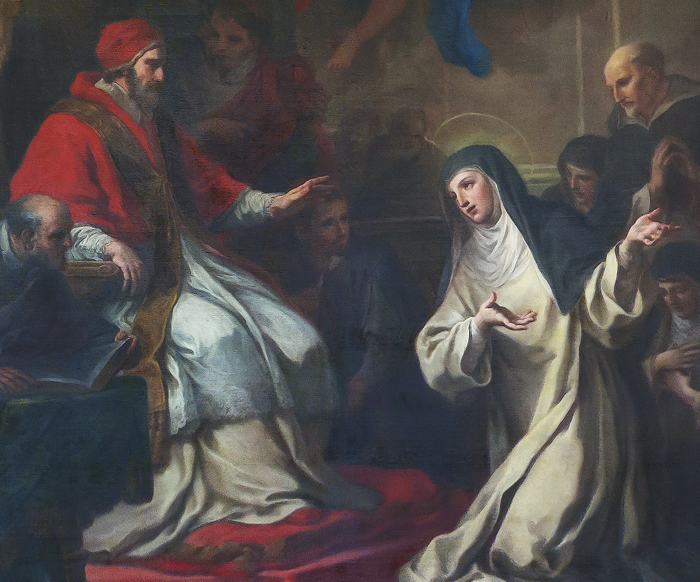
Or what about the fiery preachings of St. Francis of Paola, St. Vincent Ferrer and St. Louis Grignion de Montfort, and the serious admonitions that St. Catherine of Siena addressed to the Popes of her time?
What, then, can be said of the luminous trajectory of St. Joan of Arc, the shepherdess from Lorraine who commanded armies, won battles, crowned the King of France, and repeatedly silenced a tribunal of scholars, guided by angelic voices and inner promptings?
The lives of those who, led by a clear movement of the Holy Spirit, fought for the rights of the Church against its enemies, internal and external, veiled or declared, very often present undeniable traces of authentic prophecy.
The grand days in which we live
All this unveils an impressive horizon: how grand is the History of the Church! Some think that glorious events no longer occur in our days, that the feats of the great men of the past are not repeated. They are mistaken!
The truth is that we live in one of the most decisive times in history.
In this century in which the distinction between good and evil seems to have been abolished, in which the most elementary truths are questioned, in which each person presumes to redefine the fundamental principles of morality and reinterpret the law of God according to their own selfish criteria, in these times in which the world is heading, as never before, towards its own destruction, could God have become silent?
No! Assures Msgr. João:
The voice of God rings out as clearly today as it has for two thousand years, through the Magisterium of the Holy Church […]. But it is also heard through those who stand out for their fidelity to this Magisterium.10
Let us not shrink back from this immense, yet glorious responsibility: as participants in Christ’s prophetic mission through Baptism, we – and no others – are called to exercise prophecy in our time, each according to our state and condition.
Only this is necessary: that we be Catholics, not just in name, but in truth; fervent Catholics, with an intense sacramental life and ardent piety.
If we embrace this condition with all our soul, God will never fail to show us the paths to follow. Thus, we will be able to walk safely in the light of His divine will and lead many others to salvation.