 Heralds of the Gospel Magazine, Vol. 20, nº 227, September 2026
 Heralds of the Gospel Magazine, Vol. 20, nº 226, August 2026
 Heralds of the Gospel Magazine, Vol. 20, nº 225, July 2026
 Who are the Heralds of the Gospel?
 Help of Christians
 Christmas Carols







From the land of predilection, to the land of exile
Adam, prince of the most beautiful and delightful of kingdoms, placed as lord of all visible nature – of whose secrets he had perfect knowledge and over which he exercised a mysterious dominion – was further favoured by preternatural gifts that assured him, among other benefits, of immortality. However, he sinned; Eve sinned. Both left that land of blessing and predilection, where the Most High walked in the cool of the evening (cf. Gn 3:8), and entered a land of exile. Human nature, deprived of the preternatural gifts and helpless in the face of an environment over which it no longer had control, felt hindered, diminished, and threatened by the righteous anger of a God who had been offended. Apprehension, sorrow and uncertainty entered with man into the land of exile, followed not long afterwards by the terrifying image of death.The fratricide of Cain
Adam and Eve, who knew they were destined to die, before passing away, experienced the tragedy of contemplating the son of blessing, the son of predilection, Abel, the sweet, the just, the magnificent, prostrate on the ground, dead. They had never seen a dead man! Perhaps they did not even yet have a precise notion of what death was, because what cannot be seen is not fully known. And killed by whom? By a brother. The ignoble fratricide had stained the ground with righteous blood which, according to Genesis (cf. Gn 4:10), rose to Heaven crying out to God for vengeance. The fratricide of Cain - Church of St. Mary Magdalene, Troyes (France)
Mediation with a view to earthly interests
In the first place, there are the religions without mystery, which perhaps correspond to a family of souls of the human race: those who are more orientated to this world, who do not directly deny the existence of another life nor are they uninterested in it, but who are so engrossed with the day to come that the centre of their concerns turns to earthly affairs. In these religions, the priest appears as a mediator between the gods and the people, but although his eyes are turned towards Heaven, he carries out missions that are characteristically earthly. What missions? The priest is vested with magical powers, by which it is believed he has the ability to heal, to kill or, by means of incantations and sorceries, to govern thunder, to placate beasts. He therefore solves human problems: he performs cures, brings about death – as an instrument of revenge – and commands the elements. One sees here a vague nostalgia that the human race felt, in this decadence, for the dominion that it exercised over creation in Paradise before the fall of Adam. Our nature demands this dominion and the priests, to satisfy this need, presented themselves in this way to men. Thus emerged the class of exorcist priests, who drove away the evil spirits capable of hindering the people in their daily labours, ruining crops, spreading diseases, causing cattle to flee. These were also sacrificial priests, who took, before the sinner, a victim, whether an animal, a fruit, or any offering – unfortunately, often a human victim – and immolated it to appease the anger of a god whom man felt was angry with him, whom he feared, and therefore with whom he wished to curry favour in some way.The priesthood as communicator of divine life
Nevertheless, there is another family of souls, perhaps rarer and certainly more elevated: those capable of understanding that, however important earthly problems may be, they are mere logistics; man is not here on earth to solve them. They understand that hunger is not the central question of life; they know how to think. They pause to reflect and, taking a break from the honest activities of daily toil, from time to time they ask themselves: “What is the meaning of this life? Why was I born? Where am I going? After I die, what will become of me? I don’t know! I need to find out.” These pre-eminent questions dominate their existence, which, without them, becomes meaningless. Pagan priest offering a sacrifice to Jupiter, detail of “Sts. Paul and Barnabas in Lystra” by Bartholomeus Breenbergh - Princeton University Art Museum, New Jersey
One night in Nazareth, peace is made between Heaven and earth
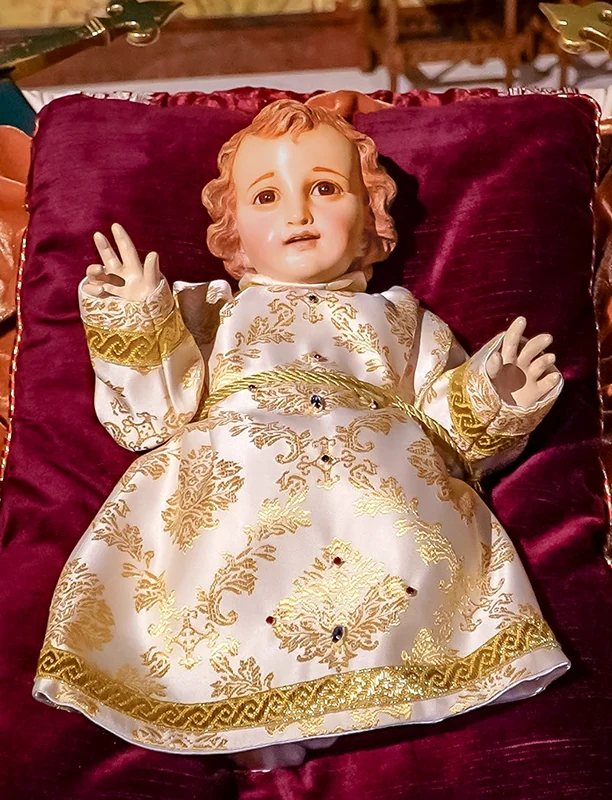
In fact, all or at least many of these religions were animated by the hope that peace would one day be made between Heaven and earth; the moment would arrive when time would reach its culmination and a chosen one of God, perfect and beloved, would come into the world to restore the order that the sin of our first parents – remembered in so many ancient religions – had snatched away from us. The Child Jesus as Priest - Our Lord of Mercies Parish, Guatemala City
Priest and Victim
If it is true that the priesthood is characterized by the link between man and God, no one could establish this link more perfectly than He who was at once Man and God – the Second Person of the Blessed Trinity incarnate. Our Lord Jesus Christ is priest by His very nature, and He founded the true priesthood, the full priesthood, the Christian priesthood, the Catholic priesthood! However, He is not only Pontiff, but also Victim. Our Lord offered Himself in a priestly action, by which He accepted without interruption, from the Garden of Olives to the moment of the “Consumatum est”, the entire ocean of sufferings that would befall Him for the Redemption of humanity. So great was His desire to immolate Himself for us – an immolation indispensable for the reconciliation between God and man – that we see Him, in the prayer of the Garden, suffering, feeling dread and trembling, his blood seeping from His pores at the horror of what He had to suffer. However, receiving strength from the Angel, He wanted to do the will of the Eternal Father, for His glory first of all, and for love of every man. This is the priest from whom all other priests proceed. And the priesthood that the Catholic Church has is on account of its participation in Our Lord Jesus Christ.The grandeur of the priesthood
Therefore, the priest is the link between Our Lord Jesus Christ and us. Through his words, the greatest miracle on earth takes place: endowed with the power of transubstantiation, he multiplies the sacrifice of the Cross on the altars of the world, bringing the fruits of Redemption everywhere. The priest appears to us as one who teaches religion, who guides humanity to the fulfilment of the Commandments, not as a teacher who offers a sterile and lifeless teaching, but as one who, by means of the Sacraments, is able to transmit the grace of God to souls, so that their intelligence becomes more lucid and serene. In this way, the human will too, so weak, so cowardly, so self-interested, is given new vigour by the power of grace: the priest transmits life – he who speaks of eternal life – and leads a certain family of souls to think exclusively or almost exclusively of Heaven. He addresses another family and makes them this promise: “You too, seek the Kingdom of God and His justice, and all other things will be given to you as well.” The priest is the salt of the earth and the light of the world, not only because he is the salt and light of the Church, but because the Church is the salt and the light of Christian Civilization. After Christ came to earth, there is no civilization possible outside Christian Civilization: there is barbarism, or there is Our Lord Jesus Christ. ◊Taken, with adaptations, from: Dr. Plinio. São Paulo. Year IV. N.45 (Dec., 2001); p.6-10.