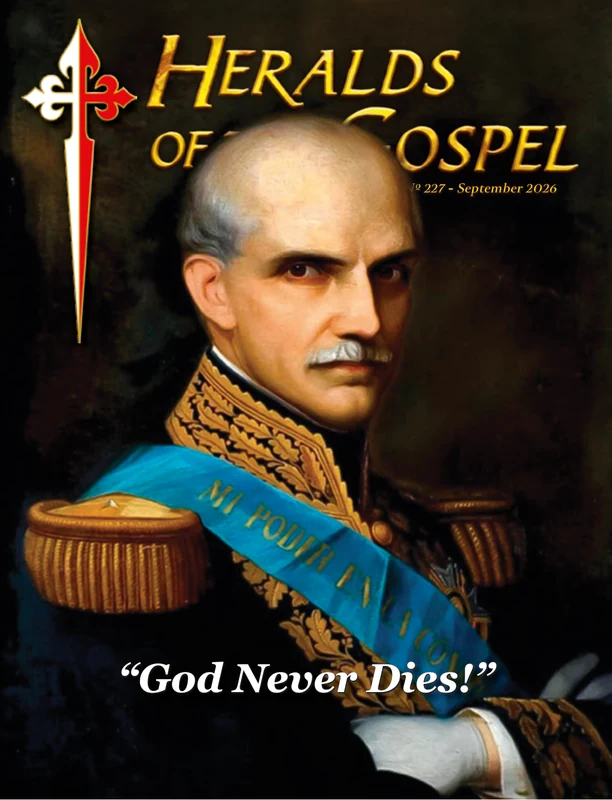
 Heralds of the Gospel Magazine, Vol. 20, nº 227, September 2026
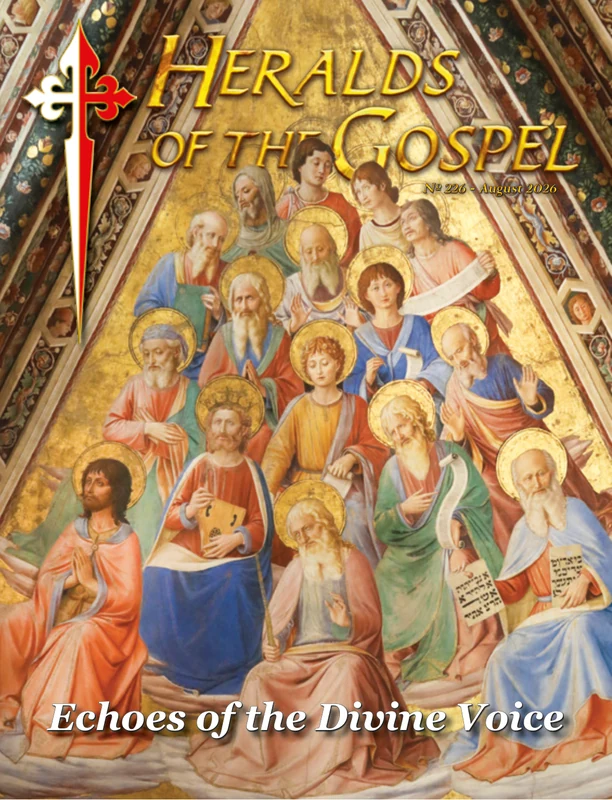 Heralds of the Gospel Magazine, Vol. 20, nº 226, August 2026
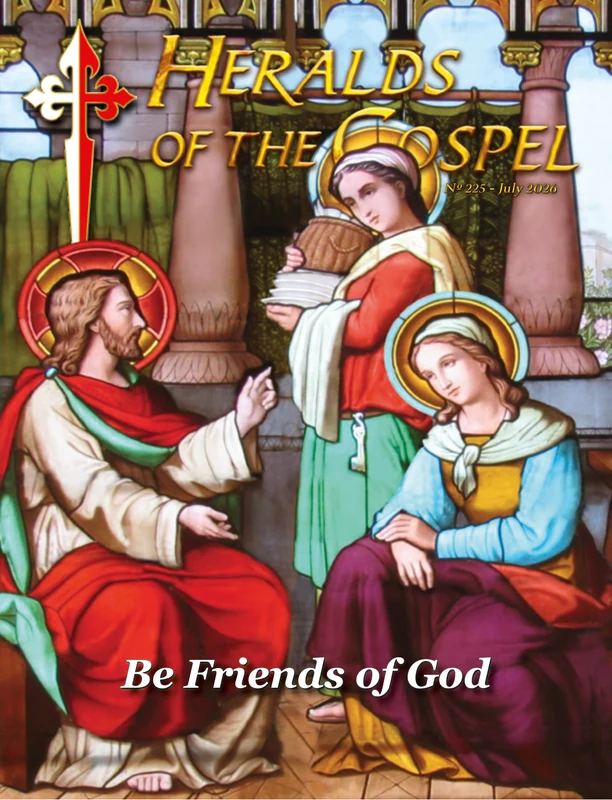 Heralds of the Gospel Magazine, Vol. 20, nº 225, July 2026
 Who are the Heralds of the Gospel?
 Help of Christians
 Christmas Carols







Crowned by the Most High
Among the Israelites it was common to wear floral crowns, as a symbol of joy and festive ornament at feasts and solemnities.1 But they were also used as insignia of royalty, bestowed directly by God on His elect: “I have set the crown upon one who is mighty, I have exalted one chosen from the people” (Ps 89:19). Now, while among the Jewish people the Lord’s beloved ones were thus honoured by Him, in Rome only the most valiant obtained – from men – such a distinction, represented by crowns of simple appearance, but which would be transformed over time into splendid pieces.The reward of the brave
To be a hero: this was the necessary condition to be crowned in the Roman Empire, not with the fatuous laurel of the Caesars, but with the award of authentic warriors, of those who wrote the history of the Eternal City in blood and iron, risking their lives on the battlefield. It was among these fierce warriors that the first elaborate crowns appeared in Rome. Acclaimed by the crowd on their return from war, the victors were decorated according to their exploits: the corona muralis was given to the first soldier to scale the walls of a besieged city; the corona vallaris to the first who stormed the enemy camp; the corona navalis was awarded to the one who won a naval victory; the corona obsidionalis was the prize of the general who freed a besieged battalion. The categories of diadems used to laud the prowess of the Roman legions multiplied with each battle and were even protected by law, which allowed the deserving to wear them during the funeral or even to receive them posthumously. Crowns were therefore highly prized by the Romans, who considered them a much more valuable reward than sums of gold and silver. This propensity was to later influence nascent Christianity.The crown in Christian Civilization
It seems natural, then, that with the advent of Christianity some of these customs – purified and enhanced by the Blood of the Redeemer – were adopted by baptized monarchs. For them, the symbolism of the crown united the glory of those who fight, the honour of those who govern and the sign of divine predilection. “Coronation of Charlemagne”, by Friedrich Kaulbach - The Maximilianeum, Munich (Germany)
The burden of responsibility, beneath the lustre of power
Down through the centuries, Christians have fashioned the precious relics of the Passion into veritable jewels, treasures of incalculable value, the glory and memorial of the Redemption for the Church. Thus, according to tradition, the iron from a nail of the Crucifixion was used to make one of the oldest and most famous crowns of Christianity: the Iron Crown of the Lombards. It is said that it was made in the 6th century by Queen Theodelinda, as a gift for her husband, and became the official insignia of those who ascended the Lombard throne. Its base consists of an iron circlet covered with gold leaf and precious stones, to remind its wearers that the crown carries a burden whose weight is hidden under an ephemeral and deceptive brilliance. It is believed to have been worn by Charlemagne at his coronation as King of the Lombards in 774.Sacrifice and the cross on the French crowns
 The Crown of St. Louis, containing relics of the Passion - The Louvre, Paris
Symbol of the heavenly Jerusalem
One of the most beautiful and famous crowns in the world is now in Vienna: that of the Holy Roman Empire. Although it appears in various portraits on the head of the Emperor Charlemagne, historically it was made after his death for the coronation of Emperor Otto I in 962, the date on which the history of the Holy Empire began. It remained the prerogative of the supreme monarch for eight centuries, and was last used in 1792 for the coronation of Francis II. Although eighteen emperors were crowned by the Popes, it is not certain that this treasure was transported to Italy for every ceremony. However, after the Renaissance, the ceremony of imperial investiture was transferred to Aachen and then to Frankfurt, and the crown came to be used more frequently. Made in an octagonal shape and enriched over time, the twelve stones adorning the front of the crown symbolize the foundations of the heavenly Jerusalem (cf. Rv 21:19-20), the perfect model of society, which the Holy Empire was to resemble. The enamel figures representing Jesus Christ, David, Solomon, Hezekiah and Isaiah, as well as the nature of the gems surrounding them, evoking the breastplate of the high priest of the Old Law, point to the moral and sacred significance of this crown.A crown that “personifies” royalty
Among such regalia, perhaps no other has such a curious history as the Holy Crown of Hungary. In national legends it was linked to the memory of the terrible Attila, king of the Huns, who was rightly considered by the Hungarians as one of their ancestors. It is said that, shortly before he devastated the city of Rome, an Angel was sent to stop him, promising his descendants a crown of infinite duration, bestowed by the Successor of the Apostles. Real or not, this prediction actually came true at the beginning of the eleventh century, when Duke St. Stephen – until then the armed apostle of Hungary – received the famous crown from the hands of Pope Sylvester II, together with the title of king. It was a work of rare perfection, made of fine gold in the shape of a hemisphere and inlaid with many gems and pearls. Topped by a Latin cross, it was decorated with enamels and figures representing Our Lord Jesus Christ, the Blessed Virgin, the Apostles, some martyrs and Angels. In 1702, the Eastern Emperor Michael Doukas presented the Hungarian King Géza II with another crown, in an open and Byzantine style, also very precious. Twenty years later, the two diadems were merged into one, forming a new crown of surpassing magnificence. The Holy Crown of Hungary - Parliament of Budapest
Proof of love for the monarchy
Beautiful ceremonies and venerable customs rose up around crowns. However, among the monarchies that have survived the course of history, the English monarchy is one of the few that still performs solemn coronations and is perhaps the only one that preserves most of the ancient rites. This tradition flourished with St. Edward the Confessor and therefore has Catholic roots, although today it is the occasion on which the head of the schismatic Anglican Church is invested. Since the 13th century, the Crown of St. Edward was used in several coronations. Unfortunately, its original version, kept as a holy relic in Westminster Abbey, was melted down by Olivier Cromwell in 1649 during the temporary establishment of the republic in England. In 1660, however, the monarchy was restored under Charles II, who decided to have another regal diadem fashioned, based on the previous one. It thus honoured the memory of St. Edward and symbolized his crown’s link to Britain’s past. Many of the royal jewels sold during the republic were bought by monarchists and then returned to the new crown. This makes the St. Edward Crown that we know today, with its more than four hundred precious and semi-precious stones set in solid gold, an invaluable piece, an echo of the Middle Ages in the 21st century and a categorical statement of the British love for royalty.Royal link between Heaven and earth
There are countless other crowns to consider. However, as the limitations of these pages do not allow us to do so, we would like to invite the reader to consider one that is perhaps the most beautiful of all: the Imperial Crown of Austria. Made in 1602 as the personal crown of Rudolf II, it became part of the treasury of the Holy Roman Empire and, after the Congress of Vienna, that of the Austrian Empire. Imperial Crown Austria - Imperial Treasury of Hofburg Palace, Vienna
An imperishable crown
The point which perhaps sums up the beauty of all the crowns considered in this article, more valuable than any of the jewels making them up, is undoubtedly their symbolism. “The admirable, legitimate, and profound power of symbols!” Dr. Plinio Corrêa de Oliveira wisely pondered. “Only one who lacks the intelligence to understand it, or who wishes to destroy the sublime realities that these symbols express, denies it. And woe to the country in which – whatever the form of government […] – Public Opinion allows itself to be led astray by vulgar demagogues, deifying triviality and showing deference only to that which is banal, inexpressive and commonplace.”3 And we cannot fail to consider the highest aspect of this symbolism. All of us, the baptized, are royal heirs of the grandest of kingdoms: that of Heaven, which Our Lord Jesus Christ came to preach in order to raise our sights to eternity. Sic transit gloria mundi… Although undeniably beautiful and symbolic, the crowns we have mentioned here have been or will be forgotten. For each man, however, is reserved an “unfading crown of glory” (1 Pt 5:4), which the Supreme Shepherd will bestow on those who have been faithful until death. The words of the Book of Revelation are addressed to us: “hold fast what you have, so that no one may seize your crown” (Rv 3:11)! ◊Notes
1 The historical information contained in this article is based on the work: CHAFFANJON, Arnaud. La merveilleuse histoire des couronnes du monde. Paris: Fernand Nathan, 1980.
2 Cf. ROHRBACHER, René François. Vidas dos Santos. São Paulo: Editora das Américas, 1959, v.XV, p.433-437.
3 CORRÊA DE OLIVEIRA, Plinio. Têm os símbolos, a pompa e a riqueza uma função na vida humana? [Do Symbols, Pomp and Splendour Have a Function in Human Life?] In: Catolicismo. Campos dos Goytacazes. Year VII. N.82 (Oct., 1957); p.5.