 Heralds of the Gospel Magazine, Vol. 20, nº 227, September 2026
 Heralds of the Gospel Magazine, Vol. 20, nº 226, August 2026
 Heralds of the Gospel Magazine, Vol. 20, nº 225, July 2026
 Who are the Heralds of the Gospel?
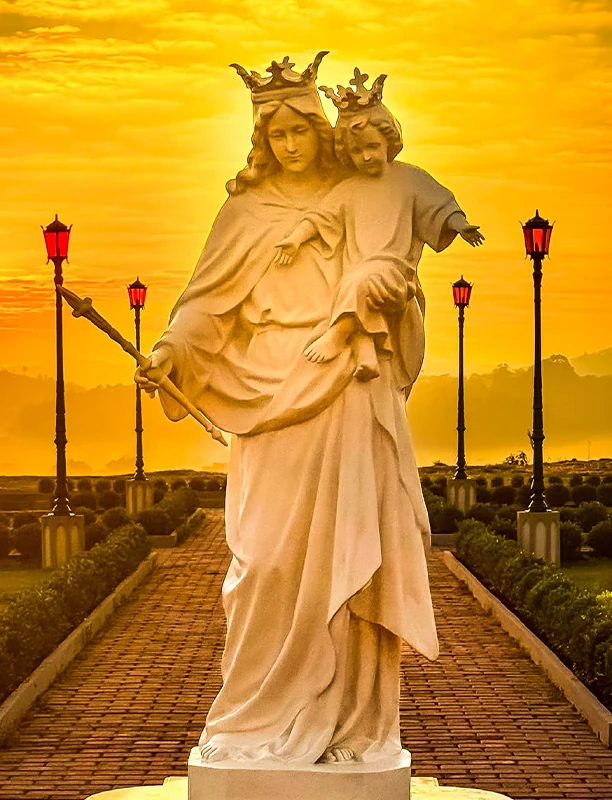 Help of Christians
 Christmas Carols







The frog transformed into a prince: this is one of the fables before which history makes obeisance, for in it the marvellous boldly unites with the real.
According to the Gaulish myth, when the barbarian King Clovis (c. 466-511) was about to wage a decisive battle, a hermit came to meet him bringing a message from Heaven.
An Angel ordered the monarch, as yet unbaptized, to replace his royal emblem – three frogs on a red background! – with a symbol that, from then on, would represent the king of the Franks: the fleur-de-lis.1
A question: was this modification to the royal standard strictly necessary to win the battle? Perhaps not. But the real question is another: could Clovis possibly have kept his frogs upon embracing the Catholic Faith?
From the answer that inevitably comes to baptized lips, it follows that the change made there was not a mere practical measure: it was above all a providential practical measure. In what sense?
The art of symbols
Much more than a simplified version of a lily’s outline, the fleur-de-lis is a symbol. And a symbol, by nature, associates two realities in the mind: the existing reality, such as a plant or an animal, and that which it represents.
Thus, one can speak of the purity of the lily or the royalty of the lion, not because they possess these characteristics in themselves, but because man discovers deeper meanings in them through analogy.
Dr. Plinio affirmed that “symbols are so important that God made the whole of creation in order to give mankind symbols that would lead them to love Him.”2
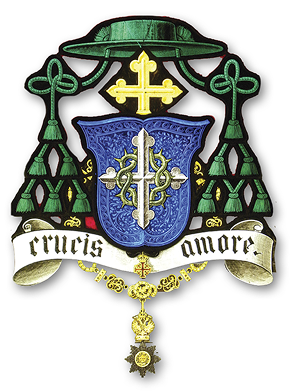
The art that makes use of symbolic emblems on coats of arms to represent people, lineages and even nations is called heraldry. It is a sort of catapult that propels us from the visible to the invisible, from tangible realities to higher considerations.
Even today, remnants of this forgotten art – present on national flags, on episcopal coats of arms and even in the logos of multinational companies – permeate our daily lives, spanning the centuries… For the origins of heraldry date back millennia.
From battlefields to palaces and corporations
Horses neighing, metals clashing, piercing cries of suffering or shouts of victory echoing across the plain… amidst the chaos of battle, it is essential to distinguish one’s allies and be easily recognized.
For this reason, medieval knights began to display certain figures on their garments and shields to identify themselves. The emblem was more visible on a shield, and these representations were christened with the name “coats of arms.”
Heraldry first made itself heard amidst the war cries and the anguish of agony…
The choice of figures and colours – which had a fundamentally practical purpose – brought with it the desire to portray the knight who bore them in the most striking way possible.
The lion, king of animals, also reigned supreme in heraldry at that time as the preferred figure, appearing in about fifteen percent of European coats of arms.3
And these, as time went on, came to represent not only the warrior, but also families, prelates, civil and religious communities…
Heraldry left the battlefields and sat by the hearths of homes, in episcopal palaces and, finally, in the offices of various corporations.
With the proliferation of coats of arms, disputes began – well into the 13th century – over the most beautiful and, therefore, most sought-after insignias. It was therefore necessary to establish certain rules for their creation.
Once the kings decided that those responsible for this work would be the heralds – officials of the medieval monarchies – this art became known as heraldry.
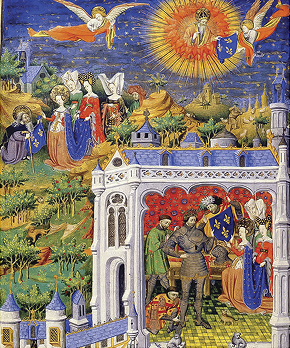
Bedford – British Library, London
Ten Million Coats of Arms
Over time, coats of arms permeated all social strata, from the royal court to the simplest artisans.
The Bellenville catalogue, dating from the 14th century, lists more than thirteen hundred significant shields from all over Europe. Between the 16th and 18th centuries, almost ten million have been identified!4
“Goodness is eminently diffusive” as the old adage affirms. Indeed, what “publicity” was used to spread heraldic shields throughout Europe?
It seems that their proliferation is simply due to the spirit of the marvellous and of “enmarvelability” of those people.
If our society – let it be said parenthetically – still had such a pursuit of sacredness and perfection, so characteristic of innocent souls, even in seemingly superfluous things, perhaps it would not have lost a certain joy and dignity that so characterized life in the past.
Unfortunately, even if “abuse does not prevent use,” it at least deteriorates it. Over time, heraldry became a platform for vanities, where nobles flaunted their lineages and boasted of their prowess. But there was no longer any space in it for the Omnipresent One…
Such was the shield crafted in the 19th century by Richard Plantagenet, Marquis of Chandos, composed of no less than seven hundred and nineteen quarterings, symbols of his ancestry.5
From the representations of the noble ideals of yesteryear, there was a shift to extravagance, which lost its deeper meaning in overstatement.
And today, does heraldry have any application?
The coat of arms of God
The winged lion, the double-headed eagle: these are two fascinating images that exist only in heraldry. However, there is a much more mythical and transcendent figure, and it was this one that God chose for Himself.
Some have tried to create an imaginary coat of arms that could belong to the Holy Trinity.6 But, many centuries before, the Lord Himself had already claimed His own emblem: the Cross.
“Catholics have taken the Cross,” emphasizes Dr Plinio,
as a sign of honour, as a symbol of all that is most sacred and holy. And here we can see three manifestations of the era of faith: the cross placed at the top of crowns; the cross as a heraldic symbol of the noblest honours bestowed upon families of the high aristocracy; and the cross used as the insignia for military decorations.7
Let us therefore, as proud defenders of the Faith, take up this divine coat of arms, from which hangs Jesus Christ Himself, like a standard with which He invested each of His disciples: “If any man would come after Me, let him deny himself and take up his cross daily and follow Me” (Lk 9:23).
– Church of the Immaculate Conception, Starý Smokovec (Slovakia)