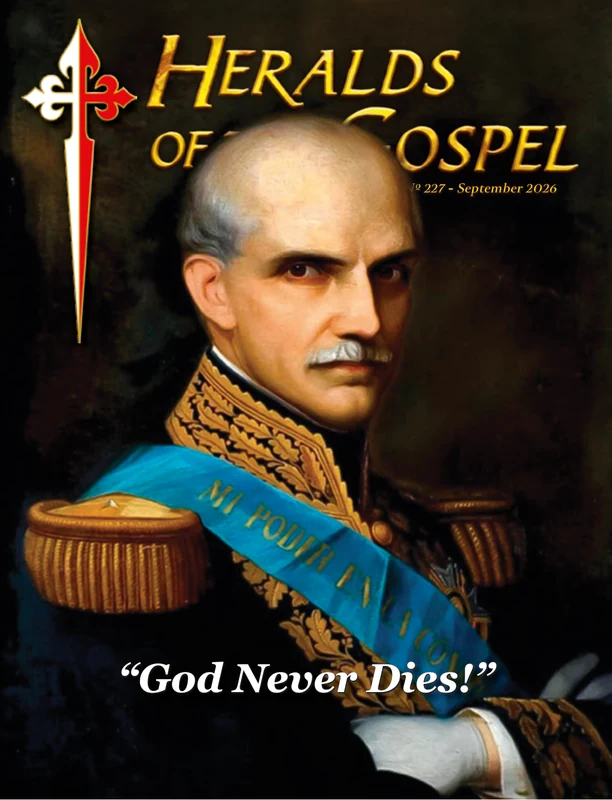
 Heralds of the Gospel Magazine, Vol. 20, nº 227, September 2026
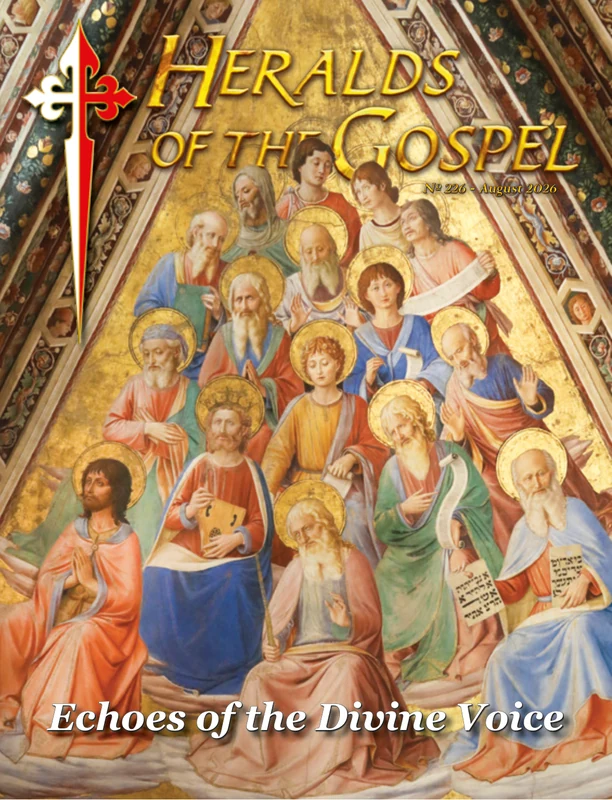 Heralds of the Gospel Magazine, Vol. 20, nº 226, August 2026
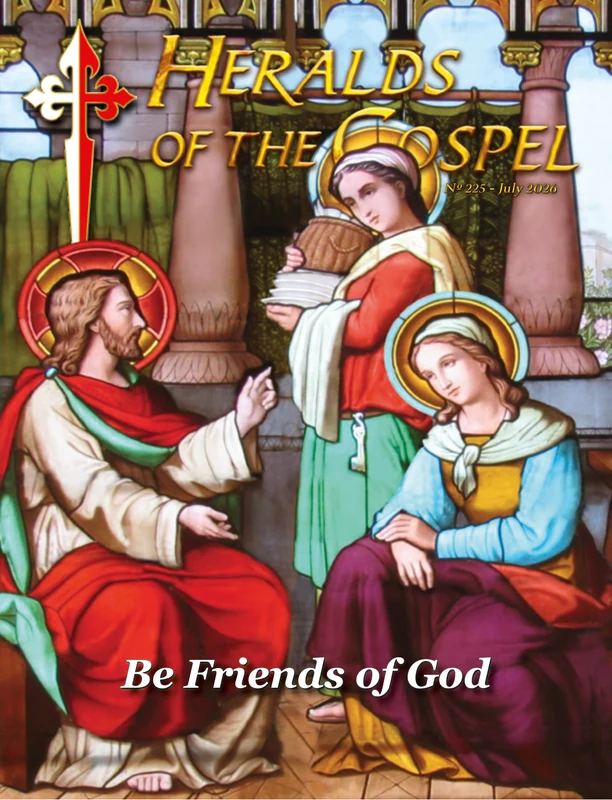 Heralds of the Gospel Magazine, Vol. 20, nº 225, July 2026
 Who are the Heralds of the Gospel?
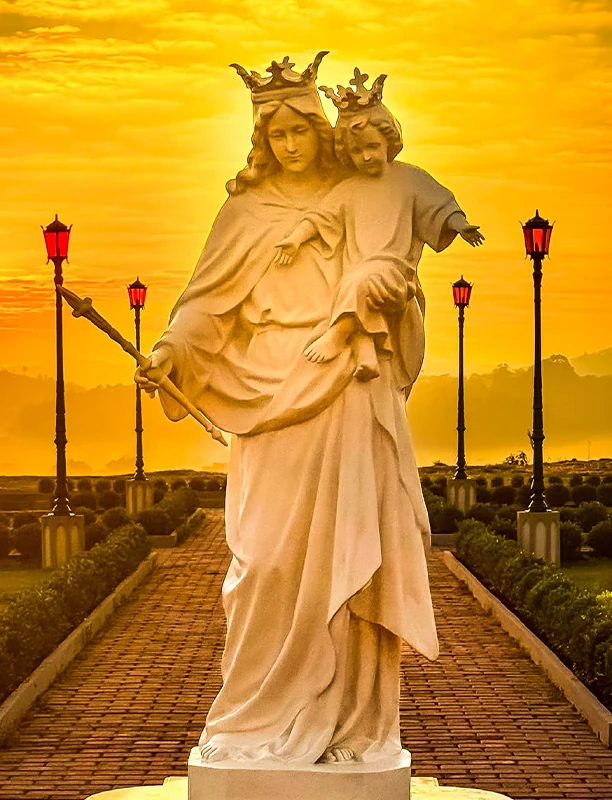 Help of Christians
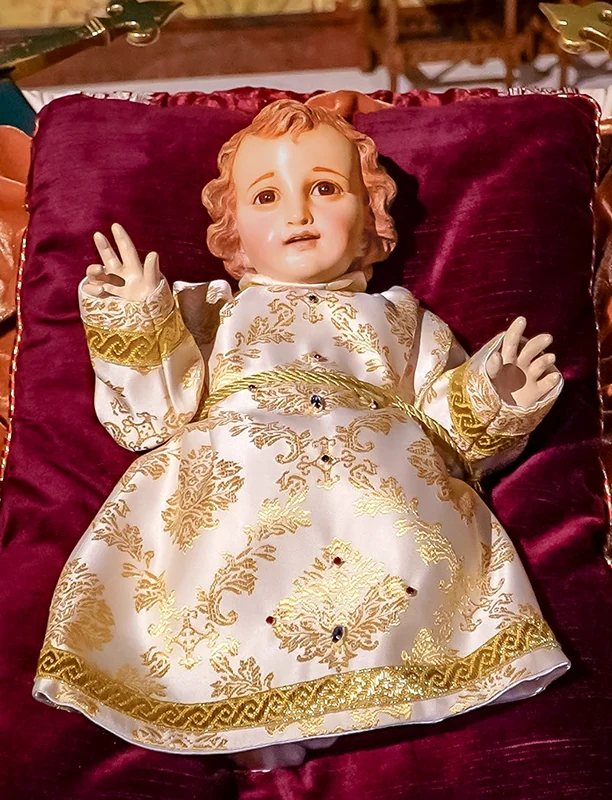 Christmas Carols
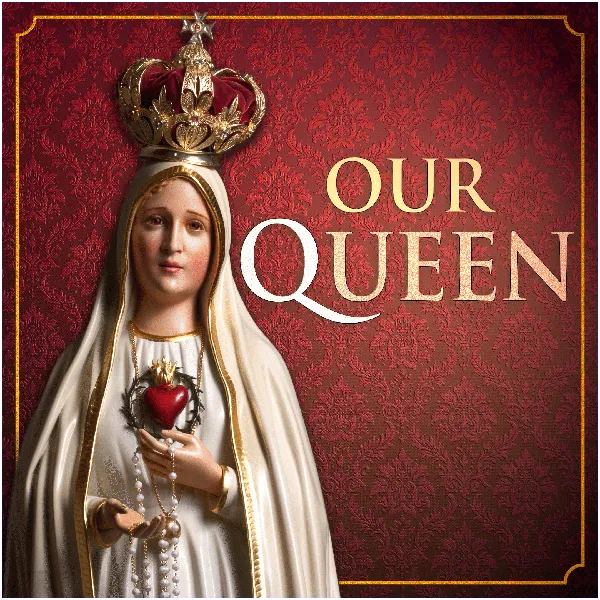







Gospel – 19th Sunday in Ordinary Time – Year B
41 The Jews murmured about Jesus because He said, “I am the bread that came down from Heaven,” 42 and they said, “Is this not Jesus, the son of Joseph? Do we not know His father and mother? Then how can He say, ‘I have come down from Heaven’?” 43 Jesus answered and said to them, “Stop murmuring among yourselves. 44 No one can come to Me unless the Father who sent Me draw him, and I will raise him on the last day. 45 It is written in the prophets: They shall all be taught by Gods. Everyone who listens to my Father and learns from Him comes to Me. 46 Not that anyone has seen the Father except the one who is from God; He has seen the Father. 47 Amen, amen, I say to you, whoever believes has eternal life. 48 I am the bread of life. 49 Your ancestors ate the manna in the desert, but they died; 50 this is the bread that comes down from Heaven so that one may eat it and not die. 51 I am the living bread that came down from Heaven; whoever eats this bread will live forever; and the bread that I will give is my Flesh for the life of the world” (Jn 6:41-51).
I – The Spirit and the Flesh are Antagonistic
The Gospel for this 19th Sunday in Ordinary Time, taken from the sixth chapter of St. John, brings us true wonders about the Eucharist. The revelation it contains was undoubtedly difficult for the people of those times, especially the carnal ones. Thanks to the flourishing of the Faith, in our day it sounds like the most beautiful music to the ears of Catholics who, despite the current crisis, believe with redoubled fidelity in the dogma of the Real and Substantial Presence of Jesus in the Sacred Host. It is interesting to note in this episode the contrast between the sublimity of the Divine Master’s teaching and the pragmatic reaction of His audience. It is the light of truth that shines amidst the darkness of mediocrity and cannot be overshadowed by it. However, two questions arise. The first is why Jesus decided to announce the Eucharist despite His listeners’ lack of openness, and the second is why they were so unprepared to hear this revelation. As we analyse today’s Gospel step by step, it will be possible to find the answers to these questions.The spiritual man and the earthly man
As a first step, we need to be clear about the distinction between those who are spiritual and those who are carnal (cf. 1 Cor 15:45-50). The spiritual live by faith and, guided by the Holy Spirit, they are docile to divine inspirations, accepting them even without immediately understanding; they thirst for elevation and love to soar like eagles. The carnal have their sights set low, like chickens, and relentlessly seek earthly happiness; as a result, they are self-interested and, when they retain some religious inclination, they use it badly, manipulating the supernatural in order to obtain a pleasant and secure existence, without the prospect of eternity.In this regard, St. Paul teaches us: “Do not be deceived; God is not mocked, for whatever a man sows, that he will also reap. For he who sows to his own flesh will from the flesh reap corruption; but he who sows to the Spirit will from the Spirit reap eternal life” (Gal 6:7-8). This means that the eternal end of these two categories of souls is drastically different. The first, orientated towards the Kingdom of Heaven, is willing to make every sacrifice in order to win the divine prize. The second, chained to the passions of this world, runs after illusory fruition, ending its sad days threatened by the spectre of infernal condemnation.There is a sharp contrast between the sublimity of the Divine Master’s teaching and the pragmatic reaction of those who hear it
II – An Invitation to True Life
Before revealing the marvellous mystery of the Eucharist, the Redeemer prepared His disciples and the crowd that followed Him through extraordinary wonders, which contained a pedagogical message of the utmost wisdom. Having crossed the Sea of Galilee, Our Lord climbed a mountain and there multiplied the loaves of bread for the five thousand men who accompanied Him, not counting women and children. After this impressive feat, “Perceiving then that they were about to come and take Him by force to make Him king, Jesus withdrew again to the mountain by himself” (Jn 6:15), thus refusing the crowd’s initiative. The disciples, for their part, left for the other shore of the lake. As they were in difficulty due to the headwinds, Our Lord appeared walking on the water and, by His power, their boat reached the shore in an instant. It is easy to imagine the astonishment that seized the Apostles, although the Evangelist does not explicitly mention it. The crowds, realizing that something enigmatic was afoot, for the disciples had left without the Master but He was nowhere to be found, went in search of Him. When they arrived in Capernaum and met Jesus, a lively dialogue took place:“When they found Him on the other side of the sea, they said to Him, ‘Rabbi, when did you come here?’ Jesus answered them, ‘Truly, truly, I say to you, you seek Me, not because you saw signs, but because you ate your fill of the loaves. Do not labour for the food which perishes, but for the food which endures to eternal life, which the Son of man will give to you; for on Him has God the Father set His seal’” (Jn 6:25-27). Our Lord’s solemn and frank rebuke reveals His keen discernment of these followers who pursued Him because they had been satiated after eating the loaves, and not for the supernatural character of the prodigy worked. This characterizes the “carnality” of these so-called disciples, many of whom would abandon the Master after the revelation of the Holy Eucharist. This is the context of today’s Gospel.Carnal men love concrete achievements that can serve their own interests, but they detest the flight of faith that forces them to forget themselves and rise to divine heights
An instinctive and fierce dislike
41 The Jews murmured about Jesus because He said, “I am the bread that came down from Heaven.”
Worshippers of banality
42 and they said, “Is this not Jesus, the son of Joseph? Do we not know His father and mother? Then how can He say, ‘I have come down from Heaven’?”
Nothing is more attractive
43 Jesus answered and said to them, “Stop murmuring among yourselves. 44 No one can come to Me unless the Father who sent Me draw him, and I will raise him on the last day.”

“Lord, I understand it, when a soul has allowed itself to be captivated by the intoxicating smell of your perfumes, it cannot run alone, all the souls it loves are drawn in its wake; it is done without constraint, without effort, it is a natural consequence of its attraction towards you.”1 And in even more lyrical tones, it is again St. Therese who explains: “‘No one,’ said Jesus, ‘can come after Me, unless my Father who sent Me draws him.’ Then by sublime parables, and often without even using this means so familiar to the people, He teaches us that it is enough to knock to open, to seek to find and to humbly stretch out the hand to receive what one asks… He says again that whatever one asks of His Father in His name, He grants it. This is no doubt why the Holy Spirit, before the birth of Jesus, dictated this prophetic prayer: ‘Draw me, we will run.’ “What is it then to ask to be Attracted, if not to unite oneself in an intimate way with the object which captivates the heart? If fire and iron had use of reason and the latter said to the other: Draw me, would he not prove that he wishes to identify himself with the fire so that it penetrates it and imbues it with its burning substance and seems to become one with it? Beloved mother, this is my prayer, I ask Jesus to draw me into the flames of His love, to unite me so closely to Him, that He may live and act in me. “I feel that the more the fire of love ignites my heart, the more I will say: Attract me, the more the souls who will approach me (poor little scrap of useless iron, if I move away from the divine brazier), the more these souls will run with speed at the scent of the perfumes of the Beloved, for a soul aflame with love cannot remain inactive; no doubt like St. Magdalen she stands at the feet of Jesus, she listens to His sweet and inflamed words. Seeming to give nothing, she gives much more than Martha who torments herself with many things and would like her sister to imitate her.”2Those who let themselves be drawn by Our Lord have hearts aflame with divine love, and becoming intimately united to God, they in turn draw other souls
The reward of faith
45 “It is written in the prophets: They shall all be taught by Gods. Everyone who listens to my Father and learns from Him comes to Me. 46 Not that anyone has seen the Father except the one who is from God; He has seen the Father.”
47 “Amen, amen, I say to you, whoever believes has eternal life.”
The sweetest words
48 “I am the bread of life.”

Remedy of immortality
49 “Your ancestors ate the manna in the desert, but they died; 50 this is the bread that comes down from Heaven so that one may eat it and not die. 51a I am the living bread that came down from Heaven; whoever eats this bread will live forever;”
“Christus passus”
51b “and the bread that I will give is my Flesh for the life of the world.”
If all the delights of this world are nothing but a futile shadow compared to the happiness of knowing ourselves to be rewarded with the infinitely valuable gift of the Eucharist, it is also a duty to remember what blood it cost Our Lord to grant us this gift of himself, making himself present in the Sacred Host in a real and substantial way. In this sense, it is worth delving into the meaning of the statement contained in the above verse. It tells us that the Sacrament of love would be directly and inseparably related to the holocaust of Jesus on the Cross, with which Our Lady was associated in the capacity of Co-redemptrix. When dealing with the Eucharist, St. Thomas3 repeatedly recalls that in this mystery lies Christus passus, Christ in His Passion. Thus, the sublime Bread of the Angels, which fills our hearts with consolation, is Jesus given up for each one of us, put to death for each one, resurrected for each one. Let us ask Our Lady for supernatural sensitivity, a spirit of faith and a flame of love in order to give due value to this unsurpassable gift that consists of receiving the Body and Blood of the Lord!In His infinite goodness, the Word of God Incarnate wanted to become our food, in a gesture of love and friendship that surpasses the limits of the marvellous
III – Let us Live from the Eucharist!
Among the wonders of God, the Holy Eucharist occupies a pinnacle position. It is the most sublime mystery of love, which elevates the human heart to the heights of faith, filling it with flames of charity. However, to reach such heights we must cooperate with the gentle and at the same time powerful attraction of the Father, which is directed to all men, although some manage to reject it. Carnal men become insensitive and immovable in relation to God’s attraction because they are attached to the things of the earth. Their spirits are mediocre, addicted to the triviality of everyday routine, anchored in the fleeting enjoyments of this life. At best, they are false devotees, as they seek divine help in a spurious way, with a view to realizing their ambitions or satisfying their animalistic instincts. Part of that number were Jesus’ listeners in that sublime speech on the shores of the Sea of Galilee and, for this reason, they rejected His words.Spiritual men, in turn, fly like eagles. They make Heaven their goal; they want above all things to please God, and only Him. That is why they allow themselves to be drawn by the Father of lights and they rejoice in being bathed in His glow. This class of souls easily adheres to the truths of Faith, even the highest ones, loving them with all their being. This glorious cohort of God’s children lives from the Eucharist and worships it frequently, participates in the Holy Sacrifice with assiduity, approaching Communion full of fervour. They are men and women who are full of faith, willing to make every sacrifice in order to see the Lord triumph over His enemies. And it was their blessed number that the Divine Master had prophetically in view when revealing the mystery of His Real Presence in the species of bread and wine.Let us be spiritual men, letting the Father draw us and living from the Eucharist; then we will be in the number of souls who will reign with Christ forever

Notes
1 ST. THERESE OF LISIEUX. Manuscript C, 33v-34r. In: Œuvres Complètes. Cerf-Desclée de Brouwer, 2023, p.280-281.
2 Idem, 35v-36r, p.283-284.
3 Cf. ST. THOMAS AQUINAS. Summa Theologiæ. III, q.66, a.9, ad 5; q.73, a.3, ad 3; a.5, ad 2; a.6; q.75, a.1; Super Ioannem, c VI, lect.6, n.7; Super Sententiis. L IV, d.8, q.1, a.2, s.2, c.