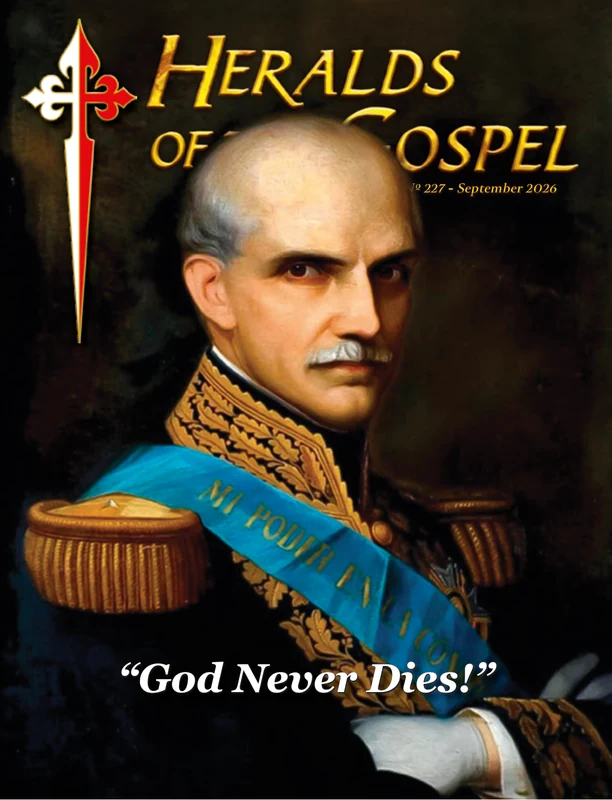
 Heralds of the Gospel Magazine, Vol. 20, nº 227, September 2026
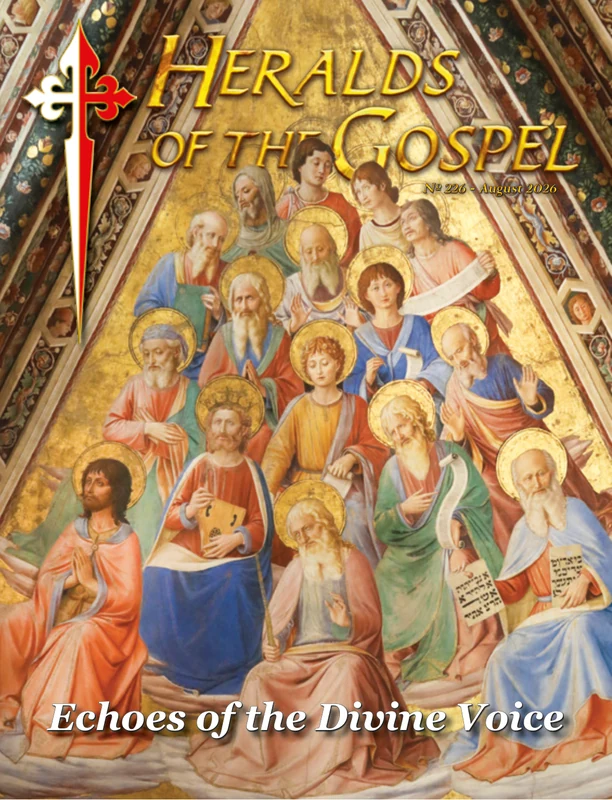 Heralds of the Gospel Magazine, Vol. 20, nº 226, August 2026
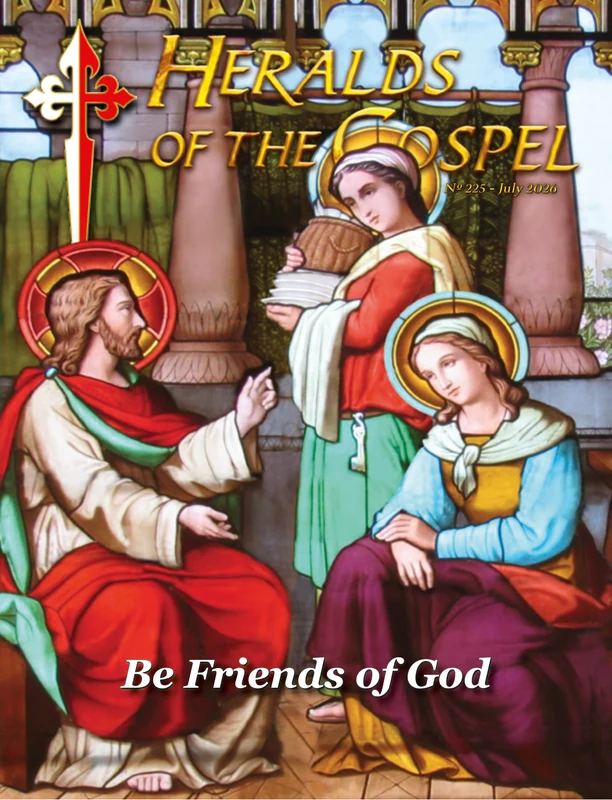 Heralds of the Gospel Magazine, Vol. 20, nº 225, July 2026
 Who are the Heralds of the Gospel?
 Help of Christians
 Christmas Carols







The Communion of Saints, in holy things
The expression Communion of Saints is best understood when considered in two distinct senses: communion in holy things, sancta; and communion among holy people, sancti. In most Eastern liturgies, while presenting the offerings, the celebrant recites: “Sancta sanctis! – “God’s holy gifts for God’s holy people.” “The faithful (sancti) are fed by Christ’s Holy Body and Blood (sancta) to grow in the communion of the Holy Spirit (koinonia) and to communicate it to the world.”2 The first meaning of the word communion that comes to mind is undoubtedly that which refers to the Eucharist. However, the term koinonia has, since ancient times, signified the intimate union of bishops with the faithful, of bishops among themselves, and likewise of the faithful among themselves. To expressing the union of people with this word was to recognize a single vital unity that bound them,3 like the divine sap that gives vigour to all branches. The letters of the Apostle St. Paul undoubtedly play an enlightening role in explaining this dogma, for, based on his masterfully taught doctrine of the Mystical Body of Christ (cf. 1 Cor 12:12-14), he brought a certain degree of clarity to a theme that nevertheless remains a mystery. “For no man ever hates his own flesh, but nourishes and cherishes it, as Christ does the church, because we are members of His body” (Eph 5:29-30). Under the same Head, who is Our Lord, we all form one Body, one Church, whether triumphant, suffering, or militant. Now, “the condition of the saints differs from ours, it is true, but just as the condition of one member of the same body differs from that of another member.”4 Therefore, since we constitute the one and the same supernatural organism, “the good of some is communicated to others. And so, among other things that the Apostles taught us, we must believe that there is a communion of goods in the Church,”5 through which Christ gives us life.Heaven and earth under the same “roof”
Communion with the blessed in eternity arises from a natural manifestation of the Catholic heart. The honour we devote to them has been propagated in the Church since its inception, for we are sure that “they know our needs better than we do, and before our prayer reaches them, God has prepared them to hear and answer it.”6 Because they are more united to the Divine Word, the saints “establish the whole Church more firmly in holiness, lend nobility to the worship which the Church offers to God here on earth and in many ways contribute to its greater edification.”7 This rule applies, a fortiori, to the Virgin Mary, who is both the Mother of Christ and a most eminent member of His Mystical Body. “She is the living memory of Jesus and, as such, she is the centre of attention that harmonizes differences and ensures the unity of the disciples’ prayer.”8 Also, prayer for the souls of the departed who are still being purified in the blessed flames of Purgatory, comes from an ancient tradition, as the Second Book of Maccabees attests: “it was a holy and pious thought. Therefore he made atonement for the dead, that they might be delivered from their sin” (12:46). Now that it is clear with whom we share such wonders, it remains to be seen of what these common goods actually consist.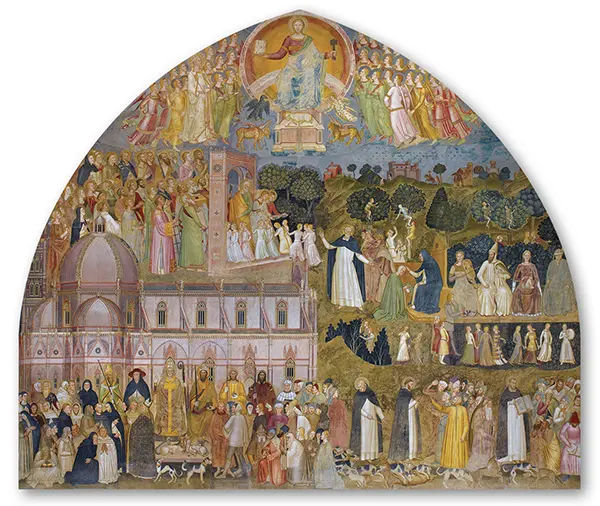 It can be said that “the Communion of Saints is the Church,” to such an extent that both realities are identical.
“The way of salvation”, by Andrea de Bonaiuto - Basilica of Santa Maria Novella, Florence (Italy)
Infinite treasure within reach of all
It can be said that “the Communion of Saints is the Church,”9 to such an extent that both realities are identical. Thus, the very faith received from the Apostles, “a treasure of life which is enriched by being shared,”10 holds within itself the richness made available to every baptized person. In the communication of this faith, we find invaluable and countless gifts at our disposal. Among these, the Sacraments are paramount, tangible signs of grace that allow us to participate intimately in divine life, and especially Baptism, the gateway through which we enter the Church. Although it is more appropriate to the Eucharist, since it is in it that our union with the Redeemer is consummated, the term communion can be applied to each of the other Sacraments, since they all lead us to Christ. Concomitant with the flow of sacramental graces, “the Holy Spirit ‘distributes special graces among the faithful of every rank’ for the building up of the Church.”11 The new spiritualities that have emerged over the centuries, not without the healthy influence of local customs and traditions, “share in the living tradition of prayer and are essential guides for the faithful. In their rich diversity they are refractions of the one pure light of the Holy Spirit.”12 It is in this diversity that the Church manifests herself to be even more beautifully and enriched, for “to each is given the manifestation of the Spirit for the common good” (1 Cor 12:7).Communion in charity
Our actions, moreover, even those considered insignificant, when performed in charity, benefit the baptized. “For all of us, who are sons of God and constitute one family in Christ, as long as we remain in communion with one another in mutual charity and in one praise of the most holy Trinity, are corresponding with the intimate vocation of the Church,”13 for “none of us lives to himself, and none of us dies to himself” (Rom 14:7). Indeed, holy actions, small sacrifices well accepted, and duties of state carried out seriously constitute in the Church’s treasury a vast, varied, and incalculable treasure for the benefit of souls. It is with wisdom that this Mother carefully guards in her sacred vault the legacy of the saints, their virtues and works, remembering them “at the appropriate time, as salutary examples, as eloquent protests against the dire tendencies of certain situations and times.”14 Thus, by the exemplary life of the righteous “we are shown a most safe path by which among the vicissitudes of this world, in keeping with the state in life and condition proper to each of us, we will be able to arrive at perfect union with Christ, that is, perfect holiness.”15 By practising good works, we further accumulate merits in Heaven which – in addition to atoning for our debts to God’s justice – can be communicated by Divine Providence to our neighbours for the benefit of their souls, even though this escapes our knowledge. It is in this way that we become “fruitful with the fruitfulness of Mary and of the Church.”16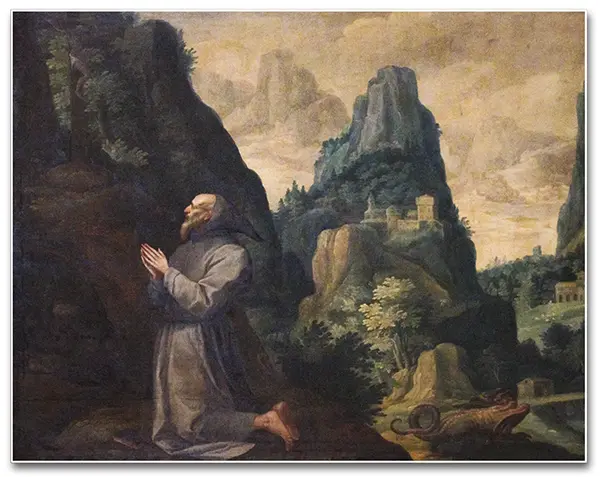 One virtuous soul elevates the entire Mystical Body, and the exemplary life of the righteous teaches us a safe path leading to perfect union with Christ
Scene from the life of a hermit, by Paul Bril
God is pleased with mediations
Since the Church Militant relies on the Saviour’s promise that we will be heard when we ask the Father in His name (cf. Jn 14:13-14), the infallible power of prayer profoundly influences the relationship between the members of the Mystical Body of Christ. Fr. Monsabré recounts that a priest, after converting a large number of people, supposedly by virtue of his gifts of oratory, withdrew to pray, and then “God showed him the poor little lay brother who accompanied him on his missions and who, during his sermons, piously recited the Rosary and the litanies of the saints. It was he who moved Heaven to obtain the conversion of sinners; it was the Communion of Saints that, through this unknown and perhaps despised man, obtained the circulation of the extraordinary graces attributed to the apostolic zeal and eloquence of the preacher.”19 Another illuminating example of intercession is the case of Henri Pranzini, a terrible murderer from the late 19th century, whose good fortune it was to enjoy the compassion of St. Therese of the Child Jesus when she was still a young girl. He was condemned to die by guillotine for his crimes, but he irrevocably refused to bow before the Holy Tribunal of Confession. Therese, already well aware of the infinite mercy of the Heart of Jesus, insistently commended this poor soul to the Divine Redeemer: “Feeling that of myself I could do nothing, I offered to God all the infinite merits of Our Lord, the treasures of the Church, and finally I begged Céline to have a Mass offered for my intentions. I didn’t dare ask this myself for fear of being obliged to say it was for Pranzini, the great criminal.”20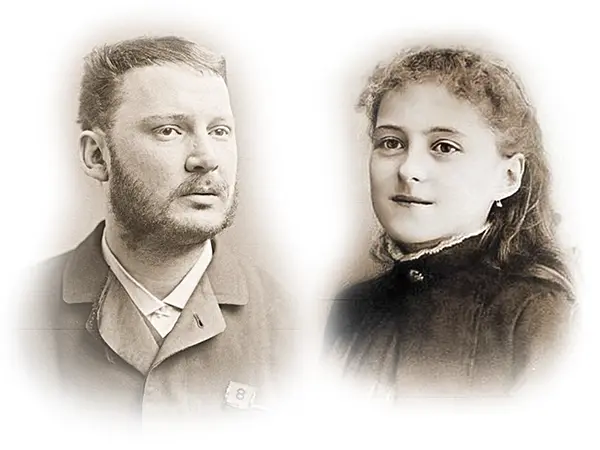 Supplicant prayer is capable of winning divine intervention, for the good of one soul or of the entire Church
At the left, a photograph of the murderer Henri Pranzini taken in March of 1887; at the right, St. Therese in 1986
Notes
1 Cf. VILAPLANA MOLINA, Antonio. La Comunión de los Santos. Madrid: BAC, 1985, p.12.
2 CCC 948.
3 Cf. HERTLING, L. Communio. Chiesa e papato nella antichità cristiana, apud FERNÁNDEZ, Aurelio. Teología Dogmática. Curso fundamental de la Fe Católica. Madrid: BAC, 2009, p.672.
4 MONSABRÉ, OP, Jacques-Marie-Louis. La Communion des Saints. In: Exposition du Dogme Catholique. Gouvernement de Jésus-Christ. 10.ed. Paris: P. Lethielleux, 1882, p.307.
5 ST. THOMAS AQUINAS. In Symbolum Apostolorum, a.10.
6 MONSABRÉ, op. cit., p.310.
7 SECOND VATICAN COUNCIL. Lumen gentium, n.49.
8 LEO XIV. Homily, 9/6/2025.
9 CCC 946.
10 CCC 949.
11 CCC 951.
12 CCC 2684.
13 SECOND VATICAN COUNCIL, op. cit., n.51.
14 MONSABRÉ, op. cit., p.321.
15 SECOND VATICAN COUNCIL, op. cit., n.50.
16 LEO XIV, op. cit.
17 PIUS XII. Mystici Corporis Christi, n.44.
18 ST. JOHN PAUL II. Reconciliatio et pænitentia, n.16.
19 MONSABRÉ, op. cit., p.327.
20 ST. THERESE OF LISIEUX. Manuscrit A. La gräce de Noël. In: Œuvres Completes. Paris: Cerf; Desclée De Brouwer, 2006, p.143.