 Heralds of the Gospel Magazine, Vol. 20, nº 227, September 2026
 Heralds of the Gospel Magazine, Vol. 20, nº 226, August 2026
 Heralds of the Gospel Magazine, Vol. 20, nº 225, July 2026
 Who are the Heralds of the Gospel?
 Help of Christians
 Christmas Carols









Physical activity has an important place in the upbringing of children, since they need to expend their natural energy by running, jumping and playing.
We have seen how Dona Lucilia strove to stimulate the aptitudes of her children so that vulgarity would not gain entrance to their souls, not even in day-to-day activities, such as outdoor childhood games.
Germanically healthful outings…
It was almost always the Fräulein Mathilde Heldmann, the German governess of Plinio and Rosée, who took them on outings to Antarctica Park and Luz Gardens.
With methodical, Germanic precision she would oblige the boy to get his exercise, for he was not much given to physical effort.
Plinio would run just long enough to avoid trouble with her and then go back to amusing himself after his own fashion, contemplating the beautiful colouring of carefree butterflies fluttering in the sunlight amid the trees and the like.
Sometimes Dona Lucilia had the children accompany her when she visited the mineral water springs at Águas da Prata resort in the state of São Paulo which were highly recommended for alleviating liver problems.
Not even there did the Fräulein neglect the outings. In fact, she was so zealous about them that Dona Lucilia became a little anxious.
But hearing the Fräulein extol the benefits of these excursions she finally gave in, while not entirely convinced the children would not overtax themselves.
Such an idea never crossed the dedicated German’s mind. Taking the little ones by the hand, she would briskly set off to climb the surrounding hills, convinced that a good hike in the pure mountain air could only benefit her pupils’ health.
With motherly affection, Dona Lucilia sought to compensate the children for their efforts when, at times, they showed but meagre enthusiasm for their walks.
Therefore, stays in Águas da Prata were not devoid of pastimes to their liking – the first of which was being in their mother’s company. And this took on a special attraction when she read aloud the stories of Bécassine.
Bécassine, in Águas da Prata
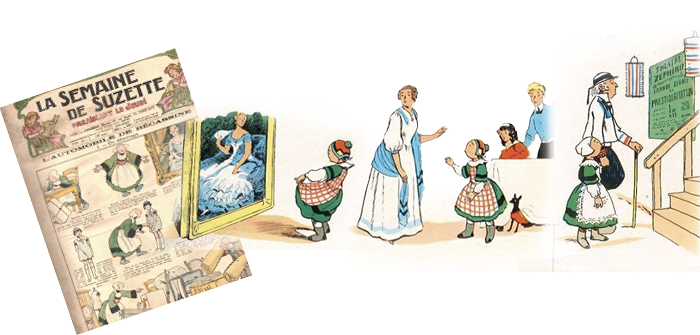
To provide Rosée with good reading material, Dona Lucilia bought her a subscription to a French children’s magazine, La Semaine de Suzette.
It featured a series of stories of Bécassine, a quaint and ingenuous Breton peasant girl, gifted with little intelligence but lots of common sense.
The stories had a host of characters, representative of several human types of French society of the time.
One of the most interesting was Madame la Marquise de Grand Air, the mistress of a beautiful château in Brittany, whom Bécassine served as a devoted housemaid from early youth.
Another prominent figure was Bécassine’s affable uncle Corentin, a typical “notable” of the hamlet of Clocher-les-Bécasses.
The stories were narrated by means of coloured drawings in little boxes, accompanied by the text, which made them highly appealing to the children.
These cartoons, attributed to the spirited Commandant Pinchon, were so successful that French sociologists affirm their value as scientific documents today.
But Dona Lucilia’s young listeners mostly cherished the comments with which she punctuated the reading – in French of course, since she held that this should be the second language of every cultivated person.
With her fine-tuned psychological sense, she praised certain attitudes the characters took, drawing a moral from them. She explained French customs and etiquette so that her children would gradually learn how to live in society.
Enjoyable hours spent together
Maternal love is boundless, and Dona Lucilia never thought that she dedicated too much time to instructing her children, even to the detriment of her own comfort.
During the first stays in Águas da Prata, Dona Lucilia and her family occupied three adjoining rooms at the Costa Hotel.
Life at this isolated thermal resort in the countryside of the State of São Paulo differed from life in the capital, especially for the children. They had fewer lessons and assignments from the Fräulein and more time to be with Dona Lucilia.
The small city, not far from Poços de Caldas (“Hot Spring Wells”), seemed lost in the pastoral expanse.
The hotel was a charming and traditional establishment, but old and somewhat poorly designed, for passers-by on the street could easily see into the rooms, since the windows were quite low.
For this reason, Dona Lucilia, who had to rest frequently because of her liver pains, kept the shutters closed.
In the afternoon, after their nap, the children would go to their mother’s room. The room was dim, with only shafts of light filtering through the shutters.
They opened the door quietly, came in and turned on the bedside lamp. One of them snuggled close to Dona Lucilia, and with an arm over the pillow and La Semaine de Suzette in hand, asked:
“Mama dear, can we talk about Bécassine?”
The delightful hours spent in this way would be forever treasured by the children. The light slowly receded from the shutters giving way to nightfall. Never once did Dona Lucilia hint to the children that they had come at a bad time or that she was tired.
Redoubled expressions of affection
Once the roles were reversed; Plinio fell ill in Águas da Prata and had to take to bed.
Every afternoon, Dona Lucilia went to her son’s room with a copy of Bécassine in her hand. Seated by his side she would pass the time, describing the adventures of the picturesque Breton peasant.
As her delicate fingers leafed through the pages, the boy drank in her gilded descriptions.
Despite his mother’s doting care, the boy did not improve. He came down with a sore throat, then a rash. The doctor did not know what to make of it.
Dona Lucilia redoubled her loving attentions, staying by Plinio’s side almost the entire time, striving to make the hours pass by more pleasantly for him.
There is no doubt that her agreeable companionship sped up the hands of the clock during ten unforgettable days.
This paradisiacal arrangement, however, came to an abrupt end when Dr. João Paulo – despite Dona Lucilia’s fears – opted for drastic measures.
He wrapped the boy in blankets and boarded a train for São Paulo with the family. When they disembarked at Luz Station the sickness had disappeared as if by magic.