 Heralds of the Gospel Magazine, Vol. 20, nº 227, September 2026
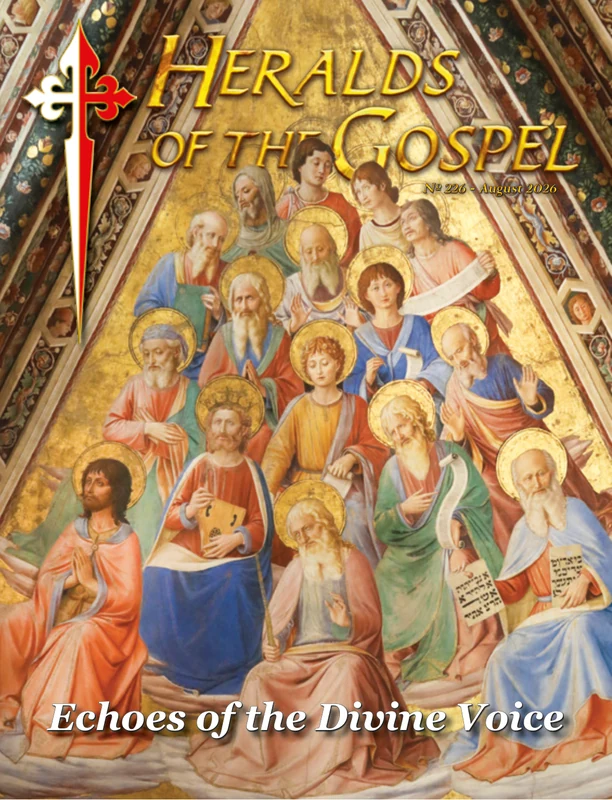 Heralds of the Gospel Magazine, Vol. 20, nº 226, August 2026
 Heralds of the Gospel Magazine, Vol. 20, nº 225, July 2026
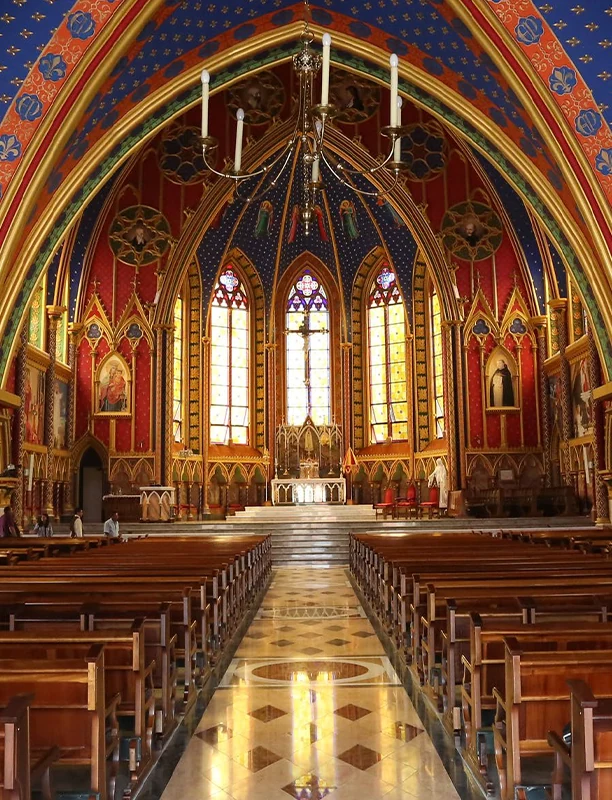 Who are the Heralds of the Gospel?
 Help of Christians
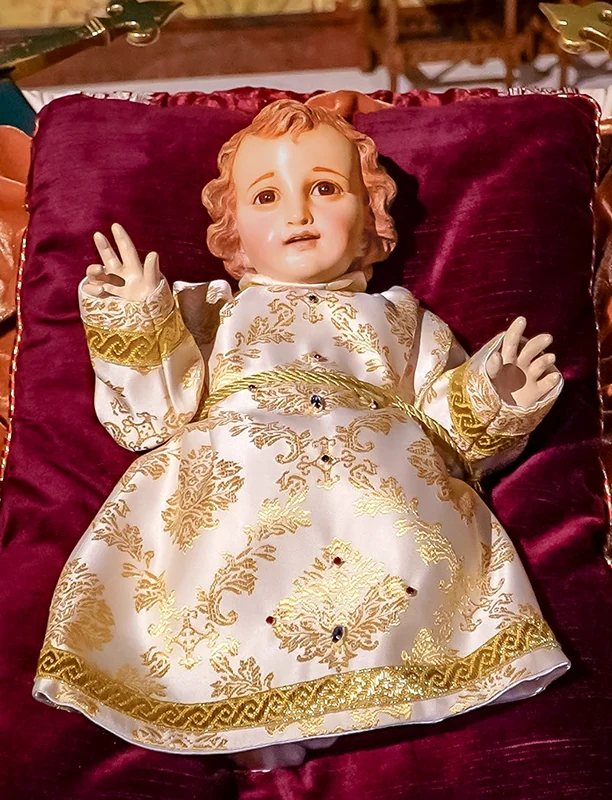 Christmas Carols









A great saint, due to love
Unlike other saints throughout the history of the Church, she was not a soul favoured with ecstasies, visions or brilliant and unprecedented heavenly communications. There is no denying the mystical graces that Providence granted her, such as Our Lady’s smile, her dream of Blessed Anne of St. Bartholomew and, finally, the last grace of her life, a visible supernatural rapture before she breathed her last. However, apart from these exceptional occasions, St. Therese’s holiness was manifested in her daily life. What made her eminent was not revelations, penances or miracles, but love. This was her vocation! Her words were kept and passed on to the faithful thanks to the intuition that some of those around her had that, even in ordinary life, Therese was not just any soul. Her captivating simplicity showed a singular call from God. And they were not wrong! To this day, her writings and utterances have been a source of grace for an incalculable number of people and will continue to be so, I am sure, until the end of time.A jovial and lively character
The statements made in the final months of her short life were important. The fullness at which Therese had arrived shines through. Of the various “little panes” that make up the stained glass window of the personality of the Saint of Lisieux manifested in this last period, one stands out in particular: her joy, which was profound and contagious! How could someone suffering from a painful and deadly illness, immersed in terrible temptations against faith, manage to spread so much happiness around her? Good humour was part of her character. From an early age, even in the midst of the crisis of scruples she suffered as a child, she knew how to maintain a serene countenance, communicate well-being to others and even utter comical remarks! The autobiographical writing known as Manuscript A, prepared between 1895 and 1896, contains stories of this kind, and even the letters written in Carmel can provoke joyful laughter. I cannot resist quoting one of them. In March 1897, she wrote to a priest, her spiritual brother, who was in China at the time. He had told her about picturesque aspects of his mission; she, continuing and even extending the jocular tone, also recounted a sui generis event that took place under the roof where she lived: “Would you believe that sometimes in Carmel we also have fun adventures? The Carmel, like Su-Tchuen, is a foreign land in the world, where some of the most basic customs are lost; here is a small example. A charitable person recently gave us a small well-bound lobster in a basket. Without a doubt, it had been a long time since this marvel had been seen in the monastery. Nevertheless, our good cook Sister remembered that it was necessary to put the little beast in the water to cook it; she did so with a groan at being forced to inflict such cruelty on an innocent creature. The innocent creature seemed asleep and let itself be handled at will; but as soon as it felt the heat, its gentle nature changed to fury, and aware of its innocence, it asked no one’s permission to jump into the middle of the kitchen, for its charitable executioner had not put a lid on the pot. “Immediately the poor Sister armed herself with tongs and ran after the lobster which made desperate leaps. The fight continued for quite some time until, finally weary of the struggle, the cook, still armed with her tongs, comes in tears to find our Mother and tells her that the lobster is possessed. Her face said even more than her words. (Poor little creature so sweet, so innocent just a moment ago, and now you are bedevilled! Truly, one must not put stock in the compliments of creatures!) Our Mother could not help laughing while listening to the declarations of the severe judge who demanded justice. She immediately went to the kitchen, took the lobster which, having not made a vow of obedience, put up some resistance, and after placing it back into its prison, she left, but after having closed the door, that is to say the lid. “In the evening at recreation, the whole community was brought to tears from laughter at the devilish little lobster and the next day everyone was able to sample a morsel. The person who wanted to treat us was successful, because the famous lobster or rather its story will serve us more than once as a feast, not in the refectory, but at recreation. My little story may not seem very amusing to you, but I can assure you that if you had witnessed the scene, you would not have been able to keep a straight face.”1Humorous words that radiate sanctity
The most impressive thing is that this lively and mischievous side of St. Therese was not lost on the way to her death; on the bed of the infirmary, on her way to the grave, it often shone: “She amuses herself by telling us everything that will happen after her death. The way she tells us about it makes us laugh when we should be crying, she’s so funny,”2 commented her cousin Sr. Marie of the Eucharist. The Carmelite community of Lisieux in 1895; inset, St. Therese
 While a novice, in 1889, embracing the cross in the cloister of the Carmel of Lisieux
Where did so much joy come from?
We would not finish this article profitably if we only transcribed the witticisms of the Saint of Lisieux. In order to draw lasting benefit from them, we should meditate on the source of this incredible ability to live joyfully in the midst of the greatest tortures of soul and body. Firstly, she wanted no one to be upset by her sufferings and future absence. Surely what pained her most was to see those she loved suffer; and, wanting to spare them this, she brought out enough happiness in herself to be able to spread it to them and console their sorrows: “When I can, I do my utmost to be joyful, to transmit joy.”14 But let us not dare doubt, as Mother Agnes of Jesus once did, St. Therese’s sincerity: “It is so as not to make us sad that you look like that and say funny words, isn’t it?” A categorical answer dispelled the erroneous judgement: “I always act without pretence.”15 Another reason for her joy can be glimpsed in Therese’s own statements: “The Good Lord has always made me want what He wanted to give me.”16 The graces she received throughout her life inspired her to long to be consumed in Love, together with a deep presentiment that she would die young. And tuberculosis was the clearest proof that she was being heeded: “It is unbelievable how all my hopes have been realized.”17 Therefore, the good humour she showed in the midst of her approaching death was, in short, the song of a soul grateful for the faithfulness of her Lord and Father. A lesson given at the beginning of her convalescence is valuable: “I always see the good side of things. Some people take everything in such a way as to suffer as much as possible. As for me, it is the opposite. If I am in the most pure suffering, if the sky is so dark that I cannot see any light, so be it… Then I make of this my joy.”18 Photograph taken in 1896
A mission about to begin
Finally, her happiness also consisted of glimpsing, amid the fog of trial, her coming mission, the shower of roses forming on the horizon: “Only one expectation makes my heart beat: the love that I will receive and that I will be able to give. And then I think of all the good I would like to do after my death: baptising children, helping priests, missionaries, the entire Church”; “My mission is about to begin, my mission to make the Good Lord loved as I love Him, to give my little way to souls. If the Good Lord fulfils my wishes, I will spend my Heaven on earth until the end of time. Yes, I want to spend my Heaven doing good upon earth. […] My heart thrills at the thought…”20 May each of us, still pilgrims on earth, turn to St. Therese of the Child Jesus! Let us raise confident supplications to her and a shower of roses will be poured out upon us. I dare assure you that in this way we will be helping her to fulfil her lofty mission and increase her joy in Paradise, the same joy that we are called to enjoy one day in her company. ◊Notes
1 Letter 221. To Fr. Roulland, 19/3/1897. The text of this letter and the words of St. Therese collected in the Últimos colóquios, quoted in this article, have been transcribed from: ST. THERESE OF THE CHILD JESUS AND THE HOLY FACE. Obras Completas. 2.ed. São Paulo: Paulus, 2021.
2 GAUCHER, Guy. A paixão de Teresa de Lisieux. 4.ed. São Paulo: Loyola, 1998, p.130.
3 Últimos colóquios. Caderno amarelo, May 7, n.3.
4 Idem, Therese to Celine, July, n.2.
5 Idem, August 4, n.3.
6 Idem, To Marie of the Sacred Heart, June 9, n.4.
7 Idem, Caderno amarelo, July 6, n.3.
8 Idem, To Marie of the Sacred Heart, July 8, n.4.
9 St. Therese never liked milk, for she felt ill when she drank it.
10 GAUCHER, op. cit., p.134.
11 Últimos colóquios. Caderno amarelo, July 8, n.17.
12 Idem, August 27, n.2.
13 Idem, September 24, n.5.
14 Idem, September 6, n.2.
15 Idem, July 13, n.7.
16 Idem, n.15.
17 Idem, August 31, n.9.
18 Idem, May 27, n.6.
19 Idem, August 29, n.2; August 30, n.2.
20 Idem, July 13, n.17; July 17.