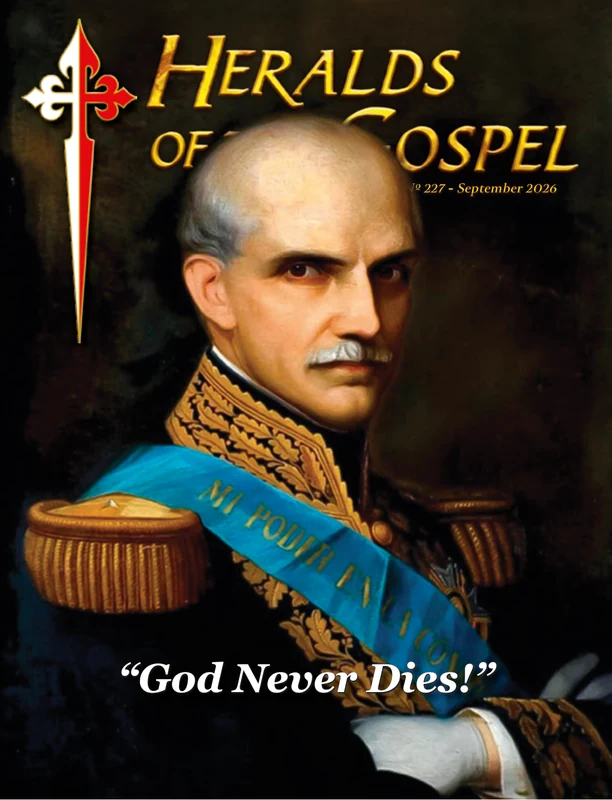
 Heralds of the Gospel Magazine, Vol. 20, nº 227, September 2026
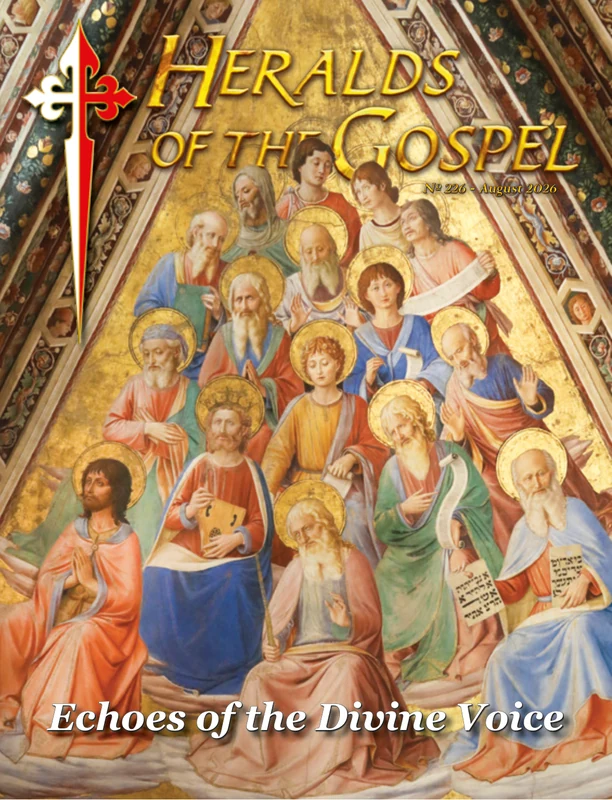 Heralds of the Gospel Magazine, Vol. 20, nº 226, August 2026
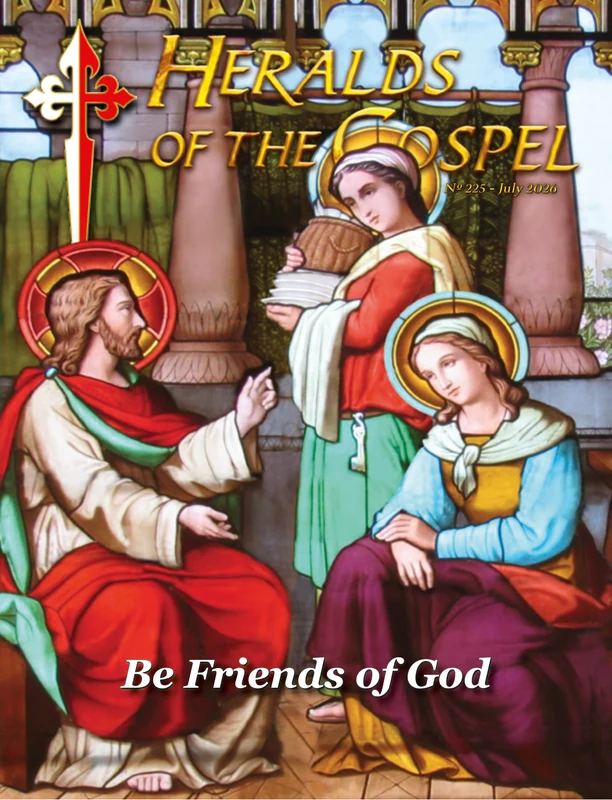 Heralds of the Gospel Magazine, Vol. 20, nº 225, July 2026
 Who are the Heralds of the Gospel?
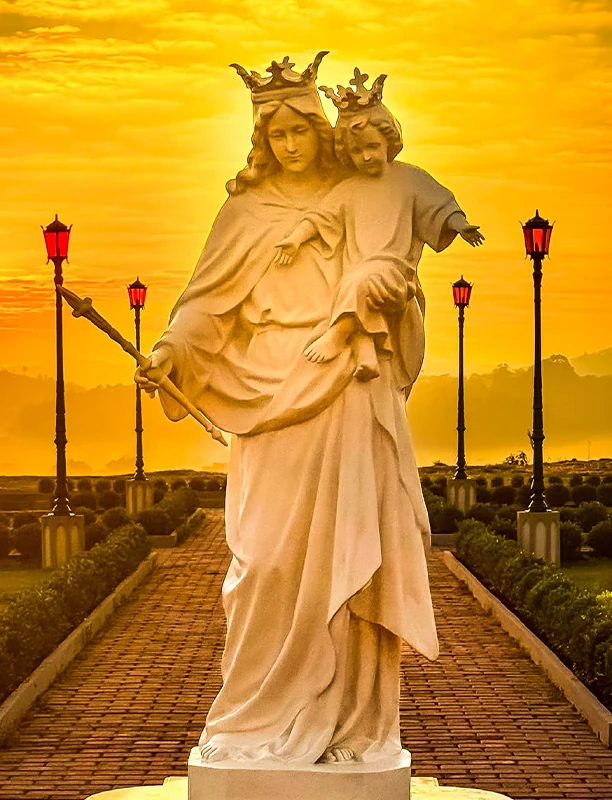 Help of Christians
 Christmas Carols





Fidelity from the beginning
Antonio Ghislieri was born in Bosco, a town in northern Italy, on January 17, 1504. At the age of fourteen he entered the Order of Preachers under the name of Friar Michael, and was ordained a priest at the age of twenty-four. He was elected prior of several different Dominican monasteries over the years, among them those of Vigevano, Soncino and Alba. As superior, he insisted on the observance of religious discipline and fidelity to the charism of St. Dominic. Prayer and study were to be the continuous nourishment of the spirit, and silence the most perfect song of praise to God. He exhorted his friars not to leave the cloister unnecessarily, for he said that “salt, when thrown into water, becomes indistinguishable from it; and religious, by God’s grace the salt of the earth, easily absorb the spirit of the world when unnecessarily in contact with it.”1 His extreme strictness towards himself was well known. He fasted, practised penances, spent long hours of the night in prayer and meditation. In spite of his frail health, his fellow Dominicans testified that, while he was present in the monastery, his stall was never empty during community prayers. Having been chosen as the confessor to the governor of Milan, whenever he went to attend to him, he made a point of making the journey on foot, enduring the hardships of the weather. In winter, when he was urged to at least accept a heavier cloak, he refused, claiming that he wished to practise evangelical poverty by depriving himself of some comforts. Years later, as Pope, the discreet religious would demonstrate the same austerity and rigour.Integrity and uprightness in defending the truth
In the middle of the 16th century, Luther’s errors were spreading rapidly throughout Europe, threatening the salvation of souls and peace on the continent. Pope Paul III decided to reactivate the Inquisition in 1542, with the intention of stopping the advance of heresy, uncovering its hidden authors and enlightening souls about the Catholic truth. Ghislieri’s good reputation soon reached Rome, and in 1551 he was appointed general commissioner of the Holy Office. This position gave him broad powers as inquisitor, which the Dominican knew how to use with justice, prudence and mercy. While he was inflexible in the fight against heresy, Friar Michael was at the same time benign and patient, striving to lead offenders to repent of their errors and convert. Every morning “he visited the accused, and spared nothing in order to bring them back to Jesus Christ. He encouraged them to debate freely with him and dispelled their doubts with a gentleness as persuasive as it was eloquent. His charity did not stop there. When the guilty abjured their errors, he did everything to lighten their punishment.”2 These efforts and labours for the good of his neighbour bore precious fruits. Perhaps one of the most notable was the conversion of Sixtus of Siena. A Jew by birth, Sixtus had solemnly accepted the Catholic Faith at the age of twenty. His extensive knowledge of Hebrew earned him professorhip in Italy’s leading universities. However, his high self-esteem had led him into the obstinate teaching of serious heresies. Alerted to his errors, he abjured them and was forgiven by the Church. Some time later, however, he relapsed into them and was taken to prison, where he was to await the day of his death. For Friar Michael, this was the hour of mercy; he had to obtain from Providence the authentic transformation of that relapsing man’s heart. Over the days that followed he visited the prisoner repeatedly. He exhorted him kindly, convinced him of his faults, instilled in him desire to live a life of penance for love of Our Lord, and finally brought him to repentance. Aware of the good intentions of Sixtus, he appealed to the Holy Father to revoke the death sentence that was hanging over him. Great was Friar Michael’s joy when he learned, months later, that this convert had become a Dominican friar. From then on, Sixtus led a modest and virtuous life. He used his knowledge to defend the Catholic Faith, and is still considered today as one of the greatest Dominican theologians of his time.“Let me die a simple Dominican”
In 1556, in consideration of the immense services he had rendered the Church, Pope Paul IV appointed Ghislieri Bishop of Nepi-Sutri, a small diocese near Rome. The news reached him like a storm breaking out in a clear sky. He immediately begged the Pontiff to reconsider the decision and allow him to live until the end of his days as a simple Dominican monk. The Pope, however, reaffirmed the appointment, insisting that he accept the office as the will of Providence. Bishop Michael, who continued to wear the Dominican habit faithfully, changed the physiognomy of his diocese. He visited its every corner, even the poorest and most forgotten regions, brought the clergy back to purity of life and morals, and made sure that the sheep received the salutary nourishment of Christian teaching. Years later, as Pope, he would be committed to fostering a similar renewal within the universal Church, and he would remember how beneficial his experience in Nepi-Sutri had been. On March 15, 1557, Paul IV made him a Cardinal. Some months before, he had warned Bishop Ghislieri that he would tie a chain to his foot so strong that it would make it impossible for him even to think of life in the cloister. Such words were fulfilled to the letter, even if the new Cardinal did not suspect how…“Habemus Papam!”
In late 1559, Paul IV having died, the Cardinals gathered for the conclave, which had every sign of being of great importance to the Church. Cardinal Charles Borromeo, Archbishop of the prominent diocese of Milan, aware of the influence he exercised over the College of Cardinals, did not conceal his preference for the new Pope. After weeks of intense debate and several ballots, he succeeded in turning the tide in favour of Cardinal Ghislieri, who until then had remained in his cell, imploring the Holy Spirit to choose the right Pontiff. All that remained now was to convince him. Cardinals Borromeo, Morone and Farnesio went to his quarters and informed him of everyone’s decision. Faced with his resistance, they took him almost by force to the Pauline Chapel, where all the Cardinals knelt at his feet and proclaimed him Sovereign Pontiff. The former monk of St. Dominic, with great reluctance, finally accepted and chose the name of Pius V. There was great commotion in Rome at the news. Little by little the people realized that the new Pontiff “lived in a monastic cell, that he drank nothing but water and that he spent hours meditating on the Passion of Christ […]. Soon it was also noted that those processions of cardinals that caused scandal with their insolent pomp […] no longer paraded through the streets of the city. On the other hand, charitable institutions received generous allocations, and public utility works received a new boost. The admiration reached its peak when the Vicar of Christ was seen to make the pilgrimage on foot to the basilicas, carrying the monstrance.”3The Council of Trent translated into works
The historic Council of Trent, convened in 1545 by Paul III, ended in 1563. The immense task of putting into practice all that had been determined in the decrees of the great assembly fell to Pius V. St. Pius V, by Alonso Antonio Villamayor - Fine Arts Museum, Salamanca (Spain
The Council of Trent, by Elia Naurizio - Tridentine Diocesan Museum, Trento (Italy); inset, the Roman Breviary and Catechism published by St. Pius V in accordance with the guidelines set by the great assembly
Defender of Christendom
In the early days of July 1570, hundreds of Turkish ships could be seen on the horizon of the island of Cyprus. Pius V had suspected for some time that the Ottoman power would launch a violent attack against the Christian nations, and now there was no longer any doubt. The Successor of Peter did not hesitate to take upon his shoulders the weight of the defence of Christendom. As soon as the sad news of the massacre in Cyprus reached him, he sent commissioners to the principal kings of Europe to establish a league to oppose the infidels. On May 25, 1571, after arduous diplomatic efforts, the treaty establishing the Holy League was signed by Spain, the Republic of Venice and other Italian cities, together with the Papal States. The fleet of more than two hundred ships and eighty thousand men left the port of Messina on a beautiful autumn day in 1571, commanded by Don Juan of Austria and under the blessings of the Papal Nuncio. A little less than a month later, on October 7th, one of the greatest naval conflicts in history took place: the Battle of Lepanto. The cross and the crescent fought for hours on end until the Christian troops attained victory. On that day His Holiness instituted the feast of Our Lady of the Rosary, in order to give thanks for the splendid triumph achieved through her intercession, and ordered the addition of the invocation Help of Christians to the Litany of Loreto.“The Church is widowed of her holy pastor”
On Good Friday 1572, the worsening of an illness that had begun to afflict him shortly before his election to the Papacy forced him to remain bedridden. On May 1, the Roman Pontiff went into agony. Anyone who approached him at that time could hear him groan: “Lord, increase my suffering, but equally my patience!”6 A model of a wise and irreproachable shepherd, St. Pius V crossed the threshold of this life with a smile traced on his face
The body of St. Pius V - Santa Maria Maggiore Basilica, Rome
Notes
1 ANDERSON, Robin. Saint Pius V. Rockford (IL): TAN, 1989, p.3.
2 VICOMTE DE FALLOUX. Histoire de Saint Pie V. Chiré-en-Montreuil: Chiré, 1978, p.43.
3 DANIEL-ROPS, Henri. A Igreja da Renascença e da Reforma (II). São Paulo: Quadrante, 1999, v.V, p.115-116.
4 Idem, p.115.
5 ST. JOHN BOSCO. Compêndio de História Eclesiástica. Campinas: Livre, 2016, p.189.
6 Idem, ibidem.
7 THE LIFE OF SAINT PIUS THE FIFTH, and Other Saints and Blessed of the Order of Friar Preachers. New York: D. & J. Sadlier, 1887, p.115.