 Heralds of the Gospel Magazine, Vol. 20, nº 227, September 2026
 Heralds of the Gospel Magazine, Vol. 20, nº 226, August 2026
 Heralds of the Gospel Magazine, Vol. 20, nº 225, July 2026
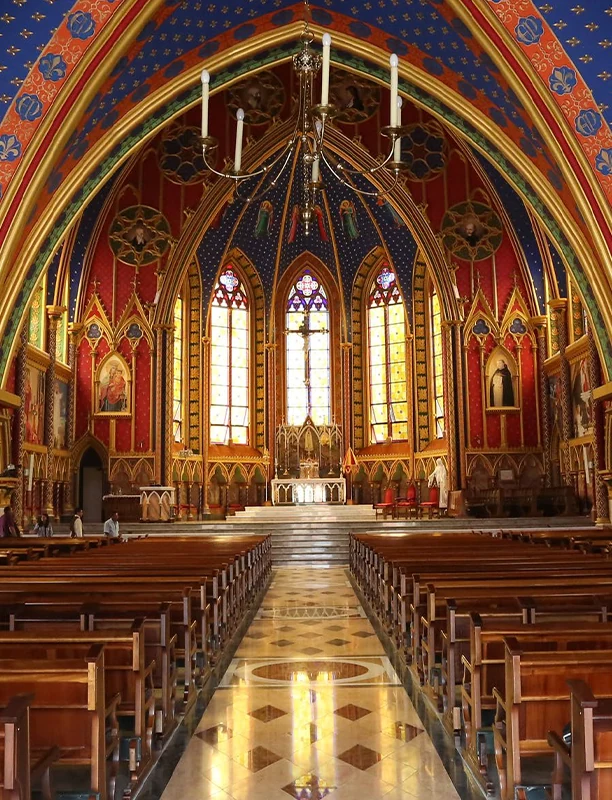 Who are the Heralds of the Gospel?
 Help of Christians
 Christmas Carols








A living example of genuine detachment and the purest unpretentiousness, St. Francis shone for his poverty of spirit. Convinced that the form of this world is passing away, his heart was free from any attachment.
A youth with a strong and jubilant soul
Francis’ childhood and youth unfolded in a very carefree ambience. The son of rich merchants, he always had a plenty of money at his disposal, which he spent almost without thinking. Gifted with a very liberal way of being, he naturally enjoyed all he could in terms of good food, clothing and personal belongings. It soon became apparent that he “belonged to the category of strong and joyful souls,”2 quickly becoming, due to his consistently outgoing personality, a leader among his contemporaries. Although something of a wit, he was affable and courteous to anyone who spoke to him, never insulting anyone or uttering vile words, even when offended. Thus he lived surrounded by friends, with whom he enjoyed festivities and strolls in the city, singing all the while. The virtue of generosity also shone in his soul at an early age. He attended to all the requests of the poor and needy with invariable solicitude, and one day he made the resolution to never deny a request put to him in the name of the Lord.3 Greed never found a home in his heart, perhaps as a sign of the enormous predilection that Providence had placed in his soul. St. Francis of Assisi -
 Friary of St. Anthony, Rio de Janeiro
The beginning of the conversion
Curiously, it was during this frivolous youth that God began to reveal himself to Francis and speak to his heart. Twice he visited him via dreams, which, although not of a clearly mystical character, moved him deeply and made him reflect on the life he was leading. The first manifest event of his conversion took place on one occasion as he walked and sang with his companions through the streets of Assisi. Suddenly he was enraptured by the Lord “and his heart was filled with such sweetness that he could neither speak nor move, nor feel or hear anything other than that sweetness, which had separated him so much from worldly feelings that, as he himself said later, even if he had been cut to pieces he could not have moved from that place.”4 From that day on, something had changed within him. “He began to regard himself as vile and to despise those things which he had loved before, but still not entirely, for he was not yet completely detached from the vanities of this world.”5 Thus, gradually withdrawing himself from his former worldly interests, he began to strive to lead a holy life. Every day he retired to pray alone, and sought to give to the poor more often and with greater largesse than before. However, the path to which Providence called him was not entirely clear. He longed for poverty above all things, but since his heart found no echo in the circles he frequented, he refrained from asking advice from anyone but God in this regard. The Most High had appointed Francis to personify poverty as never before understood or lived by humanity. The sources from which he had to draw the heavenly archetypes he was called to represent came – as he expected – from God himself.The divine will becomes clear
Once, while passing in front of the Church of San Damiano, Francis heard an interior voice directing him to enter and pray. Obedient, he entered the precinct and stood before the Divine Crucified One, who suddenly began to speak to him: “Francis, do you not see how My house is in ruins? Go and rebuild it.”6 At first, the young convert understood the Redeemer’s request literally, and promptly arranged for the complete reform of that little church. However, Christ’s words had a far greater scope, which Francis only came to understand over the course of time: he was to be a reformer of the Holy Catholic Church, leading it back to the true path from which, unfortunately, it had drifted. This divine manifestation contributed greatly to the Poverello understanding his vocation. And it was made clear definitively during a Mass at which he heard from the lips of the priest the words of Our Lord: “Take no gold, nor silver, nor copper in your belts, no bag for your journey, nor two tunics, nor sandals, nor a staff” (Mt 10:9-10). Hearing this, he exclaimed with emotion: “This is what I wish to accomplish with all my heart!” From that moment on, “he knew with absolute certainty what he wanted, nor did he waver or hesitate any longer. [...] Overflowing with joy, his whole soul sighed to follow the word of the Lord and to make it a reality.”7Opposition from his family
Now, as only happens to those who give themselves radically to the service of God, persecution was not long in entering Francis’ life. Having resolved to abandon houses, lands, father, mother and brothers for love of God, he immediately received the reward promised by the Saviour: the hundredfold, with persecutions (cf. Mk 10:29-30). His father, Peter of Bernardone, fiercely opposed his son’s decision to follow Christ. One day, not knowing what else to do to dissuade him from his intentions, he vehemently denounced him to the Bishop. But the latter, discreet and wise, advised Francis to come to his palace and answer his father’s accusations. And so he did. On the appointed day, he presented himself to the Bishop. After being comforted by his ardent words, the young Saint took an unexpected attitude: he went to a nearby room, stripped himself of his clothes and, returning to the room, deposited his clothing and all the money he had been carrying at his father’s feet, as a sign of his complete break with the world. Peter of Bernardone, astonished and enraged, took the belongings of his “mad” son and left without a word. Our Lord Jesus Christ and St. Francis of Assisi -
 Santa Maria of Palma Cathedral, Mallorca (Spain)
Why “transformer of the world”?
To understand well the spirit and work of St. Francis, one must consider that the humanity of the 13th century was being eroded by a profound crisis, existing above all in the highest strata of society, including the clergy themselves. There was a “growing enthusiasm for the pleasures of the world, the direct effect of the improvement of living conditions and of developments in social relations.”10 Transposed to the sphere of customs, this hankering after earthly enjoyment pervaded all social classes and gave free rein to the excesses of luxury and the craving for profit; as a result, hearts were gradually distanced from the love of sacrifice and the aspiration for holiness.11 The great error of the Middle Ages has a metaphysical root: people began to make use of material means only for the benefits they brought in themselves, and no longer as instruments for knowing, loving and glorifying their Creator. They began to appropriate what was God’s for their personal delectation. In these historical circumstances, St. Francis was sent by the Holy Spirit to be a living example of genuine detachment and the purest unpretentiousness. The charism of the work he founded reflects the poverty of spirit of which the Gospel speaks to us (cf. Mt 5:3): to have one’s heart free from all attachment, to use one’s goods as if one were not using them, “for the form of this world is passing away” (1 Cor 7:31); to rejoice with creatures for the joy of finding in them a reflection of the Creator’s perfections, and not in search of small-minded, individual pleasure. This is the unpretentious admiration which shines with unrivalled brilliance in the famous Canticle of the Creatures, “the new sermon which the Saint sent his friars to preach throughout the world, to conquer it for the love of God.”12 St. Francis of Assisi cuts the hair of St. Clare - St. Mary of La Rábida - Monastery (Spain)
The first followers and the founding of the Order
Now completely enlightened concerning his mission, Francis began to proclaim the truth in the full ardour of Christ’s spirit, and invited others to join him in striving for holiness. When he succeeded in gathering around himself twelve disciples, he decided that from then on they would be called Friars Minor. The whole congregation gathered around the little Church of the Porciúncula, always vested in shabby robes. Inspired by God, the Poverello left for Rome in order to obtain from Innocent III the approval of his first rule, which prescribed absolute poverty in imitation of the life of Christ and the Apostles. The Holy Father, who a few days before had seen the Holy Church miraculously supported by a small and humble looking man, soon recognized St. Francis and granted him not only the approval he desired, but every sign of affection and admiration.New path of salvation
Armed with the papal blessing and protection, the friars went out into the cities in pairs, proclaiming to all that new way of salvation which God had deigned to reveal to their spiritual father. In his preaching, St. Francis possessed “something enticing which convinced. [...] He was an inexorable moralist, who did not remain silent about anything that seemed wrong to him,” and for this reason he awakened “not only awe, but fear around him: he had something of the formidable soul of St. John the Baptist". His discourse was compared “to a sword that pierced hearts.”13 This immense apostolate soon won over for the service of God a seventeen-year-old noblewoman named Clare, who, enraptured by the holiness of Francis, decided to follow him with all her heart. She then became the founder of the female branch of the Order. In a short time, there were so many who were attracted by the Franciscan charism that Francis was obliged to also found a Third Order, which would number among its members figures such as St. Louis IX of France, St. Elizabeth of Hungary and St. Elizabeth of Portugal.Persecuted by his own disciples...
 St. Francis of Assisi -
 stained glass of San José Cathedral (Costa Rica)