 Heralds of the Gospel Magazine, Vol. 20, nº 227, September 2026
 Heralds of the Gospel Magazine, Vol. 20, nº 226, August 2026
 Heralds of the Gospel Magazine, Vol. 20, nº 225, July 2026
 Who are the Heralds of the Gospel?
 Help of Christians
 Christmas Carols







Origin almost unknown
We have little historical information about this illustrious man. We only know that he was a Jew from the Diaspora, born in Cyprus, of the tribe of Levi. Of his family, we have the only reference that St. Mark was his cousin (cf. Col 4:10). Furthermore, the name Barnabas was not given to him by his parents, but by the Apostles, as an evocative word meaning “Son of encouragement” (Acts 4:36). The beginning of his journey is equally unknown to us. Not even the exegetes agree on whether he was one of Our Lord’s disciples. Because his name does not appear in the Gospels, many believe that he was among the first converts after the descent of the Holy Spirit at Pentecost. Nevertheless, because of his important role in the early Church, St. Barnabas appears in the sacred writings alongside the other Apostles, a sign of deference that the Fathers of the Church and the Sacred Liturgy also imitate.1First apostolic missions
At the beginning of his mission, we see St. Barnabas exercising his apostolate with St. Paul. It was only recently that this staunch Pharisee had become a fervent preacher of the name of Jesus Christ. When Paul went up to Jerusalem to be with the other Apostles, the disciples were hesitant to believe in his conversion, moved by the memory of the persecutions once perpetrated by the follower of Gamaliel. In view of this, St. Barnabas took him with him and testified to the sincerity of his words. He recounted the Lord’s apparition on the road to Damascus and how he had preached courageously in that city. Thus, St. Paul was able to remain in the Jerusalem community. However, realizing that in view of the converted apostle’s preaching, the Jews were already plotting his death, the elders were inclined to send him back to Tarsus. So Paul and Barnabas were separated, but only for a short time. Dispersed by the persecutions that had taken place during the time of St. Stephen, some of the brothers had moved to Phoenicia, Cyprus and Antioch, where they preached the Gospel and converted many people to the Lord. Knowing this, the Church in Jerusalem sent Barnabas to the latter place. He was delighted to see the progress of the Faith in pagan lands and urged the brothers to persevere in their fellowship in Jesus Christ. As the distance between Antioch and Tarsus was short, Barnabas set off in search of Paul and took him with him, and they both spent a whole year in that city. Their fervour was so ardent that the disciples were called Christians for the first time.Amid miracles and persecution
The first apostolic journey opened a new chapter in the history of the two evangelizers. Considering the conditions of the time, long journeys were a real hardship, not to mention the harsh trials and violent persecutions they endured, as we will soon see. The genesis of this endeavour is surrounded by a mysterious and supernatural aura. Sacred Scripture tells us that while they were worshipping, the Holy Spirit’s plan became manifest: “Set apart for me Barnabas and Saul for the work to which I have called them” (Acts 13:2). The disciples, obeying the heavenly voice, immediately laid hands on them and let them go. The two first went to Seleucia, from where they sailed to Cyprus and travelled the length of the island, from Salamis to Paphos. Back on the mainland, they landed at Perga in Pamphylia and headed for Antioch of Pisidia. When the Jews expelled them from the city, they travelled as far as Iconium. Wherever they went, they proclaimed the name of Jesus Christ and confirmed His teachings with marvellous wonders. Out of consideration for the calling of the Jewish people, they first tried to convert them by teaching in the synagogues. Everywhere the result was the same, that is, the crowds were divided: on the one hand, many Jews and pagans adhered to the Catholic Faith; on the other, the unbelievers, clinging to their wickedness, stirred up riots and protests to drive them out. In Iconium, the two Apostles were almost stoned, which prompted them to flee to the cities of Lycaonia: Lystra, Derbe and their surroundings.Integrity in all situations
In Lystra, Paul and Barnabas would once again be crowned with persecution, but first an episode interrupts the narrative of the journey. There was a man in this city who was lame from birth and whose legs were completely disabled. He sat and listened to St. Paul preach. With his profound discernment of souls, the Apostle saw in him a seed of faith and, fixing his gaze on him, commanded: “Stand upright on your feet!” The miracle was immediate: the man leapt to his feet and began to walk. The crowd, having witnessed this stupendous miracle, exclaimed in amazement: “The gods have come down to us in the likeness of men!” Steeped in idolatry, the inhabitants of Lystra associated the two evangelists with pagan deities: they called Barnabas Zeus, and Paul Hermes, because he was the one preaching. The uproar was accompanied by even the pagan priests, who together with the people were ready to sacrifice bulls decorated with garlands. Immediately Paul and Barnabas protested against this idolatrous attitude and, with effort, convinced the crowd that they too were mere mortals. At the same time, they admonished them to abandon false gods and accept the teaching of the one true religion. The same uprightness of spirit that led the Apostles not to lose heart in the face of persecution was also reflected at the moment when worldly glory was offered to them: no grain of incense was accepted, but with total unpretentiousness they pointed to the one God.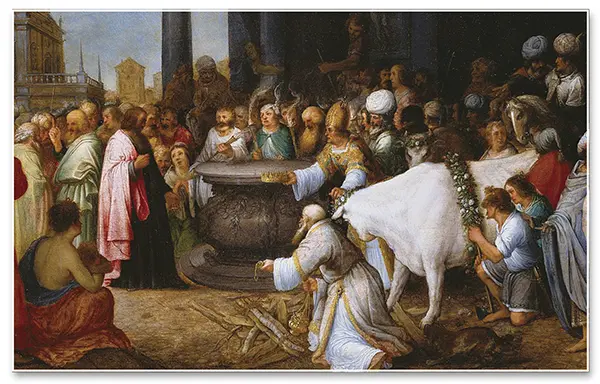
“Paul and Barnabas in Lystra”, by Adriaen van Stalbemt - Städel Museum, Frankfurt (Germany)
Apostolic Council in Jerusalem
Undoubtedly, even more difficult than resisting external persecution is eliminating infiltration into the ranks of the good. Whether in an army, a community or even in the human body, the worst illnesses usually arise from within the organism itself. And so a seed of division sprang from within Christianity, which led St. Barnabas and St. Paul to react with even greater energy than they had in the face of the threats or riots raised against them by the Jews. Some disciples who followed the doctrine of Jesus Christ began to preach the Mosaic rule of circumcision, even to non-Jews. Paul and Barnabas immediately objected and, as a great discussion arose, they decided to take the matter to the Church in Jerusalem. The Apostles and elders gathered to discuss the matter. Having heard both opinions, St. Peter reiterated that circumcision was of no value for the Gentiles, since it is by the grace of Our Lord that we are saved. Emphasizing the view of the first Pope, Paul and Barnabas recounted the wonders that God had worked through them among the pagans. Finally, St. James, with a solemn speech, ratified the decision made and prescribed only a few specific points of the law to be observed by the Gentiles. In this way, Peter, James and John, who were “reputed to be pillars” (Gal 2:9) of the Church, gave their full support to Paul and Barnabas’ apostolate among the pagans, allowing the two to remain in Antioch and even sending some of the faithful with them.The event of a lifetime, the dawn of eternity
The work of St. Barnabas and St. Paul, who remained together for so many years, has a mysterious unfolding, in which divine designs are hidden under the veils of an incident. After both had spent some time in Antioch, St. Paul expressed his desire to retrace his journey through Asia Minor, with the aim of strengthening the communities he had once founded. St. Barnabas consented, but wanted to take his cousin St. Mark with him. However, St. Paul peremptorily refuses to receive the Evangelist in his entourage, because of a previous disagreement, which can happen even among the brightest sons of light in this vale of tears. The decision is made: the two Apostles separate. Completely free of the petty resentments which the modern mind is led to see in this scene, the two men, filled instead with decisiveness and a firm determination, each set off on a different journey. St. Barnabas left with St. Mark for Cyprus, while St. Paul took Silas as his companion and travelled throughout Syria and Cilicia.
St. Barnabas - Basilica of Santa Maria sopra Minerva, Rome
Notes
1 Cf. ARNALDICH, OFM, Luis. San Bernabé. In: ECHEVERRÍA, Lamberto de; LLORCA, SJ, Bernardino; REPETTO BETES, José Luis (Org.). Año Cristiano. Madrid: BAC, 2004, v.VI, p.262-270. Most of the information about St. Barnabas in this article is taken from the Acts of the Apostles (cf. Acts 9–15).