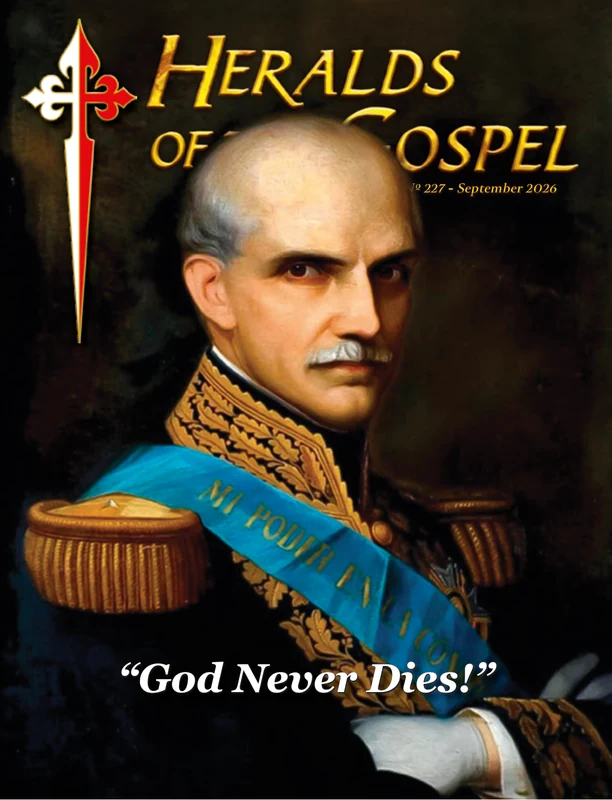
 Heralds of the Gospel Magazine, Vol. 20, nº 227, September 2026
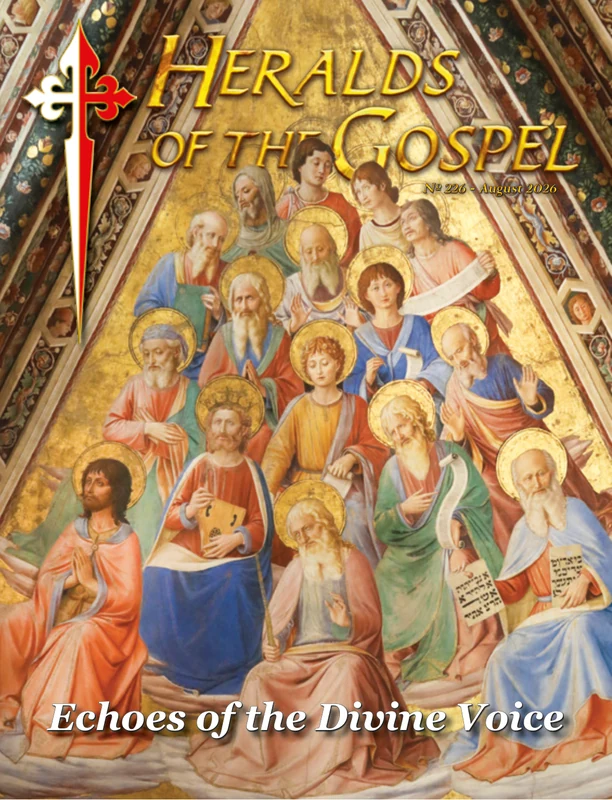 Heralds of the Gospel Magazine, Vol. 20, nº 226, August 2026
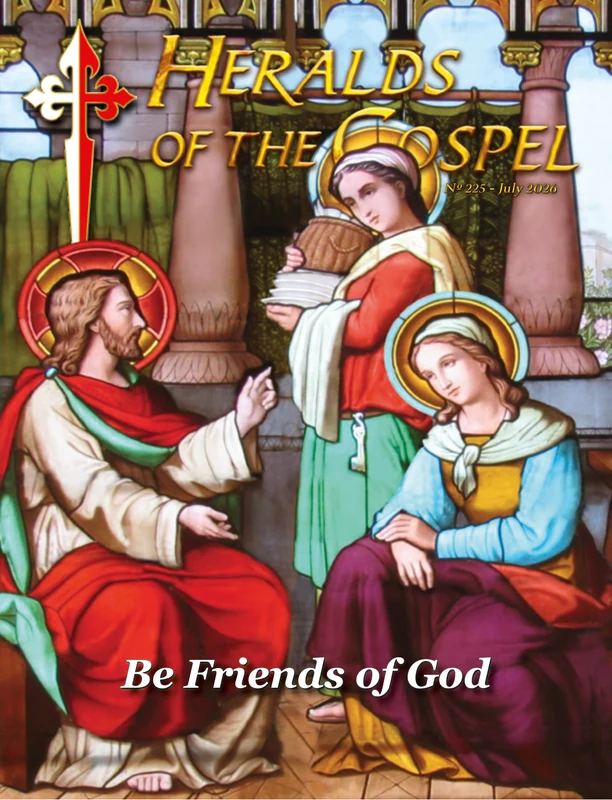 Heralds of the Gospel Magazine, Vol. 20, nº 225, July 2026
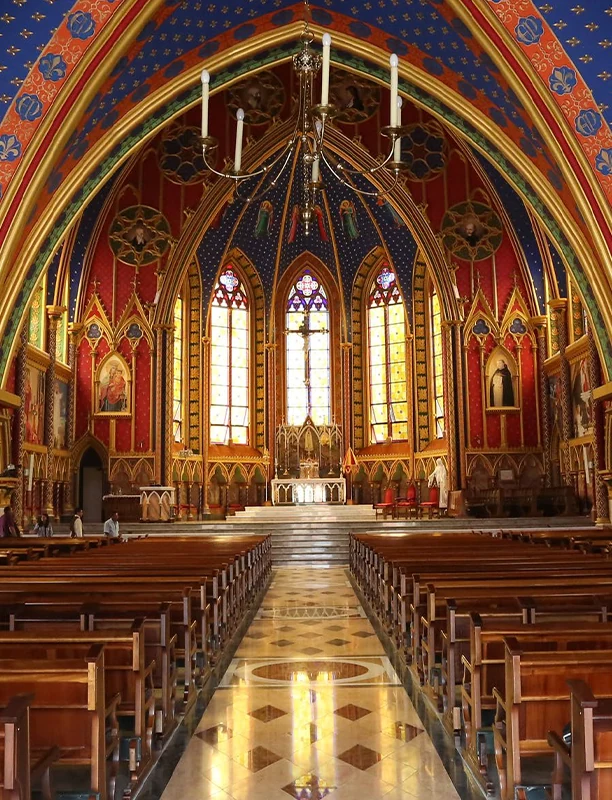 Who are the Heralds of the Gospel?
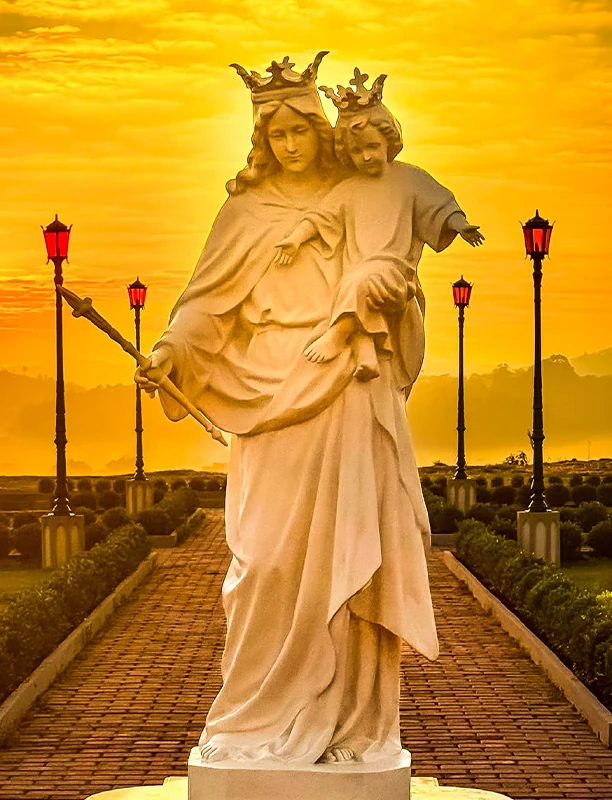 Help of Christians
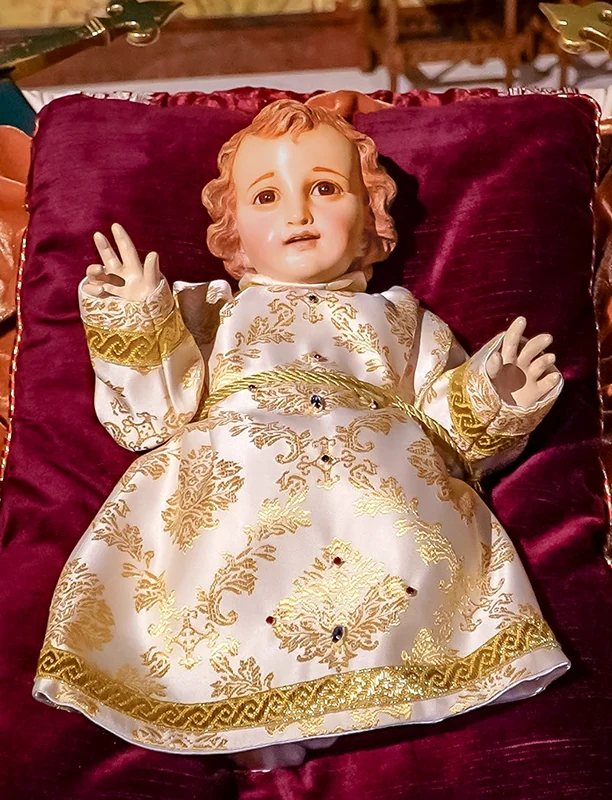 Christmas Carols







From Merovingians to Carolingians
The centuries following the baptism of Clovis, king of the Franks, saw the weakening of the Merovingian dynasty.3 Exhausted and impotent, the last sovereigns of this famous line,suggestively nicknamed fainéants, or vagabonds, were no more than symbols, used artificially. Meanwhile, the power of the great families of the Frankish aristocracy grew, especially the influential figure of the maires du palais – mayors of the palace –, authentic viceroys. This phenomenon was repeated in all five regions into which the Frankish kingdom was divided between the 6th and 7th centuries: Austrasia, Neustria, Burgundy, Aquitaine and Provence. At the end of the 7th century, the prefecture of Austrasia passed to Pepin of Herstal, of the Pepinid dynasty, who was honoured with the title of duke. It was he who unified Austrasia, Neustria and Burgundy and maintained this enormous domain until his death in 714. Charles, known as Martel, succeeded his father Pepin of Herstal. A victor on the Rhine, in Neustria and Aquitaine, the valiant warrior will be particularly honoured for his victory over the Muslims of Abd-er-Rahman in Poitiers in 732. “It was from this hero,” says Gobry, “that the entire Carolingian dynasty was born, which owes its name as much to Charles Martel as to Charlemagne.”4 Charles Martel was succeeded by two of his sons: Pepin the Short received Neustria, Burgundy and Provence; Carloman received Austrasia, Germania and Thuringia. By now, practically all the Frankish kingdoms were in the hands of the Pepinids, who acted as maire-du-palais. However, Carloman decided to leave the world behind and entrust his states to his brother, in order to become a Benedictine monk in Monte Cassino. Pepin therefore “reigned” alone over the Franks. The Merovingian dynasty was in its final days. Pope St. Zechariah would have the last word: “To whom is it more just to give the name of king,” he is asked, “to the one who possesses royal authority in name only, or to the one who possesses it without the name?” And the Pontiff gave the answer: “It is just and reasonable that he who possesses royal omnipotence should also have the name of king.”5 Thus, in 751, the dynasty of Clovis’ descendants definitively ceased to rule. Henceforth, the Carolingians reigned.Birth of the Pontifical States
The devoted relationship that would be established in the future between Charlemagne and the Roman Pontiffs was based on a series of events that took place during the reign of his father, Pepin the Short. A few years after the consecration of the first Carolingian king, the Lombards, under the command of Aistulf, king of Pavia, took Ravenna and threatened Rome. Pope Stephen II, seeing himself in danger, turned to the new king of the Franks. In 753, to escape the Lombard danger, he left the Eternal City for France, where “the young Charles – the future Charlemagne – representing his father, received the illustrious visitor.”6 In 756, during the second raid against Aistulf, the Pontifical States emerged – Rome, Perusia and Ravenna, later joined by Comacchio – which, conquered by Pepin and donated to the Pope, would be maintained for over ten centuries.Charlemagne at the kingdom’s head
On the death of Pepin the Short in 768, the Frankish kingdom was divided between Charlemagne and Carloman, his younger brother. But the division lasted only three years. In 771, Carloman died and Charles reigned alone. Thus, from a combination of providential factors, a vast kingdom, later to become an immense empire, comes under the rule of one wise monarch. What will Charles’ first act be? His attention turns to the interests of the Church, as it will throughout his reign. He resumes his wars against the Lombards, Rome’s adversaries, and besieges the city of Pavia. Holy Week 774 is approaching and the end of the siege, which has been going on for six months, is nowhere in sight. Charles, who has personally presided over the siege of the Italian city under Lombard possession, decides to celebrate Easter in Rome with the venerable Successor of Peter. Thus, accompanied by a number of bishops, abbots, dukes and counts, and escorted by a troop of knights, the monarch sets out for the Eternal City via the Province of Tuscany. Still thirty miles from their destination, the Frankish entourage comes upon the unfurled banners of the entire Roman army which, sent by Pope Adrian I to welcome the honoured defender of Christendom, has marched out to meet them. The general joy is indescribable.
“The Coronation of Charlemagne”, by Friedrich Kaulbach - Maximilianeum, Munich (Germany)
A deep and supernatural relationship
The king and his entourage make the final leg of the journey on foot. In front of St. Peter’s Basilica, in whose portico the Holy Pontiff awaits him “surrounded by his priestly senate,”8 Charles decides that he will climb the steps on his knees. And so he does, kissing each step. After the gesture of humble veneration, the man set to be the greatest emperor of Christendom finds himself at the feet of Christ’s Vicar. Then, in a symbolic gesture, king and pope embrace warmly and, with the monarch holding the Pontiff’s right hand, to the acclamations of “Blessed is he who comes in the name of the Lord,” they enter the sacred edifice, where “the most holy pope and the most excellent king swear alliance and mutual fidelity over the body of the Prince of the Apostles.”9 A deep and supernatural relationship is established between St. Adrian I and Charlemagne, and the correspondence between them evinces feelings incomparably superior to the political interests to which many historians attribute this friendship. Could there be a scene be more representative of the perfection of human society, in which the Holy Church affectionately cherishes the temporal government, and the latter pays her the greatest tributes of love and submission? We can say without hesitation that, on that occasion, Christendom could glimpse the establishment of a social order entirely in accordance with God’s plans. After the siege of Pavia, Charles took as his own the iron crown of the Lombards. He went on to fight the Lombard Adalgis in January 777, and visited Rome again in 781 to request the royal anointing for his two sons, Carloman, king of Italy, and Louis, king of Aquitaine.The giant undertaking of a giant Emperor
Wars took up a large part of Charles’ reign. In a Europe still dominated by barbarism, territorial borders had to be strengthened, defended and expanded. It should be noted, however, that these enterprises always bore an undeniable missionary character, being undertaken in defence of the Faith and with a view to spreading the Catholic Religion. They were conflicts against various inimical peoples: Lombards, Frisians, Saxons and even Muslims from northern Spain. As Darras assures us, “Europe had a master, the world an arbiter, the Church a defender, and soon Rome would inscribe this immortal title on the pedestal of the new king’s statues: “Carolus Magnus Romanæ Ecclesiæ ensis clypeusque – Charlemagne, sword and shield of the Roman Church.”10 If Charlemagne shone for his valour on the battlefield, he shone no less for his piety and filial devotion to the Holy Church. In fact, he made it his mission not only to defend the Church, but also to surround her with ever greater honours and splendours.
“Charlemagne in Paderborn”, by Ary Scheffer - Palace of Versailles (France)
An excellent service to the cause of Christian culture
An old calumny depicts Charlemagne as illiterate, unable to sign his own name. Nothing could be more false, especially in the case of a man from whom a true cultural renaissance was born amidst the darkness of ignorance and barbarism. In fact, Charles was a cultured man. He spoke his own language with perfection – he had even started writing a grammar manual – as well as Latin and Greek, which he understood, although he did not speak. During his meals, he delighted in hearing the reading of St. Augustine’s City of God.12 Furthermore, he did not lack poetic and musical talent, always combined with great piety. The Catholic liturgy owes one of its most beautiful hymns to the emperor’s plume: Veni Creator Spiritus.13 Charlemagne ushered in an era known as the Carolingian Renaissance. The emperor “rendered excellent service to the cause of Christian culture with his educational capitularies, in which he insisted on the importance of a high standard of accuracy in the copying of manuscripts and the correction of texts.”14 He also “gave a strong impetus to education and the arts, asking the bishops to organize schools in connection with their cathedrals.”15 These schools, set up in a large number of churches and monasteries, were opened to all, and wise teachers were sought from all over the West, especially from England and Italy. Among these was the main exponent of culture and science at the Carolingian court: Alcuin of York.
“Charlemagne reprimands negligent students”, by Karl von Blaas - Museum of Art History in Vienna
“His final concerns were for the Church”
Until the end, Charlemagne lived of the Church and for the Church. This is what Darras says about the great emperor’s last days: “His final concerns were yet for the Church, of which he never ceased to be the armed defence during his long and glorious reign. In 813, five councils were held throughout the empire: in Arles, Châlons-sur-Saône, Tours, Rheims and Mainz. The canons of discipline they formulated were sent to Aix-la-Chapelle, where the emperor had them examined by a numerous assembly of bishops and masters and made them obligatory for all the peoples under his rule through a special capitulary.”16
True greatness is only born of faith
Charlemagne’s legacy to history is immeasurable. Emperor, father, teacher, warrior, theologian, and loving son of the Church, defender of the Pope… How can we summarize in a single word so many aspects that adorned the soul of the Emperor with the flowery beard? Only one word sums them up. The one with which, thirty years after his death, his grandson Nithard described him: magnus.17 Indeed, true greatness is only born of faith. And it was this faith, loved, cultivated and defended unreservedly by Charles that allowed him to be, in the full sense of the word, great. ◊Notes
1 Cf. EGINHARD. Vita Karoli Imperatoris. 2.ed. Roma: Salerno, 2006, p.98.
2 DARRAS, J. E. Histoire générale de l’Église. Paris: Louis Vivès, 1873, t.XVIII, p.8.
3 The Frankish dynasty of which Merovech (411-458) was the third king, and which was consolidated by Clovis I (465-511) and his descendants.
4 GOBRY, Ivan. Pépin le Bref. Père de Charlemagne, fondateur de la dynastie carolingienne. Paris: Pygmalion, 2001, p.45.
5 GOBRY, Ivan. Charlemagne. Fondateur de l’Europe. Monaco: Rocher, 1999, p.29.
6 BORDONOVE, Georges. Charlemagne. Empereur et Roi. Paris: Pygmalion, 2008, p.30.
7 DARRAS, J. E. Histoire générale de l’Église. Paris: Louis Vivès, 1891, t.XVII, p.459.
8 Idem, ibidem.
9 Idem, p.460.
10 Idem, p.443.
11 Cf. Idem, p.476.
12 Cf. Idem, p.473; EGINHARD, op. cit., p.102-103.
13 Cf. DARRAS, op. cit., t.XVII, p.496.
14 DAWSON, Christopher. A crise da educação ocidental. São Paulo: É Realizações, 2020, p.35.
15 WOODS, Thomas E. Cómo la Iglesia construyó la civilización occidental. Madrid: Ciudadela Libros, 2007, p.36.
16 DARRAS, op. cit., t.XVIII, p.157.
17 Cf. BORDONOVE, op. cit., p.11.