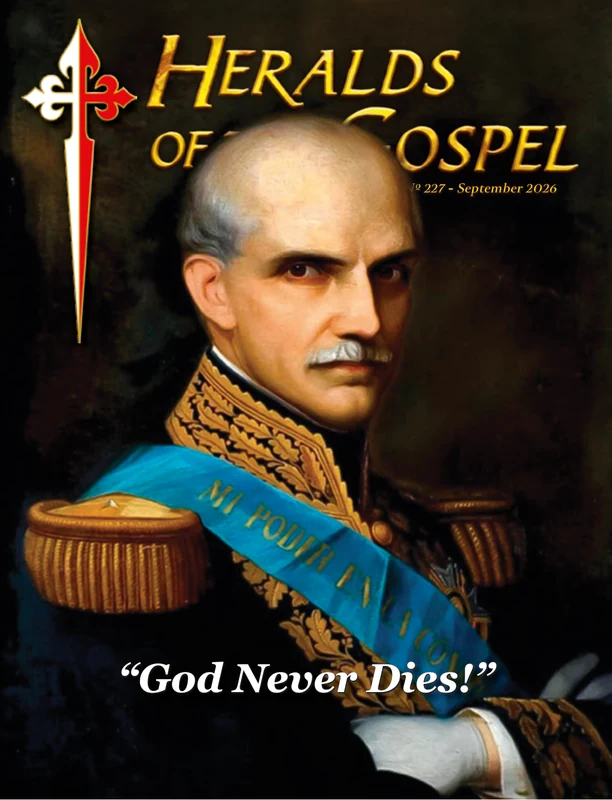
 Heralds of the Gospel Magazine, Vol. 20, nº 227, September 2026
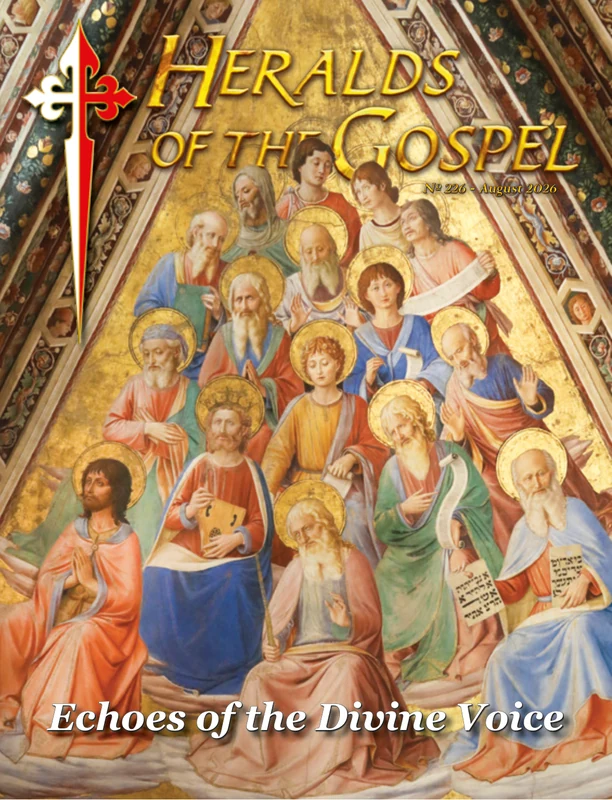 Heralds of the Gospel Magazine, Vol. 20, nº 226, August 2026
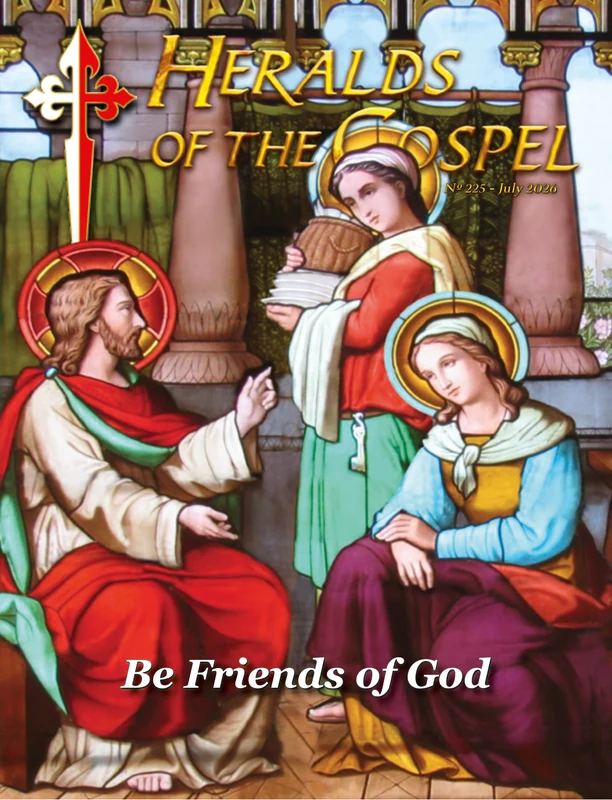 Heralds of the Gospel Magazine, Vol. 20, nº 225, July 2026
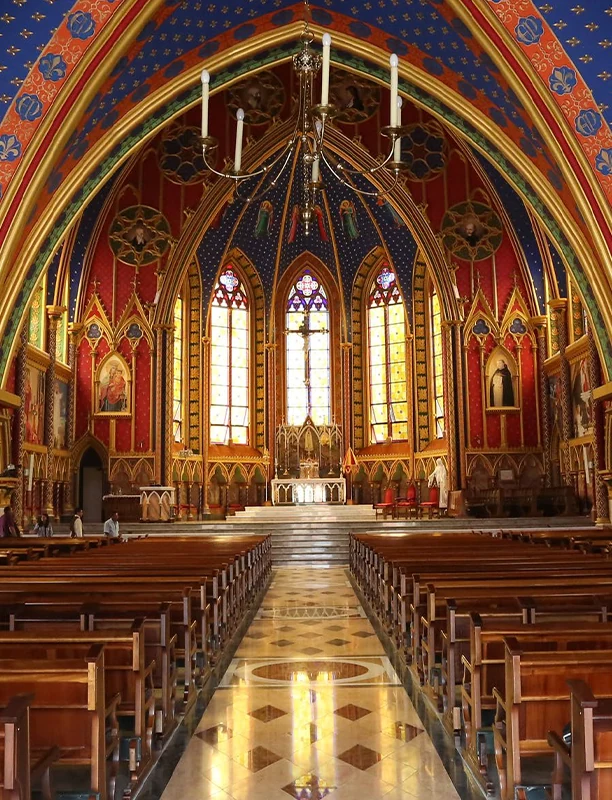 Who are the Heralds of the Gospel?
 Help of Christians
 Christmas Carols







First encounter
In 1956, Msgr. João – then a youth of seventeen – was far from imagining he would find, most unexpectedly, in the lobby of an apartment building on Vieira de Carvalho Street, in São Paulo, the greatest treasure of his life. After a morning of study, he had gone to the headquarters of the Catolicismo group – the nucleus that would later give rise to the TFP – which was housed in that building, leaving an ugly and revolutionary world behind him as he stepped onto the premises. He felt happy just to be in a setting that to him was sacred, and, while waiting for the elevator, Dr. Plinio and his mother, Dona Lucilia, appeared at the front entrance. 1His first reaction was to observe them, seeing how one was reflected in the other. In a flash, he contemplated the astounding similarity of soul between the two, and was enchanted with the venerability of Dona Lucilia. He immediately understood that she was an altogether extraordinary lady. What struck him most was not just the refinement of someone who belonged to one of the most traditional families of São Paulo, nor even the delicacy with which she accepted his help as she ascended the lobby stairs. Only with the passing decades would he decant the significance and transcendence of that first meeting which, while it was sublime was also natural and simple, just as his relationship with that lady “made of porcelain” would always be.Most unexpectedly, in an apartment building on Vieira de Carvalho Street, the young João found his life’s treasure
Reflection of the Sacred Heart of Jesus
When eleven years had passed after that first encounter – over the course of which he enjoyed others, as memorable as they were fleeting –, Dr. Plinio was stricken with a diabetic emergency. During his period of convalescence in his apartment, the then Mr. João had the opportunity of serving him more closely and, as a result, of spending more time with Dona Lucilia. He slowly became aware of the solitude in which that noble soul passed her days, shunned by close family members, with the exception of her son. Her goodness was entirely misprized, although the overflowing affection of her heart was, in a certain way, capable of embracing all of humanity. As he uncovered the charms of her soul in the fleeting moments that he could observe her, he let himself become immersed in that captivating sweetness. Within him was formed an image of virtue forged by the pain of ostracism and the loneliness of life of a simple housewife.Gradually, Msgr. João came to realize that Dona Lucilia had drawn from Our Lord a deep love and unreserved kindness towards all. He saw how she dedicated long hours to contemplation before a statue of the Sacred Heart of Jesus, proving for himself Dr. Plinio’s saying: “Somehow, He lives in her.” 2 She radiated the sacredness of the Redeemer in whatever setting she entered, tinting it with the supernatural; even her smallest gestures reflected the wonders that filled her. The atmosphere that was created around her was so enchanting and it made the practice of good so appealing that in being with her, the presence of God who dwelt in that virginal soul by virtue of Baptism could actually be felt.In contact with Dona Lucilia, Msgr. João contemplated the grandeur of God made into forgiveness and felt the warmth of the “maternal” Heart of Jesus

A heavenly relationship
This conviviality – which later Msgr. João would describe as “Lucilian” – consisted of various encounters throughout the day. He eagerly looked forward to his moments together with Dona Lucilia, and was always alert to analyse her, keeping everything in his heart, down to the most minute detail. It was enough just to come close to her and greet her, respectfully kissing her hand, to become enwrapped in her serenity. The velvety and penetrating gaze of this lady was for him a reflection of the purity of God. Decades after her death, Msgr. João fondly recalled the sensation of well-being and joy that he experienced when seeing her, for she was kind, filled with mercy and willing to forgive anything. When she realized, however, that many people chose to place themselves outside of her influence, thus rejecting the benevolence that flowed from her heart, her eyes became shrouded by a beautiful and noble note of melancholy: it was the disenchantment of unrequited affection. This suffering had refined her soul, increasing her dignity and fully configuring her with crucified Goodness. The memories of this heavenly relationship are not composed of prodigious deeds or heroic feats. On the contrary, in the cordiality of a family circle, when having tea with Dona Lucilia, chatting about episodes from Dr. Plinio’s childhood, offering her a simple rose or discreetly observing her while she prayed the Rosary, Msgr. João contemplated, as in a mirror, the grandeur of a God turned into forgiveness, and he felt the warmth of the “maternal” Heart of Jesus. Her key to relating with others was through serious, respectful, affectionate, humble and gentle kindness. Without knowing how or when, Msgr. João perceived that some kind of supremely mystical phenomenon had taken place between them to the effect that part of Dona Lucilia’s attitude, her spirit, her mentality and her benevolence flowed into him, with a view, perhaps, to extending this relationship to other souls.A mother for future centuries
Thus, he did not tarry in discerning, with prophetic insight, the future mission of this unique mother. He understood that she had a providential role, a sort of “innovation” provided by God to meet the wants and needs of a humanity feeling more and more orphaned from true goodness. It was a divine treasure, a mixture of novelty and tradition, of a soul tasked with carrying out in a particular, precise and small way, the good that Our Lady universally works in favour of souls.In this way, Dona Lucilia was like the last seed of the Middle Ages that, in falling to the ground, gave rise to something new for Christendom, as an intercessor, opening the doors of an unprecedented generosity that would “exhaust” the reservoirs of God’s grace, were they not infinite. With the rays of that same Christian Civilization of which she herself was an heir, she illuminated a decadent world where kindness had been replaced by vulgarity, affection by interest, charity by atheistic philanthropy. Meditating on the reasons that divine Providence had proceeded thus, it seemed to Msgr. João that, due to the corruption and madness of revolutionary society, it was necessary for God to show Himself nearer to a world that had destroyed the image of Jesus and His Holy Mother, giving it, in Dona Lucilia, an opportunity to recall their true semblance.She was a soul entrusted with the role of carrying out in a particular, precise and small way, the good that Our Lady universally works in favour of souls
Such a son of such a mother!
She was, in fact, a mirror of particular divine perfections, whose first beneficiary had been her own son, Dr. Plinio. As an avid admirer of the solid virtues of this man, Msgr. João recognized how much he was sustained in the practice of virtue by the presence of such a mother. Dona Lucilia was the parameter, the way, the “tables of the Law” that supported him in his spiritual life and, having been called by Providence to defend Dr. Plinio, it was natural that his fidelity would be founded on her prayers.
The treasure… in eternity
Naturally, Dona Lucilia’s death took him completely by surprise. She was so definitively “his treasure” that he never thought of their eventual separation... The sense of well-being that she exuded, even in moments of distress or illness, made her seem immune to suffering and gave the impression that she would live on eternally… Therefore, as he kept vigil by her body at the wake, he wondered, perplexed: “Will this light forsake us, then?”With the hindsight of passing years, we are able to ascertain that so many memories, smiles, and such encouragement were given to Msgr. João that by keeping them in his heart they would illumine us in the future! For him, Dona Lucilia had not departed, for she would always be at his side because of their profound union of soul. In a way she had become “eternal”, for ever since that April 21, 1968, she had become a kind of “guardian angel” to him. From then on, her presence – no longer physical – was manifested by a constant dialogue, marked by imponderables and by an altogether mystical contact, on the initiative of Heaven. Dona Lucilia made her presence felt even more powerfully than if she had been alive, accompanying him at every step, removing obstacles from along his path, arranging situations for the best and constantly supporting the large spiritual family that he spread throughout the world.After the death of Dona Lucilia, Msgr. João became the apostle of her virtues, enabling her to embrace a multitude of children who turn to her intercession
Mother of a multitude of children
And here the epic of Msgr. João takes on a special glow. He could have considered himself the fortunate man of the parable, for he had found the treasure that was hidden from the eyes of the world… but he strongly felt that this was no prize to keep to himself. Therefore, immediately following the death of Dona Lucilia, he became the true apostle of her virtues, spreading devotion to her among the younger members of the TFP and its families, encouraging them in the ways of holiness through her example and obtaining numerous favours through her intercession. He unveiled this sublime treasure to one and all, enabling Dona Lucilia – who in life could never have taken so many children under her maternal shawl – to embrace thousands upon thousands of them, presenting them in her arms to Divine Mercy. Before the tomb of Dona Lucilia, a growing number of people came who invoked her intercession, either due to the favours they had received or in the hopes of receiving them. And just as she had during her life, she continued to show herself eager to attend any request for help, almost insatiable in coming to the aid of the needy, even before the request for help was expressed.
Faithful defender, ardent son
With the death of Dr. Plinio in 1995, Msgr. João opened a new chapter in his life, in which he would need the strong and intimate support of Dona Lucilia. For forty years he had collaborated with her son and in so many situations he had felt her help. He was now certain that her loving care would be unfailing. And so it was, and even more so! There were ruptures, dramas and uncertainties to confront, drastic decisions to be made, bold steps to be taken, in short, a thousand difficulties that he could never have faced without the supernatural assistance of his protectress. On many occasions, Msgr. João declared that he never doubted that his unexpected recovery from many illnesses was due to the role played by Dona Lucilia; in the inexplicable solutions for complicated and thorny questions and in the perseverance of many young people, both consecrated and even priests whom he, through his prayers, gathered under the lilac shawl of this motherly lady. These interventions were always discreet, gentle, and efficient, as was her action on earth.However, just as at the dawn of Christianity, there were also Herods, Judases and Neros who strove to smother this light at all cost. Facing painful opposition from within, misunderstandings, false accusations and endless persecution, Msgr. João was the faithful standard-bearer of true and legitimate devotion to Dona Lucilia – anchored in the firm and orthodox traditions of the Church –, not by example alone, but especially through his works. Even during Dr. Plinio’s lifetime, filial love had prompted him to compile the episodes of Dona Lucilia’s life and write an illustrated biography3 to spread her spirituality to the four corners of the earth, to publicize the miracles obtained through her intercession, and to bring new spiritual children to her, forming a true chain of devotees: souls who, linked to her, are closer to the Sacred Heart of Jesus.The action of Dona Lucilia is perpetuated in the ministry of Msgr. João, contributing to enlivening the heart of the Church
A light for the future
Only many years later did Msgr. João understand that even his relationship with the Holy Church was, in an absolutely supernatural way, inserted in this “Lucilian” chain of love, which penetrated his acts and made him the generous dispenser of spiritual gifts to the throngs of children that God would grant him. With the priestly anointing, these gifts took on added strength and a nuance of goodness that would be difficult to match, presaging, perhaps, an as-yet-unknown regime of graces for humanity. The action of Dona Lucilia is thus perpetuated, contributing in a very special way to enlivening the Mystical Body of Christ.
Notes
1 Dona Lucilia Corrêa de Oliveira was born on April 22, 1876, in the city of Pirassununga, Brazil. She played a key role in the formation of Dr. Plinio, the reason for which she is considered a spiritual mother by his disciples.
2 CORRÊA DE OLIVEIRA, Plinio. Notas autobiográficas [Autobiographical Notes]. São Paulo: Retornarei, 2008, v.I, p.527.
3 Cf. CLÁ DIAS, EP, João Scognamiglio. Dona Lucilia. Città del Vaticano: LEV; Heralds of the Gospel, 2013.