 Heralds of the Gospel Magazine, Vol. 20, nº 227, September 2026
 Heralds of the Gospel Magazine, Vol. 20, nº 226, August 2026
 Heralds of the Gospel Magazine, Vol. 20, nº 225, July 2026
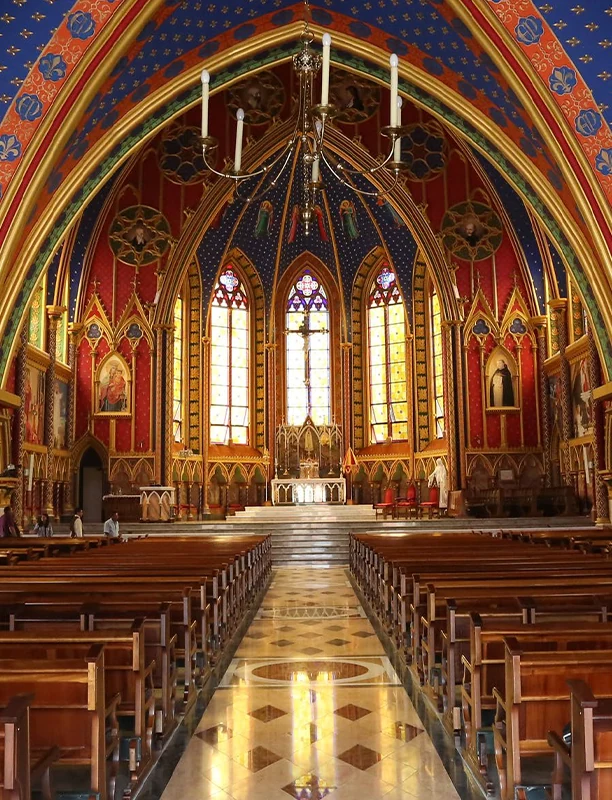 Who are the Heralds of the Gospel?
 Help of Christians
 Christmas Carols






In a dream, an angelic announcement
Let us start with this last point. Analysing the intimate relationship between the Archangel Warrior and the abbey’s history seems to be the most effective way to gain an in-depth understanding of the succession of events that took place over the course of a millennia. The early dawn of this long epic date backs to the beginning of the year 708. While regions of Europe were being violently disputed by barbarians who wanted to establish their territories, the small town of Avranches – situated on the north-west coast of France – remained a safe land. Not far from the village, a hill could be seen. Separated from the town by a dense forest,4 it had been a place of worship for Celts and Romans, later becoming home to a few hermits who, from the 5th century onwards, embraced a life of complete solitude there. A pious man of great virtue, St. Aubert, was the spiritual guide of the small village. When he was elected bishop, he made a habit of frequently going up to the mountain to pray. One night, he received a message from St. Michael in a dream, ordering him to build a temple in his honour in the remote refuge. Perhaps frightened by the perilous task, the bishop waited sceptically for a sign. On another day, the Angel appeared to him again in his sleep, still to no avail. Yet a third time, the heavenly spirit urged him to fulfil the mission, this time with more vigour, touching the prelate’s head with his finger. When he woke up, he noticed an indent in his skull… Finally convinced, Aubert hurried to fulfil the angelic mandate. Two clerics were sent to Mount Gargano in Italy. This was the site of an apparition of St. Michael in 492, from which two miraculous souvenirs were preserved: the marble of the floor, which held the Angel’s footprints, and a red cloak left by the heavenly visitor. After travelling for six months, the envoys returned with fragments of both relics. The bond between St. Michael and his mount was thus established. An oratory was soon built in fulfilment of the Archangel’s request, a tender shoot which, watered by the robust faith of a man who believed in the unexpected, began to attract pilgrims. Their names – including that of Emperor Charlemagne – were recorded by the monks throughout the 9th and 10th centuries. Now, we might say that the first “flowering” of the mount came about with the arrival of the Benedictines in 966. Under the leadership of Abbot Maynard, the sons of the Patriarch of the West settled there and augmented the existing buildings. A real monastery was built, capable of housing between forty and sixty monks. Following the custom of the Order, religious and pilgrims did not occupy the same space. There was an upper chapel reserved for the singing of the Office and another, on a lower level, which was open to visitors.Intellectual and political high point
In the midst of the routine determined by the rule of St. Benedict, an event changed the history of the monastery. It was the beginning of the 11th century, around the year 1010. During some renovations at the abbey, the monks found a skeleton in a box. Analysing it more closely, they noticed something unique: a notable orifice in the skull. The numerous miracles that ensued at the time attested to the fact that it was an authentic relic of Abbot Aubert. And the mark of the Archangel’s invisible finger was proof that he continued to guide events in that mythical place.
Reliquary containing the perforated cranium of St. Aubert - Basilica of St. Gervais Avranches (France)
Trials, clashes and triumphs
St. Michael, as the archetype of the warrior Angel, wanted his small stronghold to win the crown of glory through arms. Thus, clashes and sieges formed the next page of this story – in many ways, the most beautiful. The determination and courage of these men, essential qualities for triumph in war, had been proven before. Between the 11th and 12th centuries, the monastery had seen half of its buildings collapse at least three times, as the fragility of the terrain left it vulnerable to any earth tremor. As if that were not enough, it had also suffered devastating fires. These adversities served as a gradual training ground for the inhabitants of the citadel of St. Michael. In 1066, William the Conqueror, Duke of Normandy and aspirant to the throne of England, crossed the English Channel to claim his sovereign rights over the great island. The abbot of the time helped him by sending six equipped ships, and the mount was then annexed to the English kingdom under the rule of the victorious monarch. After about a hundred and fifty years, as the nations of Europe increasingly established their identity, the Archangel began to fear that his beloved possession would never again belong to the Firstborn Daughter of the Church… However, certainly thanks to his intercession, in the early years of the 13th century, Guy de Thouars, allied with King Philip Augustus, reconquered Normandy, and the mount once again became French. Nevertheless, the victory left serious scars on the building. Flames had consumed part of the edifice and restoration was urgently needed. It was up to Abbot Jourdain, with the help of the King of France, to start repairing the damaged parts. At the same time, a monumental forty-metre wall was erected to protect the monastery from further attacks. At a time when the practical and the beautiful habitually walked hand in hand, the huge defence wall also became a masterpiece of Gothic architecture. Within it were large halls, a refectory and a cloister, closed off from human view and open only to the heavens. When the work was finished, the abbey’s magnificence earned it the name The Wonder. Always concerned about the possible clashes that the future would bring, the abbots who succeeded one another from the 13th century onwards gradually transformed Saint-Michel into a veritable fortress. A powerful new wall, interspersed with thick towers, was built around the perimeter of the hill to protect the village established at its foot, while a small fort controlled the upper part. In fact, new attacks were unleashed upon the monastery with the advent of the Hundred Years’ War. Slow and bloody, it ravaged French soil without mercy and once again the island of St. Michael found itself surrounded by iron and fire. In 1415, Henry V’s troops advanced on Normandy and took over almost all of northern France, with the exception of Mont Saint-Michel. For twenty years, the English tried in vain to seize this defiant symbol of resistance. The defence system was complete and, above all, the Archangel never abandoned his property. On one occasion, for example, a miraculous storm hurled most of the English ships against the rocks of the island. Apparently, St. Michael did not want to see his bastion again in the hands of those who would become heretics a little over a century later.
Aspects of the constructions of Mont Saint-Michel
Transformed into a prison
Another glory was added to the abbey’s history. Between 1446 and 1521, its church was ennobled by the construction of a new choir. The first, built in Romanesque style by monks in the 11th century, had been destroyed during the Hundred Years’ War and, in its place, an extraordinary Gothic construction was erected, which to this day impresses with its grandeur, clarity and ethereality. Now, with the same patience with which it had withstood so many adversities, the glorious mountain would contemplate, impassively, the change in mentalities that determined the decline of Christian Civilization. In the 17th century, France shone in the sky of Europe with the reign of Louis XIV. However, if the world rightly evokes him as the Sun King, we can say that during his reign a period of darkness began for the monastery. By royal order, the building had to hold political prisoners and the monks were given the task of jailers. About a hundred years later, the French Revolution laid its claws on the mountain to stain it as much as it could. As a first measure, the Constituent Assembly of 1789 abolished the Religious Orders and expelled the Benedictines. That sacred place, which had brilliantly repelled the English attacks, was desecrated with the seal of tyranny… in the name of “liberty”.5 In 1793, all the premises were transformed into penitentiary cells, including the church. In it, many ate, worked, and slept… A devastating event mocked the Catholic Faith, the foundation that had supported the edifice for so many centuries: the first victims of the place of torment were three hundred faithful priests. Tragedy, mourning and consternation. How would the defender of the Holy Church and faithful patron of the mountain react?Restoration and new splendour
In His mysterious ways, inaccessible to any created intelligence, God often makes us face an apparent distancing on His part. Evil seems to triumph over those who are under the care of the Lord of Hosts. However, when we step back from the events, we realize that, behind that perplexing situation, an infinite wisdom was hidden.
St. Michael the Archangel - Abbey of Mont Saint-Michel (France)
Notes
1 CORRÊA DE OLIVEIRA, Plinio. Conference. São Paulo, 16/10/1970.
2 Cf. CORRÊA DE OLIVEIRA, Plinio. Conference. São Paulo, 6/12/1980.
3 The historical information contained in this article was taken from: CHRIST, Yvan. Cent heures au Mont-Saint-Michel. Paris: Vilo, 1976; ENAUD, François. Le Mont Saint-Michel. Paris: Olivier Perrin, 1950; GUILLO, Lomig. Les secrets du Mont Saint-Michel. Enquête sur 1.300 ans d’histoire et de légendes. Paris: Prisma, 2017.
4 Although historians are not unanimous, some sources say that this forest located next to the mountain was submerged by a violent earthquake during the time of St. Aubert, leaving the mountain isolated as we know it today.
5 During this period, Mont Saint-Michel came to be ironically called Mont-Libre.