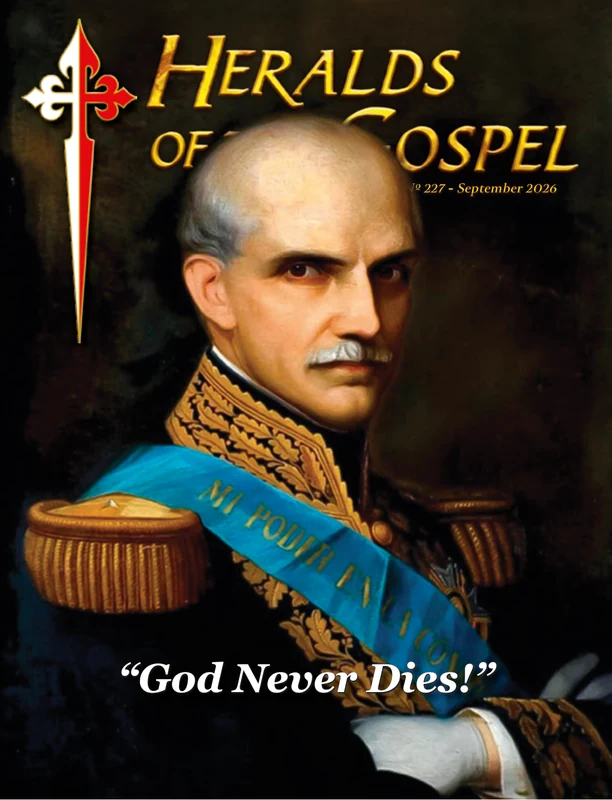
 Heralds of the Gospel Magazine, Vol. 20, nº 227, September 2026
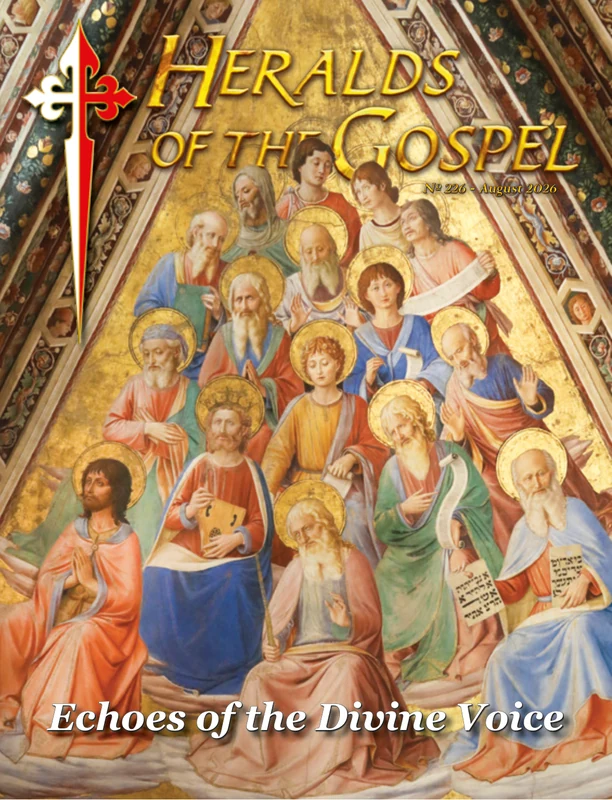 Heralds of the Gospel Magazine, Vol. 20, nº 226, August 2026
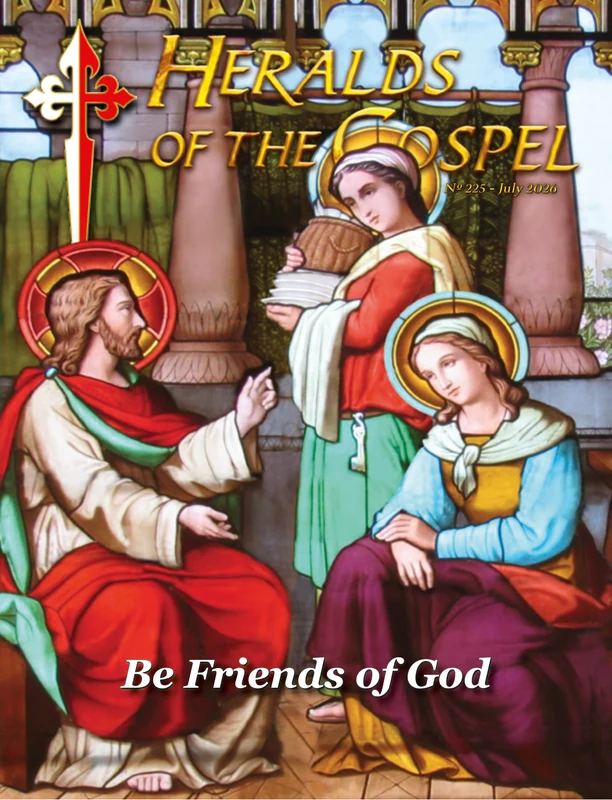 Heralds of the Gospel Magazine, Vol. 20, nº 225, July 2026
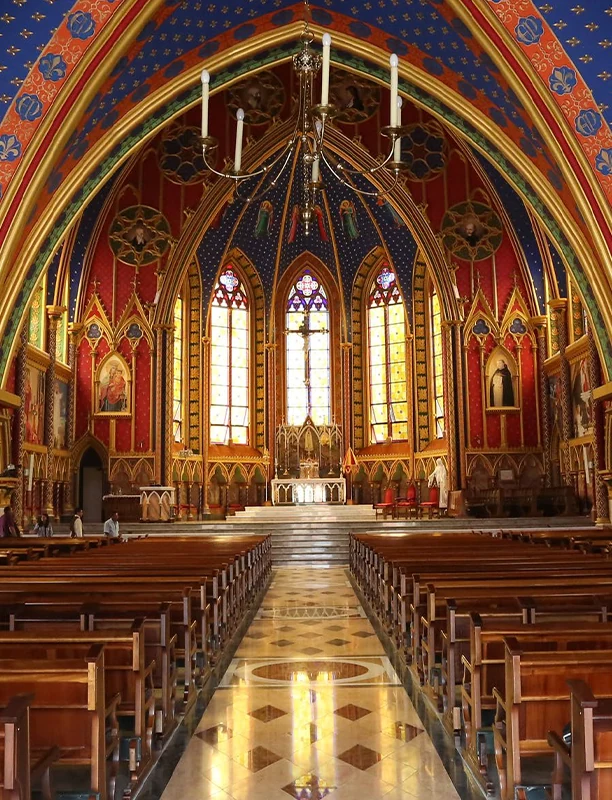 Who are the Heralds of the Gospel?
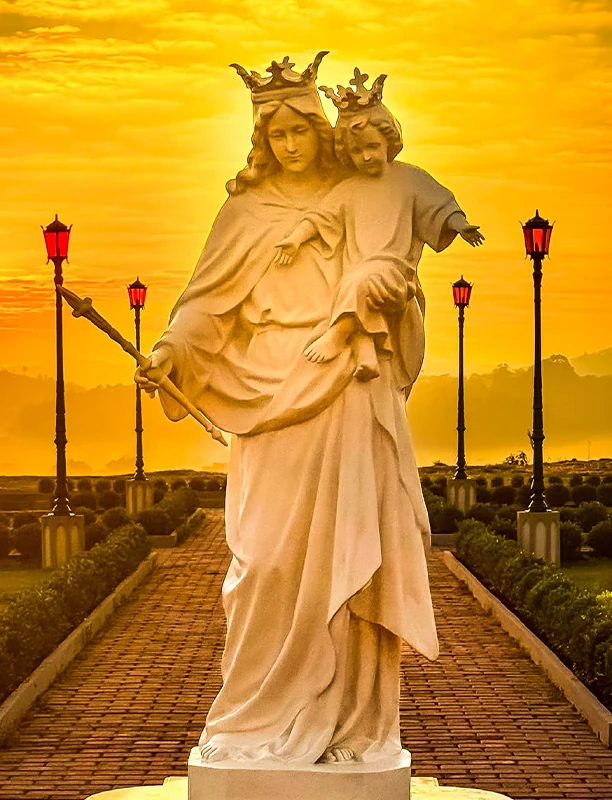 Help of Christians
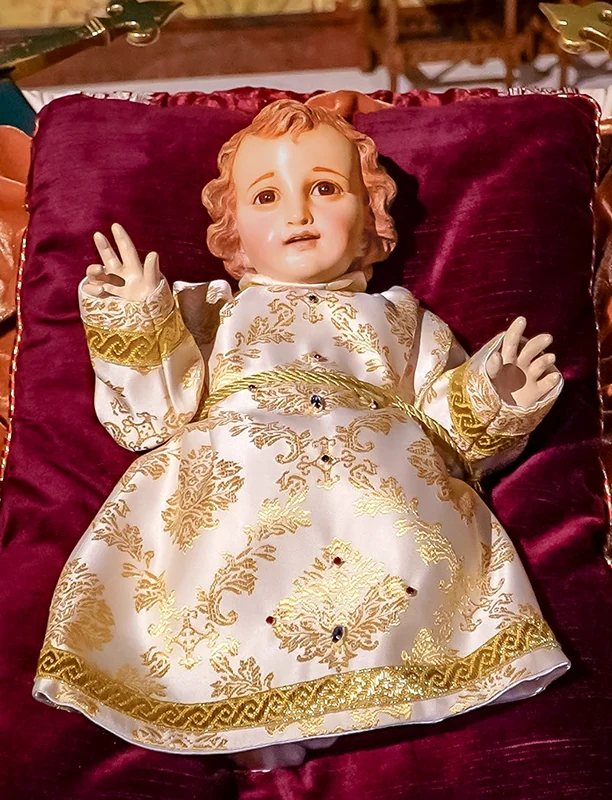 Christmas Carols






As he was taken up by a whirlwind of fire, Elijah threw his mantle over Elisha, the faithful disciple. The mantle, falling folded at the feet of his successor, symbolized the twofold transmission of the master’s spirit.
Thus, Elijah did not die: like the sun, he simply began to shine on new horizons, for “Elisha was filled with his spirit” (Sir 48:12).
Malachi, the last of the twelve minor prophets, in concluding his prophecies, foretells about the end times: “I will send you Elijah the prophet before the great and terrible day of the Lord comes” (Mal 4:5).
John the Baptist came “before Him in the spirit and power of Elijah” (Lk 1:17). Jesus Himself said He saw in him “Elijah who is to come” (Mt 11:14). And He even promises another prophet of equivalent stature: “Elijah does come” (Mt 17:11).
Meditating on these passages, an inevitable conclusion arises: there is a transmission of the spirit of Elijah which, as a precious inheritance, mysteriously passes from generation to generation.
What chain timelessly links men so distant from one another in an emblematic and mystical and spiritual lineage that, using the expression of Dr. Plinio Corrêa de Oliveira, we could call the Eliatic line?1
Let us return to the patriarch of the family.
Carmel, the cloud and the promise
Coming forth like an alliance of flame and storm, Elijah caused fire to fall three times, plunging the kings into ruin (cf. Sir 48:3, 6). However, contradictory as it may seem, he was the first devotee of Mary.
When he ascended Mount Carmel to implore Yahweh to end a great drought – a symbol of humanity awaiting Redemption – he saw a small cloud that foretold abundant rain.
In this tiny sign he glimpsed the “Virgin Mother of God herself, and thus the prophetic-monastic order of Carmel became entirely centred on Mary.”2
On the same summit, the Tishbite established “prophets to succeed” him (Sir 48:8), not only Elisha, but also many other disciples who lived in community there, where they had been entrusted to the Mother of the Saviour.
At that time, it could be said that the “sons of St. Elijah” lived practising what seems to be the flower of Elijah’s piety: slavery to Our Lady.3
John the Baptist came to confirm the Marian aspect of this symbolic lineage.
In everything similar to the prophets of Carmel – a virgin, an ascetic and an inhabitant of the mountains and deserts, he lived “following the example of Elijah and Elisha”4.
He surpassed them, however in intimacy with the promised Virgin as, upon hearing her voice, he was sanctified through her (cf. Lk 1:44).
The spirit of Mary
When viewed from a perspective that is both prophetic and Marian, everything becomes clear.
The chain that links such disparate figures to the same spirit can only be that of the slaves and devotees of the Blessed Virgin Mary, to whom they surrender everything, and to whom She gives herself entirely.
The spirit of Elijah thus presents itself as the very spirit of Our Lady, present and active in her most beloved children: “The spirit of Mary is that of holy slavery.”5
The Eliatic line is the repository of the Virgin’s spirit in that which most characterizes a prophet: mediation between the Almighty and men, “zeal for God’s glory […], along with aquiline agility for divine contemplation and holy wrath against the demons.”6
It is, so to speak, the historical prolongation of Mary’s presence, “an immense vein that, seen as a whole, ends up presenting itself to us as an assembly of men who touched each other at least with their fingertips.”7
Indeed, the presence of Our Lady was already felt in this land of exile before She was born.
Awaiting the prefigured One
In the Marian vein, Noah mirrored the Universal Queen, when he was moved “to invoke the merciful and just wrath of God”;8 by becoming the father of a new humanity, he prophesied the Mother of the redeemed.
Several other personages – such as Melchizedek and Rebekah – would represent some hues of the light that would be Mary, in the most decadent moments of the human race.
They would be the bridge of faithfulness built over these abysses: whether Noah under the waves of the flood, or Melchizedek in a polytheistic setting, or Elijah during the apostasy of Israel… each one prophesied in the desert the triumphant arrival of the “Little Cloud”.
A secret guarded throughout the centuries
Then came the “fullness of the time” (Gal 4:4) [DR]. And the vein, like a glorious and narrow isthmus, encountered the continent it longed for: Mary.
Finally, that sacred chain that had mysteriously coordinated the prophets of the Virgin-Mother would link, in the light of midday, her slaves of love.
St. John the Evangelist, through the mission that Jesus entrusted to him on the Cross to receive Mary into his home (cf. Jn 19:27), appears as the first one responsible for this epiphany.
In those moments of filial intimacy, it seems inconceivable that the Mother of the Church would not confide to him the secrets of her Heart, in particular regarding a closer relationship with her, later called the slavery of love.
Then followed, throughout history, a movement of special tenderness from those who placed themselves under the patronage of Our Lady.
To cite an early example, the oldest Marian prayer, the Sub tuum præsidium, a song of the soul of a servant who places himself in the hands of his Lady, is noteworthy:
“We fly to thy patronage, O Holy Mother of God. Despise not our petitions in our necessities, but deliver us always from all dangers, O glorious and blessed Virgin!”
If we also open the hagiography of the 10th century, we will find yet another example. In a solitary chapel, St. Odilo, abbot of Cluny, perpetually consecrated himself as a slave of the glorious Virgin.9
Proceeding past St. Bernard, St. Catherine of Siena and many other tabernacles of this special devotion, we discover, in the 18th century, “a man of fire, endowed with the spirit and strength of Elijah: St. Louis-Marie Grignion de Montfort.”10
It pertained to him to proclaim to the four winds the secret guarded by the Marian line: to become “the loving slaves of our Blessed Lady in order to become more perfect slaves of Jesus.”11
Until the end of the world
After the Apostle of Mary, did this lineage of the Virgin, which perpetuates her in moments of greatest moral catastrophe, come to an end? No.
In the very book in which he reveals this slavery, St. Louis also prophesies those who would be the last links in the Marian chain:
They will be true apostles of the latter times […] the blood-stained standard of the Cross on their shoulders. They will carry the crucifix in their right hand and the rosary in their left […]
Such are the great men who are to come. By the will of God Mary is to prepare them to extend His rule over the impious.12
Only this explains that, according to the Fathers of the Church, Elijah “will come in the second coming of the Saviour.”13
It will be his spirit, or rather the spirit of the slaves of Mary, that will confront the Antichrist (cf. Rev 11:3-12). But, since “now many antichrists have come” (1 Jn 2:18), it is not possible for the Mother and Lady to forsake her children and devotees.
Therefore, “in our turbulent times, which resemble a long, dark night, we should ask for this spirit of Elijah to return to shine over the world.”14