 Heralds of the Gospel Magazine, Vol. 20, nº 227, September 2026
 Heralds of the Gospel Magazine, Vol. 20, nº 226, August 2026
 Heralds of the Gospel Magazine, Vol. 20, nº 225, July 2026
 Who are the Heralds of the Gospel?
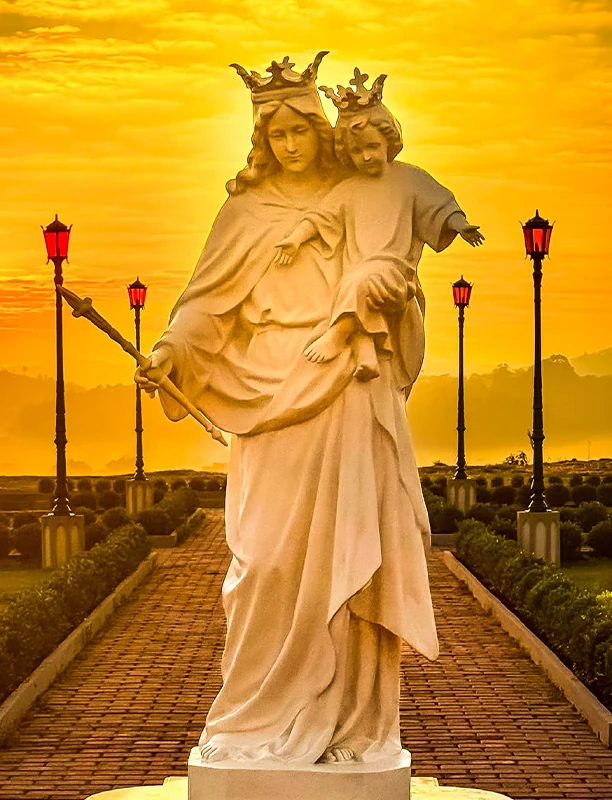 Help of Christians
 Christmas Carols








Do not be alarmed, dear reader, by the title of this article. Do not be alarmed, because we do not intend to recall here the conflicts of various kinds that afflict our world today…
Do not be alarmed, because we will neither advocate for war nor criticize it.
Do not be alarmed: we will only undertake the task of reminding you that every man is born a warrior. Yes, a warrior; a truth acknowledged since patriarchal times: “The life of man upon earth is a warfare” (Job 7:1).
From the moment man sees the light and utters his first whimper, his incipient war cry, until the last groan of the final struggle – for agony etymologically signifies combat, – he is placed in a huge and complex battlefield.
However, unlike the hostilities to which we are accustomed, in the struggle of life there are no borders that guarantee us security and protection, no peace treaties, no truces, no rearguard, no reservists.
Above all, final victory and definitive peace will never be achieved… on this earth.
In fact, even if a man deserts and leaves the battle, the battle will not abandon him.
Even if he has decided to lead a righteous life – in the practice of the Commandments of God’s Law and virtue, – the difficulties will not cease, his passions will cry out, his fears will accompany him.
And if he climbs the peaks of holiness, the struggle will intensify, because it is in the mountains that lightning strikes.
The combat of the spiritual life – for it is of this warfare that we are speaking – ends only with bodily death.

What to do about stumbling blocks?
But, if it is true that one cannot achieve a definitive victory before Heaven, it is more than proven that defeat is always at the door; and it often even knocks it down…
This is the cruel reality we face on so many occasions: failure.
It would be useless, however, to discuss our failures, since they are not new to anyone, and the extensive experience that the years accumulate is enough for us to be quite convinced of this.
What, however, becomes truly necessary is to know how to avoid them or to profit by them.
A classic example from spirituality can put us on the path toward a successful counterattack. Let us reflect on it.
The great problem for those who are standing is the risk of falling (cf. 1 Cor 10:12), especially if they are walking on rocky terrain.
However, the traveller who stumbles and loses his balance is forced to take a series of quicker steps in order to regain stability and not succumb. The result: he covers more ground in less time.
Something similar occurs in our spiritual life. It consists of a long journey towards Heaven, whose route is not only through a valley of tears, but also along a path with “stumbling blocks.”
However, thanks to such hindrances, we end up accelerating our pace and making greater progress: thus, he who slips into slander, if he runs to avoid falling, will begin to praise others; the person who loses patience will devise tactics for meekness so as not to relapse…
In a certain way, these impediments, when not wasted, give us a strengthening similar to a fractured bone which, after healing, becomes even more solid in the injured area.
If this solidification of the soul were not enough, setbacks further ground the spiritual life.
Humility is the foundation of all virtues, and the foundation of humility is humiliation; however, these are better when we do not choose them, so “it is good for our humility for us to be wounded in this spiritual warfare.”1
Aware of our nothingness, we have all the conditions to turn to Him who is All and can do all things.
Thus, in addition to urging us on and protecting us against future falls, these “stones” are a continuous reminder of two realities that man likes to forget.
Firstly, that we are weak and can achieve nothing alone… except a fall: “apart from Me you can do nothing” (Jn 15:5); secondly, everything is possible for us as long as we are sustained by grace: “I can do all things in Him who strengthens me” (Phil 4:13).
Let us give thanks to God, then, for difficulties and obstacles!
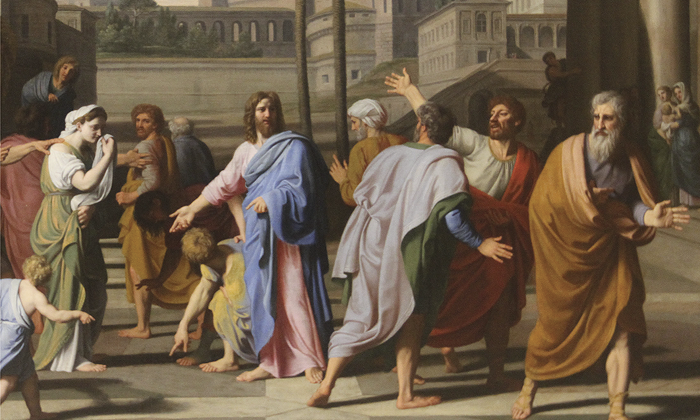
Let the dead arise!
That stumbling in the spiritual life can be useful seems to have become clear. But we do not always manage to regain our balance and remain standing. At such moments, is there any solution?
The answer is as simple as it is obvious: get up.
“But if we do fall,” advises St. Francis de Sales, “[…] rise up immediately as if you had not fallen. […] Weakness is not a great evil, and there is great value in raising oneself little by little.”2
And the illustrious Doctor of the Church does not leave out those who have the misfortune not only to fall, but even to die spiritually by offending God with mortal sin:
Provided there is no desire to remain or to fall asleep in evil, falls into mortal sin do not impede the progress that has been made through devotion. […] one recovers it with the first repentance for this sin.3
“Provided there is no desire to remain or to fall asleep…” So, has someone who remains an enemy of God for a long time lost the opportunity to turn back? Is there a remedy for prolonged death?
In spiritual medicine – more effective than that of the body – yes: even for the dead there is a cure!
In fact, although mortal sins are all the more deleterious to the soul the longer it remains in this lamentable state, forgiveness will not for that reason be denied to those who kneel in the confessional with contrition.
Worse than sin
Therefore, “if we do fall, we should try to be prepared to do everything before losing enthusiasm, hope, and resolve.”4
Otherwise, the stab wound to the Sacred Heart of Jesus will be even deeper, as He Himself explained to the Spanish mystic Sister Josefa Menéndez: “It is not sin that wounds My Heart most. What breaks it is that souls do not want to take refuge in Me after they have committed it.”5
In other words, there is something in the world worse than sin, and its name is discouragement.
By knocking us down through sin, the devil seeks above all to drag us into the abyss of despair. He knows well that “our salvation has two mortal enemies: presumption while innocent, and despair after a fall. The second is the more terrible.”6
Millennia of continuous practice have taught him that if he takes away our impetus and courage, he wins the battle. Indeed, “in this war we are always victorious, provided that we are willing to fight.”7
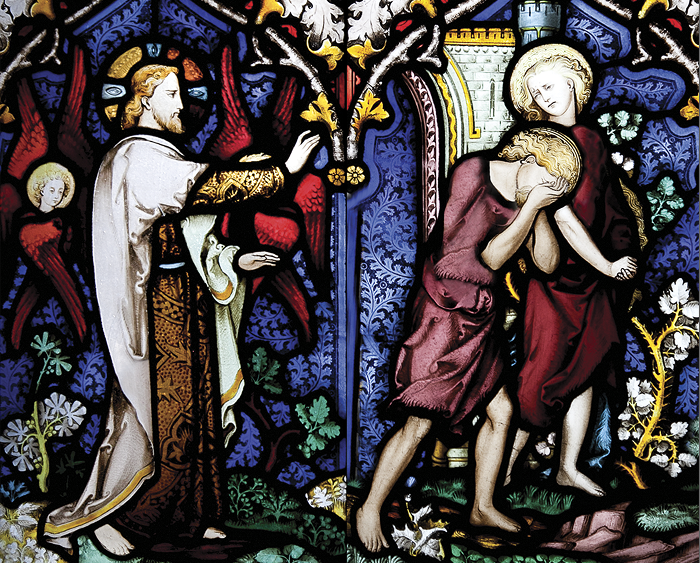
We are what was missing in Paradise
We have already briefly analysed the best solutions for the copious setbacks in our daily struggle: upon stumbling, run; upon falling, get up; in any case, do not despair!
But would it not be simpler to uproot the problem? Would it not be better if there were no such immense “stumbling block factory” as are the temptations of the devil, the world, and the flesh?
Could we not have the life that was lived in Paradise before the accursed Serpent appeared?
Oh, what a delightful life man had before sin!… He was served by plants and beasts, strolled through ever-fragrant gardens, harvested fruits that were more delicious each day, next to crystalline lakes… In Paradise there was everything!
Everything? “Paradise had everything, except a hero,”8 stated Dr. Plinio Corrêa de Oliveira.
Therefore, the expulsion from Eden was, more than a punishment, the promotion of man to the state of warrior, so that he could demonstrate to God a selfless love, which is only revealed in sufferings and in the storm.
In this sense, St. Alphonsus Liguori teaches that “the soul, being idle, without temptations and without struggles, is in danger of being lost.”9
In serious danger, to be precise, since it is threatened with clinging to this earth and forgetting the practice of the most important – and forgotten – of the commandments: “you shall love the Lord your God with all your soul” (Dt 6:5; Mt 22:37).
It is a good thing that God is God and we are not in His place.
Because, if we were the Creator, we would certainly have idealized a different world, in which there would be no possibility of error, suffering would be abolished, and sin would find no dwelling place: a world, therefore, that would be incomplete.
Why incomplete?
“And God rested”
To answer this question, let us go back to the beautiful account of creation contained in the Book of Genesis. For six days, myriads and myriads of wonders with which Divine Omnipotence deigned to adorn the universe came into being.
At the end of this period, “God saw everything that He had made, and behold, it was very good” (Gn 1:31). Only then did He rest.
St. Ambrose, commenting on this sublime passage, clarifies the reason why such rest occurred only on the seventh day: God
created the heavens and I do not read that He rested; He created the earth and I do not read that He rested; He created the sun, the moon, and the stars and I do not even read then that He rested; but I read that He created man and that at that moment He rested, having a being whose sins He could forgive.10
The Lord rests by forgiving.
The created universe would not be complete if the Almighty did not have the opportunity to reflect all His attributes in it, especially His mercy and forgiveness, in which His power shines supremely, since “God’s omnipotence is particularly shown in sparing and having mercy.”11
Now, these most ineffable divine attributes would not be evident if man were not an erring being, and capable of asking for forgiveness.
Therefore, temptations and their consequences – which we would have relentlessly eradicated from “our paradise” – are the indispensable shadows that serves as an aesthetic contrast in the work of art of creation: they make the innocence of the faithful soul even brighter and enhance the radiance of the one that has been forgiven.
So, what reasons could lead us to distrust divine mercy and become discouraged?
Our stumbling? But if they bring us closer to Heaven at a faster pace, why should we be saddened?
Sin? But if God did not hesitate to mould humanity with the possibility of sinning, will He waver at the moment of forgiveness, since to grant it He lived among us and died for us?
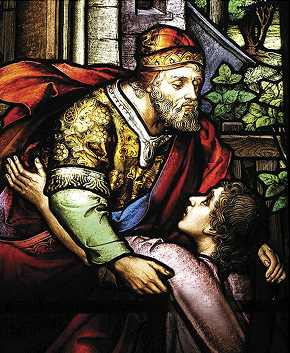
Discouragement itself? If our Mother is the very Mother of God, is it possible to lose the courage to return to the Father’s house? Is it possible to be doubtful of being forgiven?
Neither difficulties, nor falls, nor sins will make us distrust and lose heart, “for however miserable one may be, God is merciful toward those who truly want to love Him and who have placed all their hope in Him.”12
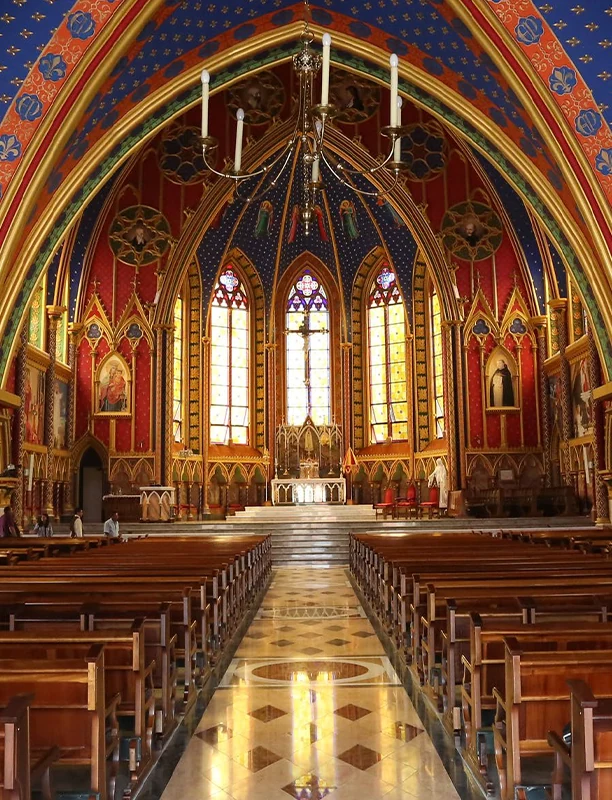
the Baptist Cathedral, Charleston (North Carolina)