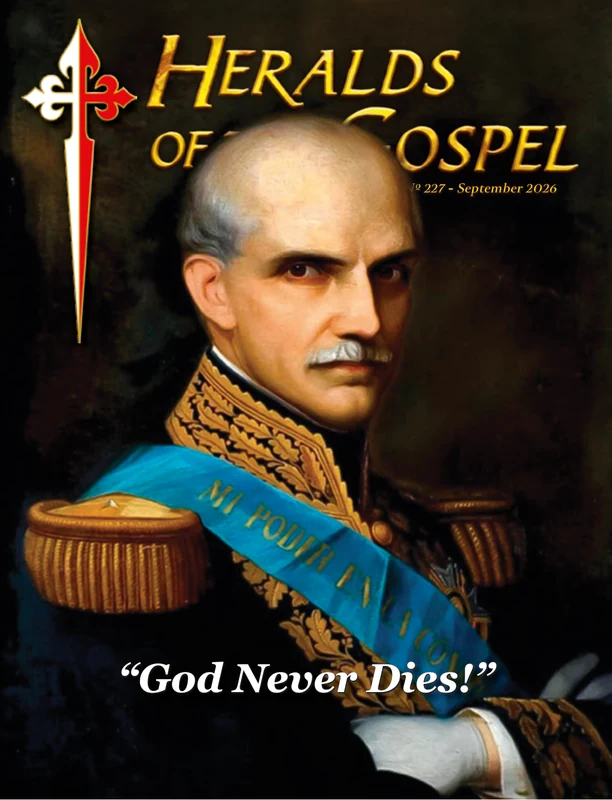
 Heralds of the Gospel Magazine, Vol. 20, nº 227, September 2026
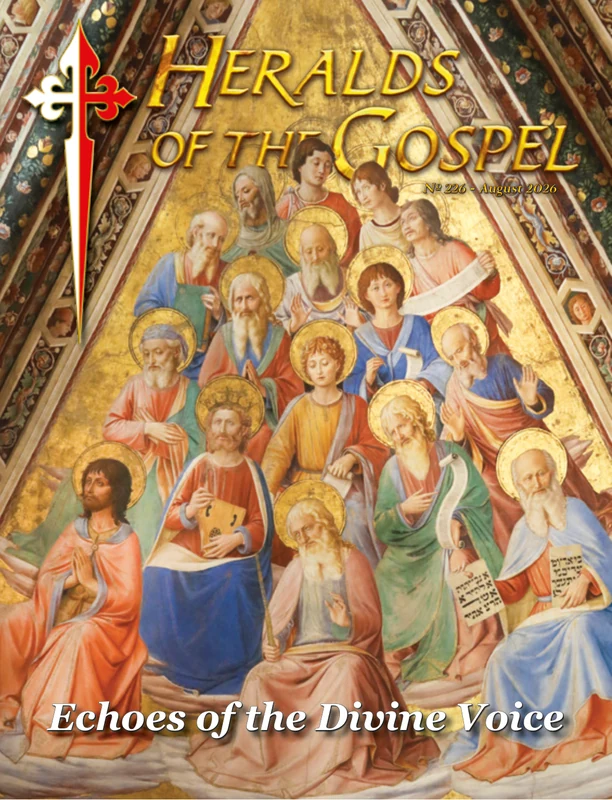 Heralds of the Gospel Magazine, Vol. 20, nº 226, August 2026
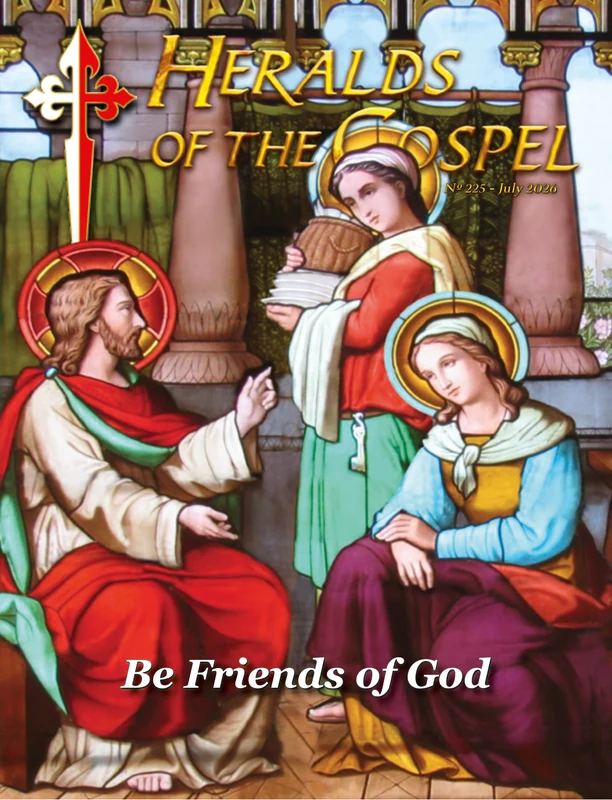 Heralds of the Gospel Magazine, Vol. 20, nº 225, July 2026
 Who are the Heralds of the Gospel?
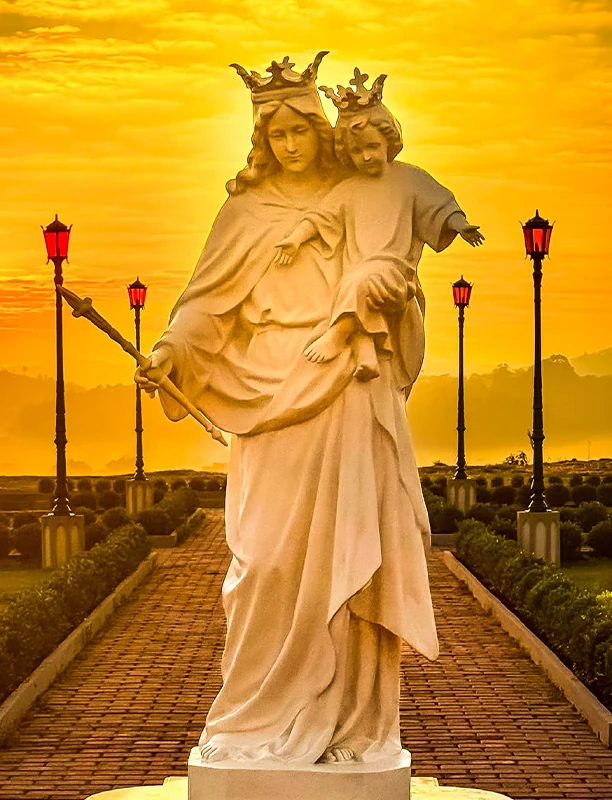 Help of Christians
 Christmas Carols








Gospel – 9th Sunday in Ordinary Time1
23 As Jesus was passing through a field of grain on the Sabbath, His disciples began to make a path while picking the heads of grain. 24 At this the Pharisees said to Him, “Look, why are they doing what is unlawful on the Sabbath?” 25 He said to them, “Have you never read what David did when he was in need and he and his companions were hungry? 26 How he went into the house of God when Abiathar was high priest and ate the bread of offering that only the priests could lawfully eat, and shared it with his companions?” 27 Then He said to them, “The Sabbath was made for man, not man for the Sabbath. 28 That is why the Son of Man is Lord even of the Sabbath.”
3:1 Again He entered the synagogue. There was a man there who had a withered hand. 2 They watched Him closely to see if He would cure him on the Sabbath so that they might accuse Him. 3 He said to the man with the withered hand, “Come up here before us.” 4 Then He said to them, “Is it lawful to do good on the Sabbath rather than do evil, to save life rather than to destroy it?” But they remained silent. 5 Looking around at them with anger and grieved at their hardness of heart, He said to the man, “Stretch out your hand.” He stretched it out and his hand was restored.
6 The Pharisees went out and immediately took counsel with the Herodians against Him to put Him to death (Mk 2:23—3:6).
I – Where Is the Absolute Found?
Who, as a child, has not carried out the simple experiment of planting a seed – perhaps a bean – and covering it with a cardboard box, in which a hole is made on the side opposite to where the seed was planted? Every now and then the lid is lifted to water the seed and, depending on the child’s level of curiosity, to check if it has sprouted. Before long the seed does germinate, a sprout appears and – oh, surprise! – the stem, which had emerged upright from the soil, starts turning in search of the light. Over the next few days excitement mounts as the stalk makes its long journey until finally appearing through the opening in the box. This botanical phenomenon is called heliotropism, a term of Greek origin signifying movement in search of the sun. Heliotropism is amply observed in the clearly defined seasons of the Northern Hemisphere. With the arrival of spring, the slight tilt of the earth toward the sun makes the barren winter trees burst into bloom. The foliage always seeks the rays of the sun and, curiously, there is no such thing as a capricious or rebellious leaf that hides from its influence.Created to love and know the Infinite
God sets the orderly plant kingdom before our eyes to symbolize a much higher and nobler aspiration found in Angels as well as in the human soul, which could be called “theotropism” – the turning toward God. Accordingly, from the first glimmer of reason, man begins to search for the Absolute. To use metaphoric language, it could be said that the heart is created with a window open to the infinite, which continually impels it toward the true, the good, and the beautiful, without which it would be impossible for us to seek a supernatural end.The Lord fashioned us in this way to make us conscious of our dependency and our subjection to a much superior being. No matter how strongly a person may declare himself an atheist, he is never so self-sufficient as to be able to live entirely dissociated from this desire for God! As long as man does not set up obstacles and is faithful to this natural appetite, he will be justified, that is, he will attain effects identical to sacramental Baptism.2 We find this in the lives of certain saints, including the African Josephine Bakhita. Uninformed regarding the Faith in early life, she wondered who had created the sun, the moon and the stars, and she delighted in paying homage to this great “patron”3 of the universe, as she called Him. Made to know and love the Infinite and to be known and loved by Him, man only attains full happiness in giving himself to God, for no other creature that we love, or any activity that we undertake can entirely satisfy us. Why, then, do so many people rush headlong into the abyss of sin? Illusion is the culprit, for man, of himself, is incapable of practising evil for the sake of evil, or error for the sake of error.4 When a person gives in to a sinful pleasure prohibited by God’s Law, or even when he commits a crime, he believes, deep down, that it will afford him some kind of happiness.Made to know and to love the Infinite, and to be known and loved by Him, man attains full happiness only by giving himself to God
The two paths that lay open to man
Sooner or later in life, two paths open before us: we can opt to make an idol out of what is relative, such as career, money or social relationships, or we can choose to embrace the true Absolute, who is God, and acknowledge our dependence on Him. This choice maintains the health of the soul, and even physical health… In the supernatural field, the more I love, the more my appetite grows, until it attains unimaginable dimensions. Thus it was with Our Lady, in whom the fire of divine ĵlove passed all earthly proportion, and She passed from this life to the next.On the opposite extreme, when a person removes God from the centre of his thoughts and affections and takes creatures to be absolute, he loses his equilibrium; the heart becomes insensible to God, the intelligence becomes dulled and the person concerns himself only with the concrete and material. The insatiable grasping after glory, the desire to satisfy personal vanity, to call attention to oneself, to dominate, to be praised and applauded provides fleeting happiness but introduces a seed of spiritual infirmity in the soul which eventually results in frustration. This happened to St. Peter when he walked upon the sea: for thinking of himself, he began to sink in the turbulent waters (cf. Mt 14:30). We will find yet another example of this in the Gospel for the 9th Sunday in Ordinary Time, in the attitude of the Pharisees in relation to Our Lord Jesus. They were concerned with the Law, and they forgot to look at God himself, who was in their midst! Why? Because fulfilment of the precepts was to their advantage, assuring their status and giving them pre-eminence in society. Consequently, it was not even the Law that they placed at the centre, but themselves! This is a typical case of spiritual absolutism that Jesus will punish by violently wielding His divine word.We have two paths open before us: either we make an idol out of what is relative, or we must embrace the true Absolute, who is God, acknowledging our dependence on Him
II – Adore the Sabbath or Adore the Lord of the Sabbath?
23 As Jesus was passing through a field of grain on the Sabbath, His disciples began to make a path while picking the heads of grain.
In the presence of Christ: either antipathy or the desire to follow…
24 At this the Pharisees said to Him, “Look, why are they doing what is unlawful on the Sabbath?”

Now, we cannot impute a spirit of contention to the Apostles, as if they acted in this way for the pleasure of provoking the Pharisees. In fact, they preferred not to rankle or argue with the latter, but on this occasion they were driven by hunger. In carrying out their apostolic obligations they had expended much energy; undoubtedly they had already exceeded the quantity of steps stipulated by the Pharisaic code, according to which it was forbidden to walk more than two thousand cubits outside the city – slightly more than one kilometre – on the Sabbath.8 In crossing the wheat field, then, they had the right to take some nourishment, which was permitted by custom on any day of the week. Additionally, by faith, the disciples had accepted the divinity of Our Lord Jesus Christ and, believing Him to be above all else, they considered the rest to be secondary – the stalks, the Sabbath law, the Pharisees… Sincere enthusiasm prompted them to follow Him who was more important, to assimilate His doctrine and be in harmony with His way of being. For this reason, they pacified their stomachs with those grains of wheat so that, free from material concerns, they could accompany Jesus up close, even side by side, with true familiarity, holding on to His every word, attitude and gesture!The disciples accepted the divinity of Our Lord; believing Him to be above everything, they considered all else – the grain, the Sabbath law, the Pharisees – to be on a secondary plane
The Divine Master puts the Pharisees in a situation of contradiction
25 He said to them, “Have you never read what David did when he was in need and he and his companions were hungry? 26 How he went into the house of God when Abiathar was high priest and ate the bread of offering that only the priests could lawfully eat, and shared it with his companions?”
But we must not think that Our Lord sought to goad the Pharisees and teachers of the Law to condemn them. Rather, He wanted to convert them, and acted charitably – He is Charity! – in order to cure them of the baneful disease from which they suffered: pride. Their view of reality was clearly impoverished; the old Asian adage could be applied to them: “When the wise man points to the moon, the fool looks at his finger.” Similar to the ancient peoples who adored idols of wood or metal, they stooped to the folly of erecting the relative as absolute, deifying those petty rules, instead of raising their sights and contemplating God! The Divine Master refuted them for this more incisively than He had in other circumstances, pronouncing a powerful argument in recalling an undeniable fact that they would have preferred to overlook just then. He cited the historic episode of David, their highest figurehead, the model of holy king and prophet.Just as ancient peoples worshipped idols, the Pharisees and Scribes had fallen into the error of holding up the relative as the absolute, deifying petty rules

“Man was made for Me…”
27 Then He said to them, “The Sabbath was made for man, not man for the Sabbath. 28 That is why the Son of Man is Lord even of the Sabbath.”
Declaring to the Pharisees “The Sabbath was made for man, not man for the Sabbath,” was tantamount to saying: “Man was made for Me and not for the Sabbath.” In fact, this day of the week set aside for the Lord was established so that the people would revolve their lives around Him. The Covenant established by God with Israel, in delivering to them the stone tablets with the Decalogue, as well as through the promises made to the patriarchs, was aimed at man and not at the institution of the Sabbath. This Covenant would only be fully realized in Our Lord Jesus Christ and in the Roman Catholic and Apostolic Church founded by Him.The real crime was committed by those who criticized the Apostles: they denied Our Lord, rejecting the unmistakeable signs that He was the Messiah

Unable to act, but confiding in Jesus
3:1 Again He entered the synagogue. There was a man there who had a withered hand. 2 They watched Him closely to see if He would cure him on the Sabbath so that they might accuse Him.
Another chance for conversion rejected by the Pharisees
3 He said to the man with the withered hand, “Come up here before us.” 4 Then He said to them, “Is it lawful to do good on the Sabbath rather than do evil, to save life rather than to destroy it?” But they remained silent.
Furthermore, rescuing an animal that had fallen into a well or saving a human life was authorized by the regulations of the masters,10 and many of those present had been in such situations, perhaps easing their consciences afterwards with a donation that promptly went to fill the pocket of the high priests… The expression “to destroy it” made the subject even more compelling, for it was equivalent to asking: “Should we grant someone life, or kill him? Can one contribute to a homicide or is it obligatory to stop it?” Who would dare utter a word? They were between a rock and a hard place, and the only way out was to admit that the Saviour was right, “But they remained silent.”Aware of the bad intentions they harboured inwardly, Our Lord sought to do them good and to give them another chance, with a view to saving them
Anger and grief: the extremes of a Divine Heart
5a Looking around at them with anger and grieved at their hardness of heart…
Out of goodness, He chose to cloak the miracle in ambiguity…
5b …He said to the man, “Stretch out your hand.” He stretched it out and his hand was restored.

This is the spirit of the wicked…
6 The Pharisees went out and immediately took counsel with the Herodians against Him to put Him to death.
III – Do I Have a Withered Hand?
Considered from a mystical viewpoint, the man with the withered hand represents, says Venerable Bede, “mankind, withered by unfruitfulness in good works […], because of the hand of our first parent, stretched out to take the fruit from the forbidden tree.”13 In effect, through the sin of Adam, humanity became sterile, incapable of gaining merit. But it was cured “by the grace of the Redeemer, when He stretched out His innocent hands on the tree of the Cross.”14 Thus, by His Passion, Our Lord Jesus Christ restored to men the possibility of producing extraordinary fruits.When a person who, having received, in Baptism, the “hand” of the theological and cardinal virtues and the gifts of the Holy Spirit, does not use this for the glorification of the Church, it withers and functions ineptly, to the detriment of the Mystical Body of Christ. This happens with all the egoists, the self-worshippers, those who withdraw their hand from helping their neighbour, and those who embrace sin: the virtues no longer operate for the benefit of others and their everyaction becomes ineffectual. They sow cactuses and harvest thorns! Their life is one of insecurity, bitterness, and slavery, for God does not bless their works. We know that, conversely, the soul of the apostolate is the interior life, which, in turn, is based on faith and piety. Those at the apex of fervour bring forth the marvel of a fruitful missionary work which can even spring up from sandy soil! Man stretches out his hand to others and God gives the good results, as St. Paul states: “So neither he who plants nor he who waters is anything, but only God who gives the growth” (1 Cor 3:7).In curing the man with the withered hand, Our Lord preferred not to make it obvious that He was the Author of the prodigy, out of goodness towards those hardened hearts

The irreconcilable hatred between good and evil
But let us not be deceived: when we resolve to practise the good, some will thank us – rather weakly, most often – and others will hate us, with far greater virulence than the acknowledgement of the former. What is the reason for this hatred? Let us consider Our Lord: It was not because He cured a man with a withered hand or because He had violated the Sabbath that the Pharisees and Herodians wanted to kill Him. Rather, it was because in publicly revealing himself, such was His divine presence that He divided the camps, as Simeon had foretold: “Behold, this Child is set for the fall and rising of many in Israel, and for a sign that is spoken against […], that thoughts out of many hearts may be revealed” (Lk 2:34-35). Those who accepted the graces of faith that He brought promptly believed; those who rejected them, hated Him, also immediately.Those who raise objections against the good always demonstrate their indulgence toward evil, yet no one can understand those who embark on the path of evil… It is the mystery of iniquity! This irreconcilable hatred implies a sin against the Holy Spirit – to deny the known truth15 – which “never has forgiveness” (Mk 3:29). It is a total rejection of Truth, Goodness, and Mercy in essence, namely, the Second Person of the Blessed Trinity, and therefore, hatred of God. Logical arguments are of no avail against this bad will – not even the magnificent éclat of virtue succeeds in persuading. Such enmity has existed ever since satan and his followers revolted against God in Heaven, and will endure until the end of the world (cf. Gn 3:15). Just as the teachings and wisdom of Jesus grew in refulgence over the course of His earthly life (cf. Lk 2:52), so also, over the various historical ages, His figure reflected in the Church is continually being revealed in its many facets, and we see the truth becoming more brilliant each day, and holiness more resplendent. Even the attacks suffered by the Church or the heresies that arise contribute to this end (cf. 1 Cor 11:19), for they demand special graces from the Holy Spirit which enlighten those who study to defend her. In this way she increases in explicit beauty.Our Lord’s presence was such that He divided the camps when He publicly manifested himself: those who accepted the graces He offered readily believed; those who rejected them hated Him

In the fight for the good, let us deal wisely with evil
In the two episodes related in the Gospel for this 9th Sunday in Ordinary Time, Our Lord shows that the champions of the good should be wise, clever, sagacious, and always on the alert to avoid falling prey to evil; on the contrary, the good should always outwit evil. What a lesson to be imitated! Let us learn to deal with evil as the Lord does, understanding that it is a ruthless adversary, capable of taking matters to their ultimate consequences, namely, of bringing us to martyrdom, like Jesus.When we are misunderstood and persecuted for love of justice, let us know how to practise resigned and joyful acceptance which draws us closer to Our Lord. He showed both anger and grief with regard to the hardened hearts of the Pharisees. And this, precisely, should be our disposition of soul: indignation against the reckless folly of opposing God, and pity that inspires us to pray for our persecutors. ◊The enmity between the good and the wicked will last until the end of the world. Those who side with the good must be wise and wary so as not to fall into the traps of the wicked
Notes
1 Since this Magazine has already published all of Msgr. João’s Gospel commentaries for the Sundays in Ordinary Time corresponding to the month of June, as well as that for the Solemnity of Corpus Christi in Year B, we offer our readers this beautiful Gospel commentary for the 9th Sunday in Ordinary Time, observed in Brazil and in some dioceses of the English-speaking world where Corpus Christi is celebrated on the Thursday after the Solemnity of the Holy Trinity.
2 Cf. ST. THOMAS AQUINAS. Summa Theologiæ, I-II, q.89, a.6.
3 DAGNINO, Maria Luisa. Bakhita: da escravidão à liberdade. (Ed.2). São Paulo: Loyola, 2000, p.58.
4 Cf. ST. THOMAS AQUINAS, op. cit., q.27, a.1, ad 1.
5 Cf. SHABAT, M 7, 2. In: BONSIRVEN, SJ, Joseph. (Ed.). Textes rabbiniques des deux premiers siècles chrétiens. Roma: Pontificio Istituto Biblico, 1955, p.160.
6 Cf. SHABAT, C.VIII, 10a. In: GUGGENHEIMER, Heinrich Walter (Ed.). The Jerusalem Talmud. Second order: Mo‘ed. Tractates Šabbat and ‘Eruvin. Berlin-Boston: W. de Gruyter GmbH & Co. KG, 2012, p.272.
7 ST. CYRIL OF ALEXANDRIA. Explanatio in Lucæ Evangelium, c.VI, v.2: MG 72, 575.
8 Cf. ERUVIM, M 4, 3. In: BONSIRVEN, op. cit., p.193.
9 TUYA, OP, Manuel de. Biblia Comentada, vol. V: Evangelios. Madrid: BAC, 1964, p.279.
10 Cf. SHABAT, B 117b; YOMÁ. M 8, 6-7. In: BONSIRVEN, op. cit., p.166; 231.
11 BERTHE, CSsR, Augustin. Jesus Cristo, sua vida, sua Paixão, seu triunfo. Einsiedeln: Benziger, 1925, p.134.
12 FILLION, Louis-Claude. Vida de Nuestro Señor Jesucristo, vol. II: Vida pública. Madrid: Rialp, 2000, p.71.
13 ST. BEDE. In Marci Evangelium Expositio, lib.I, c.3: ML 92, 155.
14 Idem, ibidem.
15 Cf. ST. THOMAS AQUINAS, op. cit., II-II, q.14, a.2.