 Heralds of the Gospel Magazine, Vol. 20, nº 227, September 2026
 Heralds of the Gospel Magazine, Vol. 20, nº 226, August 2026
 Heralds of the Gospel Magazine, Vol. 20, nº 225, July 2026
 Who are the Heralds of the Gospel?
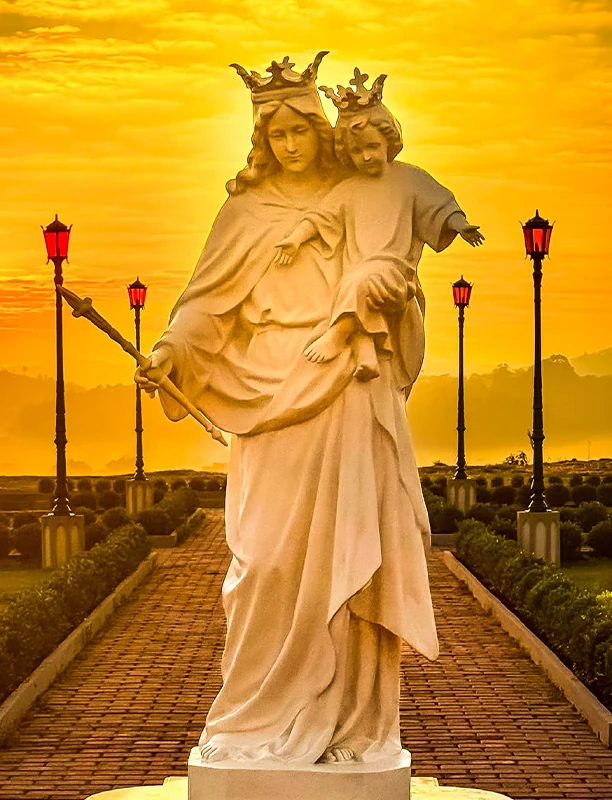 Help of Christians
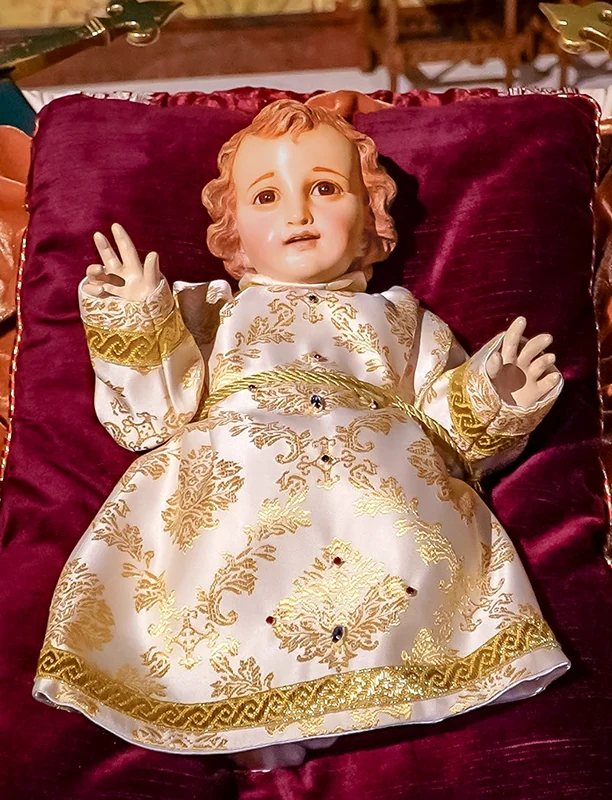 Christmas Carols






Gospel of the Nativity of the Lord – Vigil Mass
1 The book of the genealogy of Jesus Christ, the Son of David, the Son of Abraham. 2 Abraham became the father of Isaac, Isaac the father of Jacob, Jacob the father of Judah and his brothers. 3 Judah became the father of Perez and Zerah, whose mother was Tamar. Perez became the father of Hezron, Hezron the father of Ram, 4 Ram the father of Amminadab. Amminadab became the father of Nahshon, Nahshon the father of Salmon, 5 Salmon the father of Boaz, whose mother was Rahab. Boaz became the father of Obed, whose mother was Ruth. Obed became the father of Jesse, 6 Jesse the father of David the king. David became the father of Solomon, whose mother had been the wife of Uriah. 7 Solomon became the father of Rehoboam, Rehoboam the father of Abijah, Abijah the father of Asaph. 8 Asaph became the father of Jehoshaphat, Jehoshaphat the father of Joram, Joram the father of Uzziah. 9 Uzziah became the father of Jotham, Jotham the father of Ahaz, Ahaz the father of Hezekiah. 10 Hezekiah became the father of Manasseh, Manasseh the father of Amos, Amos the father of Josiah. 11 Josiah became the father of Jechoniah and his brothers at the time of the Babylonian exile. 12 After the Babylonian exile, Jechoniah became the father of Shealtiel, Shealtiel the father of Zerubbabel, 13 Zerubbabel the father of Abiud. Abiud became the father of Eliakim, Eliakim the father of Azor, 14 Azor the father of Zadok. Zadok became the father of Achim, Achim the father of Eliud, 15 Eliud the father of Eleazar. Eleazar became the father of Matthan, Matthan the father of Jacob, 16 Jacob the father of Joseph, the husband of Mary. Of her was born Jesus who is called the Christ. 17 Thus the total number of generations from Abraham to David is fourteen generations; from David to the Babylonian exile, fourteen generations; from the Babylonian exile to the Christ, fourteen generations.
18 Now this is how the birth of Jesus Christ came about. When His Mother Mary was betrothed to Joseph, but before they lived together, She was found with child through the Holy Spirit. 19 Joseph her husband, since he was a righteous man, yet unwilling to expose her to shame, decided to divorce her quietly. 20 Such was his intention when, behold, the Angel of the Lord appeared to him in a dream and said, “Joseph, son of David, do not be afraid to take Mary your wife into your home. For it is through the Holy Spirit that this child has been conceived in her. 21 She will bear a Son and you are to name Him Jesus, because He will save His people from their sins.” 22 All this took place to fulfill what the Lord had said through the prophet: 23 Behold, the Virgin shall conceive and bear a son, and they shall name Him Emmanuel, which means “God is with us.” 24 When Joseph awoke, he did as the Angel of the Lord had commanded him and took his wife into his home. 25 He had no relations with her until She bore a Son, and he named Him Jesus (Mt 1:1-25).
I – Proximate Preparation for the Birth of God
After the four-week period of Advent, the Vigil Mass of the Nativity of the Lord permits us, even before commemorating the arrival of the Child Jesus at midnight, to begin to feel graces that fill our hearts with joy. These graces, distributed daily from the altar throughout the whole world when He comes to us in the Eucharist, intensify during this great Solemnity in which we celebrate, liturgically and mystically, the Word Who became flesh among us, a joyous event heralded by choirs of Angels.Therefore, we should ardently desire that the Divine Infant come, not only to the Grotto of Bethlehem, but also to each one of us, to establish His dwelling place within us. We should also desire that He be born without delay and in an efficacious manner within the souls of all who dwell upon the earth, fulfilling what He Himself taught us to request in the perfect prayer, repeated by the Church over the course of two thousand years: “Thy Kingdom come. Thy will be done, on earth as it is in Heaven” (Mt 6:10).Christ was born in the fullness of time, at the apex of history, in an epoch reserved by Him as the most opportune and the most in need

II – A God of Human Ancestry
What was the historical moment chosen by God to become flesh? According to St. Thomas Aquinas,1 it was not fitting that the Saviour come immediately after the fall of Adam and Eve in Paradise. As the root of sin was pride, it was necessary that man, humiliated at the sight of his own misery, acknowledge the need for a liberator. If he had immediately received the remedy he would have undervalued the Creator, overlooking his own infirmity. The Angelic Doctor2 further adds that it would also not have been appropriate to delay the Incarnation until the end of the world, so that the knowledge of and reverence due to God, as well as the integrity of moral values, would not completely disappear from the face of the earth.The fullness of time
We can conclude then that, as “God decreed everything by His wisdom,”3 Christ was born in the “fullness of time” (Gal 4:4), at the apex of history, in an epoch reserved by Him as the most opportune and the most in need. Therefore, it is by reason of Him, and not merely by observing chronological criteria, that the eras were divided and everything was organized and adapted. Given that Providence’s action upon the world can be reduced to governing with the goal of His own glory and the salvation of men, Our Lord’s role of Saviour places Him all the more rightly in the centre of events. This mission of Jesus, exercised within a specific historical context, is put in special relief by the first – apparently irrelevant – part of the Gospel that the Holy Church designates for our consideration on this Vigil. Having already explained verses 18-25 of this passage in the previous article,4 we limit ourselves to commenting on verses 1-17.God and Man in just one Person
1a The book of the genealogy of Jesus Christ...

When the Catholic Church began to expand by the preaching of the Apostles, doctrinal instruction was indispensable for the proper preparation of the neophytes. While the truths of the Faith are presented to us today with all simplicity, at that time, certain concepts were taken as absurd. For some, it was easy to admit that the Saviour was Man; others, such as the converted Jews, were led by faith to readily accept the dogma of the divinity of Our Lord. The great problem lay in accepting that He was Man and God at the same time! In the first centuries, serious problems arose in this regard; objections concerning the Person of Jesus perturbed the people. The Apostles had to instruct them on questions such as: “Was He Man?”; “Where was He born?”; “Whose Son is He?”; “How can God be the Son of a woman?”; “Where did His power come from?” St. Matthew’s intention was to point out, illustrate, and emphasize Christ’s humanity, proving by these forty-two generations that He is Man, born of a woman, with a genealogy; a Son of Adam and Eve. He possessed a complete human nature, conceived in flesh – but by the hand of God, in an entirely miraculous and ineffable manner. Thus, Our Lady, a mere creature, by having given her consent and having supplied the matter for the formation of Jesus’ Body, is Mother of God.In describing the genealogy of Our Lord, the intention of the Evangelist was to illustrate the humanity of Christ, proving that He is true Man, but that He was conceived by divine power
The symbolism of numbers
The number forty-two is symbolic, for in reality, these generations encompass a wide interval – approximately 2,130 years, according to Fillion6 – and the number must have, in fact, been greater. The Evangelist divides them into three sections of fourteen: starting from Abraham to David, from David to the Babylonian exile, and from the latter to the Messiah. “The Jews were partial to dividing their genealogies into somewhat contrived groups, according to predetermined mystical interpretations.”7 In this instance, the choice of fourteen can be explained by the fact that it is two times seven, a number seen in Jewish literature as symbolic of multiplicity, universality, and perfection. Thus, the perfect number doubled is repeated three times, for three is also a number of perfection.8 In this regard, the explanation of St. Remegius is of interest: “He made fourteen generations, because the ten denotes the Decalogue, and the four, the four books of the Gospel; thus showing the agreement of the Law and the Gospel. And he put the fourteen three times over, that he might show that the perfection of Law, prophecy, and grace, consists in the faith of the Holy Trinity.”9 Another interpretation proposed by exegetes looks at the intention that moved the first Evangelist to prove Jesus’ ancestry from David, for “the number fourteen had the advantage of eminently encompassing seven, a sacred number, and of representing the numeric value of the name of David, true source of this genealogy.”10 Indeed, “given that Hebraic letters have a numeric as well as a verbal meaning, the name of the letters of David in numbers is consequently as follows: David = 4+6+4, the sum of which is fourteen.”11The depository of the promise made to Abraham
1b ...the Son of David, the Son of Abraham. 2a Abraham became the father of Isaac, Isaac the father of Jacob...
When God cursed the serpent after the fall of Adam and Eve, He promised to send them a Saviour (cf. Gn 3:15), but without yet making a concrete covenant with them. Banished from Paradise, our first parents experienced one tragedy after another throughout their long lives on earth, starting with the fratricide committed by Cain against his brother Abel, followed by all the other disgraces that befell humanity, stemming from the evil of which they themselves were culprits: sin! Only later would God establish a covenant with Abraham, announcing to him that his descendants would be more numerous than the stars of the sky and the sands of the sea (cf. Gn 15:18; 22:17). At first sight, this promise seems to refer to blood posterity, but, in reality, in making this oath, God promised Abraham children primarily in the supernatural sense, for from his lineage would be born an extraordinary Man, the awaited Saviour. Thus, in describing Jesus’ ancestry, St. Matthew begins, very rightly, with this holy patriarch and concludes saying:When God established a covenant with Abraham, He promised him, above all, a supernatural posterity, for from his lineage would be born the long-awaited Saviour
16 Jacob the father of Joseph, the husband of Mary. Of her was born Jesus Who is called the Christ.
Four foreign women
2b ...Jacob the father of Judah and his brothers. 3a Judah became the father of Perez and Zerah, whose mother was Tamar. [...] 5a Salmon the father of Boaz, whose mother was Rahab. Boaz became the father of Obed, whose mother was Ruth. [...] 6b David became the father of Solomon, whose mother had been the wife of Uriah.
A genealogy of sinners
It is practically impossible to comment on the complete genealogy in the limited space of an article. Therefore, let us choose one aspect of particular benefit for our spiritual life.Within this sequence, there is one surprising point that flies in the face of distorted perfectionism. According to this latter view, Our Lord’s lineage should have been the noblest and most eminent in the matter of virtue. However, on analysing some names in the light of sacred history, we shudder at the number and gravity of their sins.Within the sequence of the Saviour’s ancestor, there are the names of some personages who may initially surprise us, considering the number and gravity of their sins
A patriarch consumed with envy
2b ...Jacob the father of Judah and his brothers. 3a Judah became the father of Perez and Zerah, whose mother was Tamar.

A woman of depraved customs
5a Salmon the father of Boaz, whose mother was Rahab.
Two terrible sins united in one holy king
6b David became the father of Solomon, whose mother had been the wife of Uriah.

A series of corrupt kings
7a Solomon became the father of Rehoboam; [...] 9b Jotham the father of Ahaz, Ahaz the father of Hezekiah; 10a Hezekiah became the father of Manasseh, Manasseh the father of Amos...
Manasseh, grandson of Ahaz, stooped lower than all of his predecessors, for besides adoring the pagan gods and falling into horrific sins of impurity and sorcery, he “shed very much innocent blood, till he had filled Jerusalem from one end to another” (2 Kgs 21:16). Amos, his son, followed in his father’s footsteps, bowing before false gods (cf. 2 Kgs 21:21) and even keeping people of bad morals in the Temple of Jerusalem, who not only exercised shameful functions there, but wove hangings for the idol Asherah (cf. 2 Kgs 23:7). The list of sins committed by these unfaithful kings goes on and on. But the above-mentioned facts certainly suffice to provide an idea of the “quality” of some of the ancestors of Our Lord Jesus Christ, whom St. Matthew decided not to omit from the genealogy and, by inspiration of the Holy Spirit, explicitly mentions.God could have prevented an ancestor of Jesus from being the son of Bathsheba, but no; He allowed this infidelity of David and wanted the Messiah to come from her descendants
III – He Became Man to Divinize us
We are astonished when we come face to face with the reality of these abominations, and immediately ask ourselves why God tolerated them. Why did the Saviour permit and desire that His lineage include people of dissolute life? He knew of these horrors from all eternity and could have eliminated them in an instant.He came to expiate and to save
Nevertheless, He did not eliminate them but allowed them to happen, to make the action of Providence more evident: Jesus, born of a Virgin conceived without original sin, under the care of St. Joseph, a most holy man, came to make reparation for the iniquities of Adam and Eve, of all His ancestors and all of humanity. Above all, He came to save sinners and, admitting them into His lineage, He wanted to make it clear that God accepts not only the innocent, but also those who fall into sin.“It was for this cause He came,” – says St. John Chrysostom – “not to escape our disgraces, but to bear them away. [...] It is not only because He took on flesh, and became man, that we are justly amazed at Him, but because He deigned to have also such kinsfolk, being in no respect ashamed of our evils. And this He was proclaiming from the very beginnings of His birth, that He is ashamed of none of those things that belong to us.”13 Thus, He puts an end to this chain of miseries with extraordinary glory, for if men were perfect, there would be no justification for the Redemption, as the Church sings in the Easter Liturgy: “O truly necessary sin of Adam, destroyed completely by the Death of Christ! O happy fault, that earned so great, so glorious a Redeemer!”14Jesus came, above all, to save sinners, and admitting them into His ancestry, He wanted to make it clear that God does not reject them
To be pardoned, it is necessary to acknowledge our miseries
Among these sinners is David; through sublime repentance he merited to go down in history as “the penitent.” Therefore, what is necessary on our part? Humility, acknowledgement of our defects, and request for pardon and penance. We should confide in the infinite goodness and desire the pardon of Our Lord, for He takes joy in this. We should never despair if sin has sullied our life, because, even if we have erred, if we know how to implore mercy and make reparation for the offence, marvels will emerge, just as from the ancestors of Jesus, God was born! If we have been entirely innocent, we should be certain that this innocence comes from grace; if we fall into some fault, let us remember that Our Lady can purify us, covering us with her mantle and making us capable of great works.
Our heart, inhospitable grotto in which God wishes to be born
The Nativity of the Child Jesus, the greatest event in the entire history of creation, is inseparable from the thought of the mercy, goodness, and pardon granted to all who ask. The Vigil Mass, which initiates this Solemnity, brings this point to mind, presenting us with a genealogy in which we find the mark of God’s unsurpassed love for humanity. Let us, then, remain in the expectation of His arrival which will take place on this holy night. He will be born liturgically, but will also come down into the heart of each one. However, we cannot say to Him: “Come, Lord, to be born within the palace of my heart!” Rather, so that He may come in all His splendour, our soul must acknowledge what it is: a cold, inhospitable grotto that has only a poor manger filled with straw to offer Him – a symbol of our misery and our shortcomings – where He chooses to be received, and which He so desires to transform! ◊Let us ask the Child Jesus to transform our souls – inhospitable and cold grottos due to their miseries – but chosen to be His dwelling
Notes
1 Cf. ST. THOMAS AQUINAS. Summa Theologiæ, III, q.1, a.5.
2 Cf. Idem, a.6.
3 Idem, a.5.
4 Cf. CLÁ DIAS, EP, João Scognamiglio. Two Silences Which Changed History. In: Heralds of the Gospel. Nobleton, ON. No.38 (Dec. 2010); p.10-17; Gospel Commentary for the 4th Sunday in Advent – Year A, in Volume I of the collection New Insights on the Gospels.
5 Cf. ST. THOMAS AQUINAS, op. cit., q.32, a.2; a.3, ad 1.
6 Cf. FILLION, Louis-Claude. Vida de Nuestro Señor Jesucristo, vol. I: Infancia y Bautismo. Madrid: Rialp, 2000, p.172.
7 Idem, p.173.
8 Cf. TUYA, OP, Manuel de. Biblia Comentada, vol. V: Evangelios. Madrid: BAC, 1964, p.418, 878; SCHUSTER, Ignacio; HOLZAMMER, Juan B. Historia Bíblica, vol. I: Antiguo Testamento. Barcelona: Litúrgica Española, 1934, p.88-89; 586-587, note 7; TUYA, OP, Manuel de; SALGUERO, OP, José. Introducción a la Biblia, vol. II. Madrid: BAC, 1967, p.37-38.
9 ST. REMEGIUS, apud ST. THOMAS AQUINAS. Catena Aurea. In Matthæum, c.I, v.17.
10 LE CAMUS, Emile. La vita di N. S. Gesù Cristo, vol. I. (Ed.3). Brescia: Vescovile Queriniana, 1908, p.130.
11 TUYA; SALGUERO, op. cit., p.38. The old Hebrew alphabet contained no letters for vowels, and each letter received a numeric value. As the name David ― דוד ― is written in Hebrew with the letters dalet (ד) and waw (ו), with the values of 4 and 6 respectively, the resulting symbolic total is 14.
12 Cf. TUYA, op. cit., p.24.
13 ST. JOHN CHRYSOSTOM. Homilia III, n.2. In: Obras, vol. I: Homilías sobre el Evangelio de San Mateo (1-45). (Ed.2). Madrid: BAC, 2007, p.42.
14 EASTER VIGIL. Easter Proclamation. In: THE ROMAN MISSAL. English translation according to the Third Typical Edition approved by the USCCB and confirmed by the Apostolic See. Chicago: Liturgy Training Publications, 2011, p.355.
15 Cf. ST. AUGUSTINE. Sermo CXCII: In Natali Domini, IX, c.1, n.1; ST. LEO THE GREAT. Sermo XXVI: In Nativitate Domini, VI, c.2; ST. IRENAEUS OF LYONS. Adversus Hæreses. L.III, c.19, n.1; ST. ATHANASIUS OF ALEXANDRIA. De Incarnatione Verbi, 54; ST. CYPRIAN OF CARTHAGE. Quod idola dii non sint, 11. ST. HILARY OF POITIERS. De Trinitate, L.IX, n.3. ST. GREGORY NAZIANZEN. Oratio XL: In Sanctum Baptisma, n.45. ST. CYRIL OF ALEXANDRIA. Thesaurus de sancta et consubstantiali Trinitate, Assertio XXIV; ST. THOMAS AQUINAS. Officium Corporis Christi “Sacerdos”, Vesp.I, lect.1.