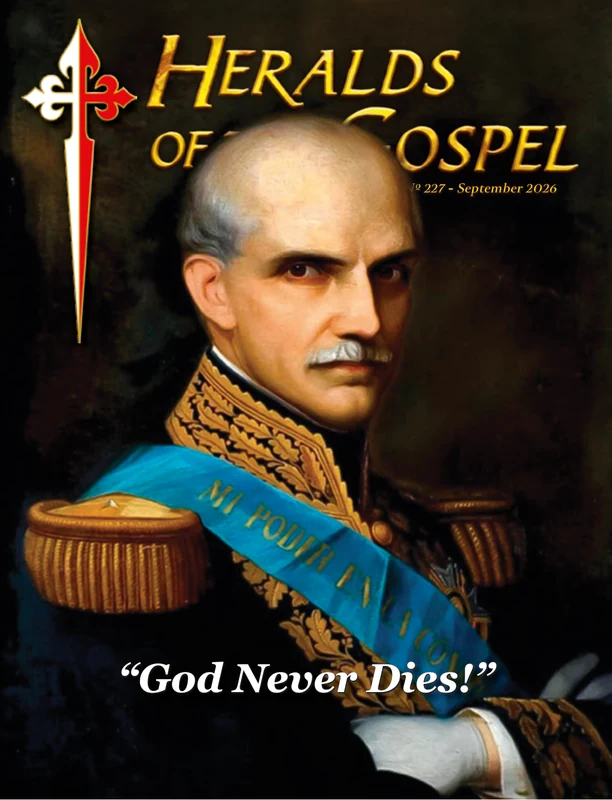
 Heralds of the Gospel Magazine, Vol. 20, nº 227, September 2026
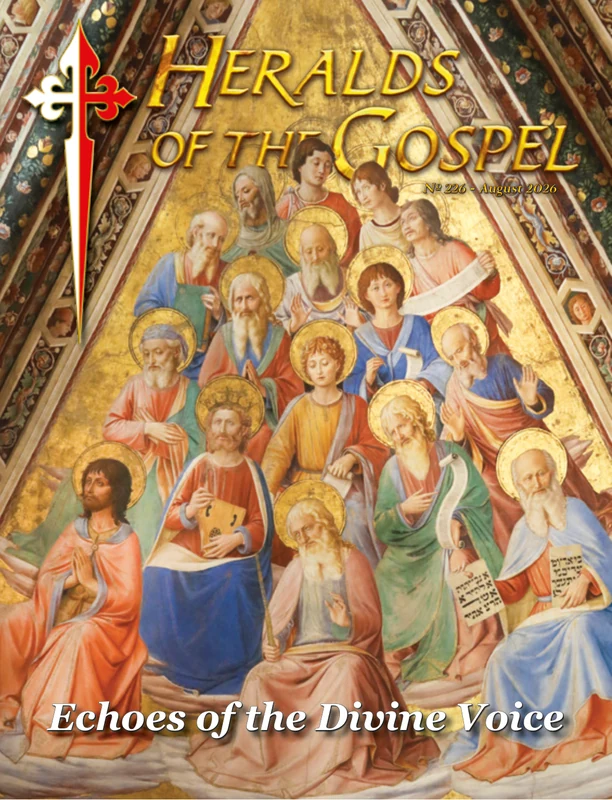 Heralds of the Gospel Magazine, Vol. 20, nº 226, August 2026
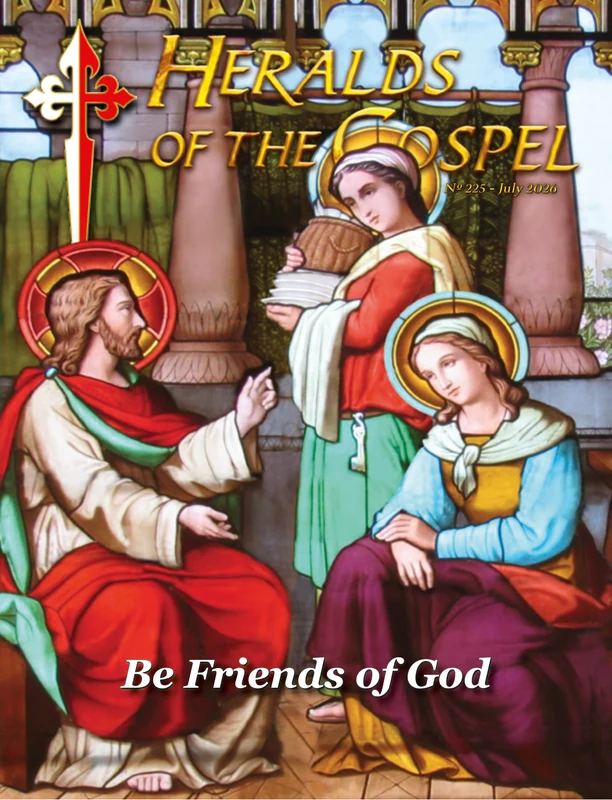 Heralds of the Gospel Magazine, Vol. 20, nº 225, July 2026
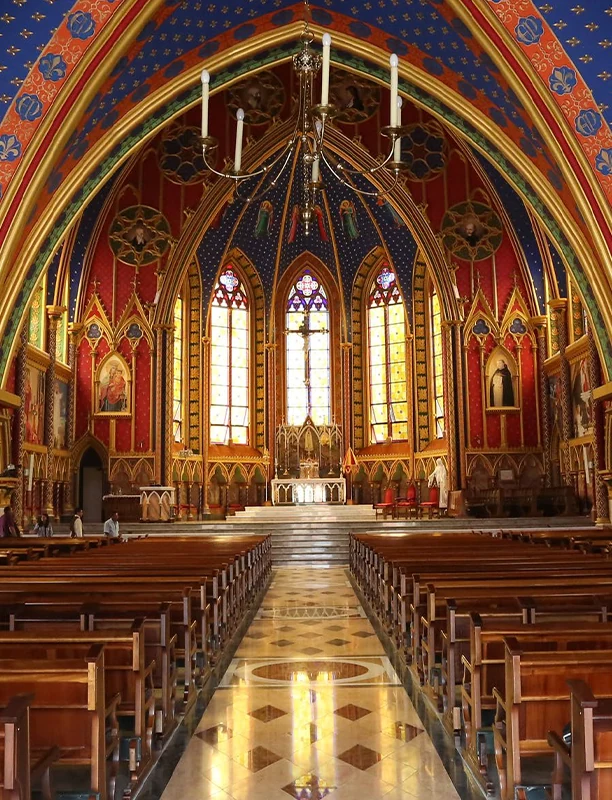 Who are the Heralds of the Gospel?
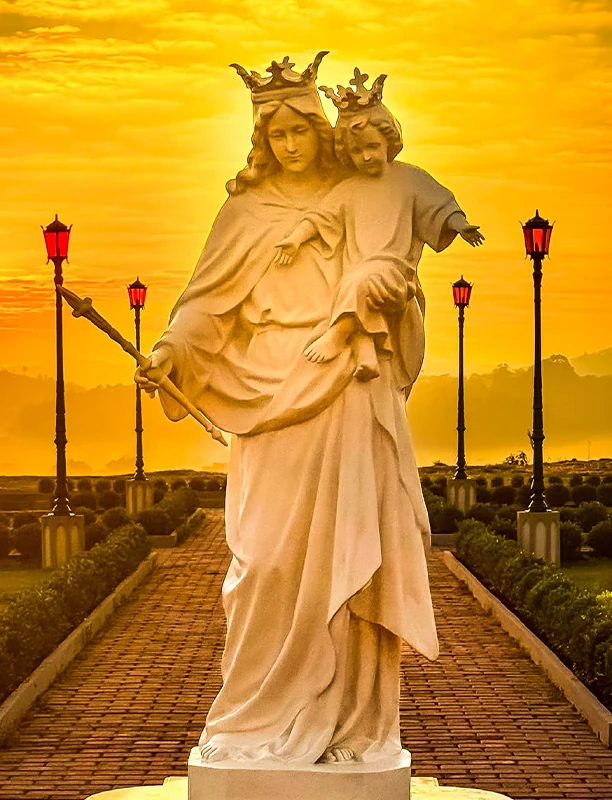 Help of Christians
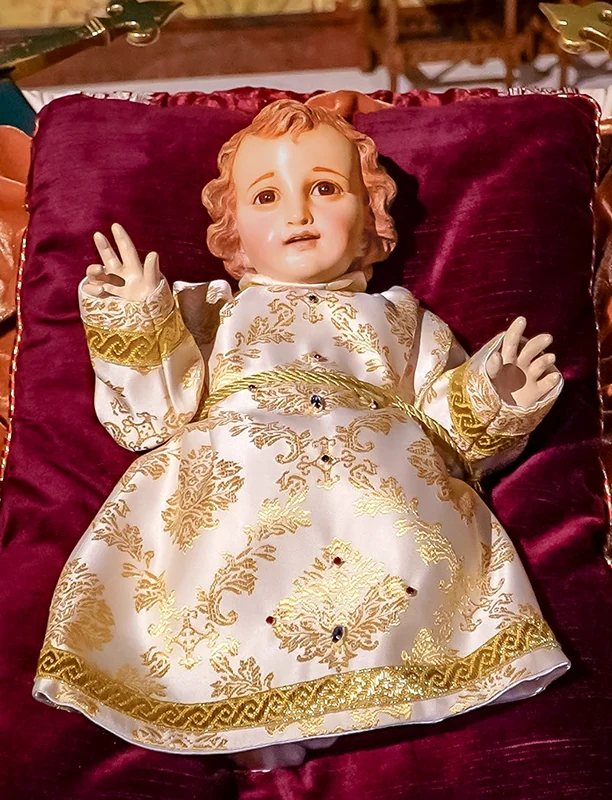 Christmas Carols







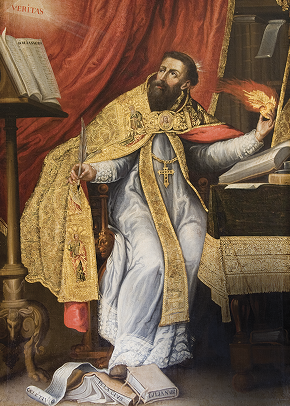
“Sicut Augustinus dicit – as Augustine says,” became a frequent expression in the writings of St. Thomas Aquinas. The Bishop of Hippo is cited around three thousand times in the Summa Theologiæ.
Numerous documents of the Ecclesiastical Magisterium and dogmatic treatises are also based on the doctrine of one who is undoubtedly one of the greatest luminaries of Theology.
Boldly original theses have passed unchallenged throughout the centuries, due only to the authority of the one who enunciated them. However, perhaps less commented on than Augustinus dicit would be Augustinus vixit…
How did he live? What did he teach about how to live? Endowed with great intelligence and no less capacity for love, St. Augustine kept his way of life consistent with his way of thinking.
While he lived given over to his passions, he followed the heresy of Mani; and upon embracing the true doctrine with fervour, how did he come to live?
His existence could be analysed from diverse perspectives: from his profound philosophical studies to his meticulous studies of the spiritual process, including considerations on the omnipotence of maternal tenderness in prayer.
In all of this, the Saint would be a paradigm. But let us limit ourselves to one of his most eloquent legacies, an image of each phase of his journey: how he organized his way of life.
On the paths of sin
Tagaste was a small town in Numidia, in Proconsular Africa. Today it is called Souk Ahras, located in the far east of Algeria, near the border with Tunisia.
Augustine was born there on November 13, 354, inheriting from his father, Patricius, something of Roman culture and from his mother, Monica, a seed of Catholic Faith and Christian life.
However, according to the customs of the time, he did not receive Baptism in childhood.
Patricius was very zealous about the boy’s education, providing everything that could establish him well in the world.
However, Augustine laments: “Yet this same father did not trouble himself how I grew towards You, nor how chaste I was, so long as I was skilful in speaking.”1
During his studies in Madaura and Carthage, as well as during an idly spent interval in Tagaste, the young man gave into vices, sometimes out of vanity, sometimes even out of malice, despite his mother’s warnings:
For I even longed in my youth formerly to be satisfied with worldly things, and I dared to grow wild again with various and shadowy loves! […] But I held it not in moderation, mind to mind, the bright path of friendship.2
About a year after his arrival in Carthage, in the year 370, a son, Adeodatus, was born to him, the fruit of a sinful union, in whose bonds Augustine remained for many years.
Despite this, and perhaps already through the prayers of St. Monica, a yearning for the pursuit of wisdom awakened in his soul upon reading Cicero’s work Hortensius.
This desire also led him to the Holy Scriptures, which unfortunately he soon rejected because of what he considered simplicity of style.3
Adherence to Manichaeism
With a far-reaching understanding, Augustine sought a doctrine that would justify his life at the mercy of unrestrained passions.4
He then adhered to the heresy of the Manicheans and gave himself to it with such fervour that he dragged along his benefactor, Romanianus, and a companion who would follow in his footsteps both in error and in conversion, Alypius.
For nine years Augustine would remain away from the Faith, leading to conduct which increased the tears and prayers of his mother who, addressing a Bishop to ask him to try to lead her son back to the right path, heard this reply: “Go your way, and God bless you, for it is not possible that the son of these tears should perish.”5
Flight to Italy
Upon completing his studies, neither Tagaste nor even Carthage satisfied the new master, who had already gathered around him a core of disciples.
Augustine decided to go and gain fame in Rome, the centre of the world. His mother suffered even more from this decision and, foreseeing the moral disaster that the move would signify, decided to accompany him. He, however, had devised other plans and, cruelly deceiving her, fled:
refusing to go back without me, it was with difficulty I persuaded her to remain that night in a place quite close to our ship, where there was an oratory in memory of the blessed Cyprian. That night I secretly left, but she was not backward in prayers and weeping.6
While in Rome, Augustine obtained from the prefect, Symmachus, the appointment to the chair of rhetoric in Milan, then an imperial city, moving there with his disciples.
However, this time it was not Augustine who fulfilled his desires… but Providence that was drawing up the plans in answer to his mother’s tears.
The encounter with wisdom
Augustine moved to Milan already completely disillusioned with Manichaeism, which he had replaced with philosophical scepticism. However, something, or rather someone, made him prefer Catholic doctrine.
A holy man named Ambrose occupied the episcopal see of that city, and his wisdom flowed to the faithful through the eloquence of his words, accompanied by the beauty of the Liturgy, hymns, and Psalms.
St. Monica – who, in pursuit of her runaway son, had also crossed the Mediterranean – quickly became a friend of this prelate, and through the prayers and holiness of both, grace began to gain ground in that soul, as hardened as it was beloved.
Attending services in the cathedral, and especially analysing the person of St. Ambrose, Augustine sensed that he had finally found wisdom, not in an abstract and conceptual way, but transposed into life, and he even delighted in watching the Bishop work.
The first step had been taken; the definitive conversion, however, would still take time in coming.
Referring to St. Ambrose, he recalls:
But verily no opportunity could I find of ascertaining what I desired from that Your so holy oracle, his breast, unless the thing might be entered into briefly.
But those surgings in me required to find him at full leisure, that I might pour them out to him, but never were they able to find him so.7
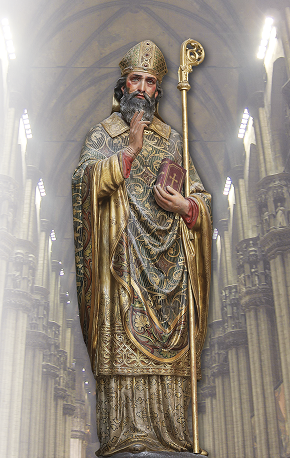
Pastor, Narbonne (France); in the background, Cathedral of Milan (Italy).
Fascination with monastic life
If reading Plotinus, translated into Latin by Marius Victorinus, helped him in refuting Manichean errors, it was above all in the epistles of St. Paul that Augustine found truth revealed and his doctrinal difficulties vanished.
He then sought out Simplicianus, a venerable elder whom Ambrose himself considered a father.
He had had the joy of witnessing the conversion of the translator of Plotinus’ works and attending, with the entire city of Rome, his solemn profession of faith and consequent renunciation of the chair of rhetoric, facts which he narrated in detail.
Hearing these narratives, an intense desire to imitate him invaded Augustine’s soul, but his will, weakened by passions, was not yet free to do so…
On another occasion, a royal dignitary, Ponticianus, came to visit him. Seeing the Pauline letters on the rhetoric professor’s desk, he felt encouraged to discuss with him the wonders of a new way of life initiated by a certain Anthony and which had already spread throughout Europe, including Milan.
Ponticianus even recounted a singular episode: two close friends of his, after visiting one of those nascent communities, had decided to leave everything to follow them, and their fiancées, upon discovering what had happened, also embraced virginity.
The courage of these young people was enough to awaken in Augustine a deep sense of shame at his own cowardice in the face of carnal passions.
A great inner struggle took hold of him, for the weakness of his will clashed with his reason and refused to obey it, just as his members did.
“A great storm broke out, bringing with it a copious torrent of tears,”8 which only subsided when, already half in despair, he went to the garden and opened the Bible to the following passage from the Apostle:
not in reveling and drunkenness, not in debauchery and licentiousness, not in quarreling and jealousy. But put on the Lord Jesus Christ, and make no provision for the flesh, to gratify its desires (Rom 13:13-14).
The darkness of doubt dissipated within him, and the light of certainty penetrated his heart.
Breaking immediately with his career and engagement, which had been made a few years earlier due to the influence of his mother, Augustine enrolled among the catechumens and, at the Easter Vigil of 387, began a new life through the regenerating waters of Baptism, accompanied by his faithful friend Alypius and his son Adeodatus.
During his time of preparation, Augustine withdrew with his family to Cassiciacum, leading a routine of study and community life. Having become a Christian, he decided to return to Africa and live there in a manner coherent with the Faith he had embraced.
It was in the port of Ostia, waiting for the ship that would take them to their homeland, that St. Monica, feeling her mission accomplished upon seeing her son not only Catholic but even willing to become a religious, peacefully surrendered her soul to God.
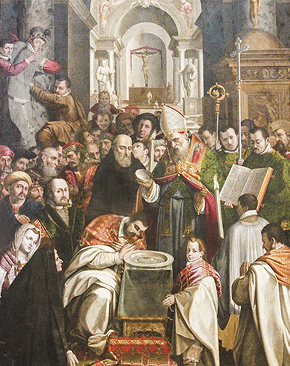
(edited) – Church dedicated to him in Gubbio (Italy)
A life of perfection
From the writings of the Holy Doctor, it is not difficult to glimpse the greatness of a soul that knew neither mediocrity nor half-truths.
Just as, estranged from God, he had reached the extremes of passion and of heresy as a corollary, having embraced grace he would lead his life in the apex of perfection, allowing not only his thoughts but also his way of life to be moulded by it.
The enchantment with monastic life is described in one of his first apologetic works, De moribus Ecclesiæ, composed shortly after his Baptism, during the time he remained in Rome after his mother’s funeral.
Addressing the Catholic Church, he observes:
Yours, as is fit, are the many hospitable, the many friendly, the many compassionate, the many learned, the many chaste, the many saints, the many so ardent in their love to God, that in perfect continence and amazing indifference to this world they find happiness even in solitude.9
And inveighing against his former fellow followers, against whom he writes the work, he exclaims:
Hear now, you Manicheans, the customs and notable continence of perfect Christians, who have thought it right not only to praise but also to practise the height of chastity […]
a daily increasing multitude of Christian men of absolute continence spread all over the world, especially in the East and in Egypt, as you cannot help knowing.10
Describing the different activities of the religious, Augustine concludes by saying: “Such customs, such a life, such arrangements, such a system, I could not commend as it deserves, if I wished to commend it.”11
This became his life’s mission. On arriving in Tagaste, he transformed his father’s house into a religious community, which many of his disciples joined.
“Vix monachus bonus…”
Augustine intended to embrace a life of recollection forever. However, his virtue and wisdom attracted the attention of Valerius, Bishop of Hippo, and despite his reluctance, he was ordained a priest in 391 and coadjutor bishop in 395.
A great perplexity arose: until then, monastic life had seemed incompatible with pastoral activity.
The Saint, however, managed to “closely unify the life of a cleric with the life of a monk,” in the “symbiosis of study-contemplation-apostolate,”12 perhaps adding another degree of perfection to both forms of life.
Among all the forms of ancient monasticism, the Augustinian form is the one that most explicitly emphasizes the union of the ascetic life with the ministerial priesthood and, therefore, the consequent commitment to the continuous study of sacred science. […]
The priesthood is something so great that only a good monk – so believed St. Augustine – can give us a good cleric: vix monachus bonus facit bonum clericum.13
To this end, he organized a monastery-seminary where the most well-prepared were chosen for the priesthood.14 In a short time, several dioceses in Africa had clerics trained in this environment at their head:
Ten holy and venerable men, continent and very learned […] sent by Blessed Augustine, at the request of several churches, some of great standing.
And they too, following the ideal of those saints, were spreading churches and founding monasteries […] not only throughout Africa, but also beyond the sea.15
Strict observance of the rule
He cared for these priests with such seriousness that he was greatly grieved when one of them left a will bequeathing his possessions upon his death.
Saddened to see him thus neglecting the commitment to evangelical poverty he had made before God, the Bishop, then seventy-one years old, gathered his clergy and, explaining the case, stated that he would change his decision to only ordain clergy of community life, so that they would not make a vow and then be unable to fulfil it.16
This bad example served to spur them on in their commitment, and in the following sermon, Augustine would exclaim with even greater vehemence:
Just as I affirmed that I would not deprive of the status of clergy anyone who wished to remain apart and live off their own possessions, so I affirm now that, although with God’s help it has pleased them to live in common, whoever lives in hypocrisy and is found possessing something of their own, I will not allow them to bequeath it in their will, but I will erase them from the list of the clergy.
Let them appeal against me in a hundred councils, let them sail against me wherever they wish, let them be wherever they can be, the Lord will help me so that they cannot be of the clergy where I am the Bishop.17
The Bishop of Hippo also dedicated himself to the formation of a feminine community, which was led by his own sister.
It was in writing to them in the year 423 that his rule has reached us, preceded by wise words of admonition against the spirit of revolt.18
Defining the principles of monastic life – such as poverty, prayer, fasting, obedience, and chastity – the rule contains this wise advice that greatly pleased the founder of the Heralds, Msgr. João:
When you go out, walk together; when you return, stay together. In your conduct, in your bearing, throughout all your movements, let nothing in you offend the gaze of anyone, but let everything be in accordance with religious holiness.19
In this observance of the rule, he lived thirty-five years as Bishop-Abbot, giving sermons, and holding numerous controversies and debates against the Donatist and Pelagian heretics; participating in several councils; writing numerous works, totalling ninety-six titles, all of which he revised before his death.
The Vandals had been besieging Hippo for three months when the Holy Bishop gave his soul to God in the year 430.
The barbarians destroyed everything in Roman Africa, but the example of St. Augustine’s life, his writings and his rule have endured throughout the centuries, undergoing a revival in the 14th century and reaching our days.
They indicate to the clergy and people of all times an ideal of perfection, of dedication, of holiness, and show the true depth of his wisdom.