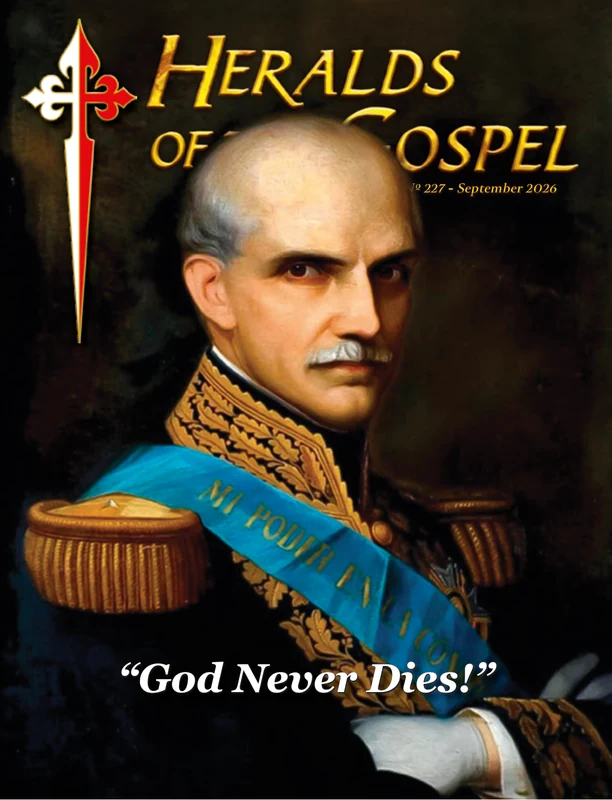
 Heralds of the Gospel Magazine, Vol. 20, nº 227, September 2026
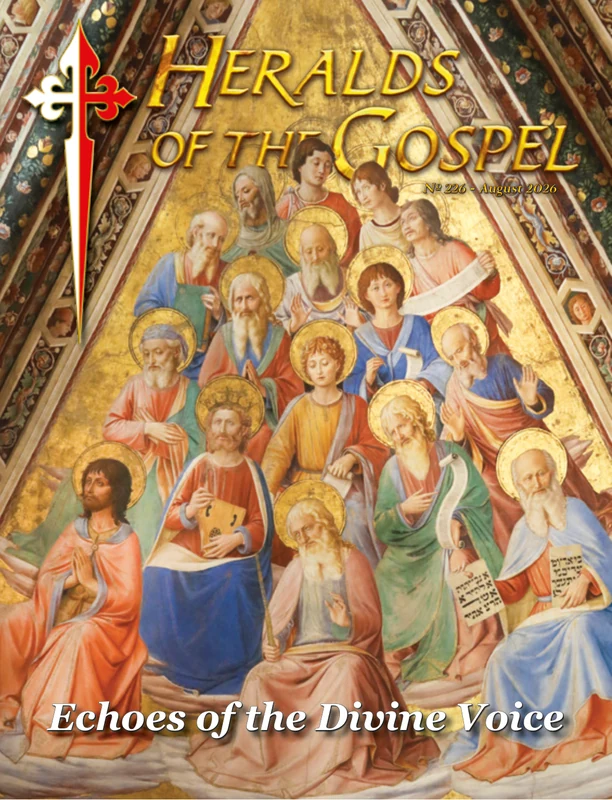 Heralds of the Gospel Magazine, Vol. 20, nº 226, August 2026
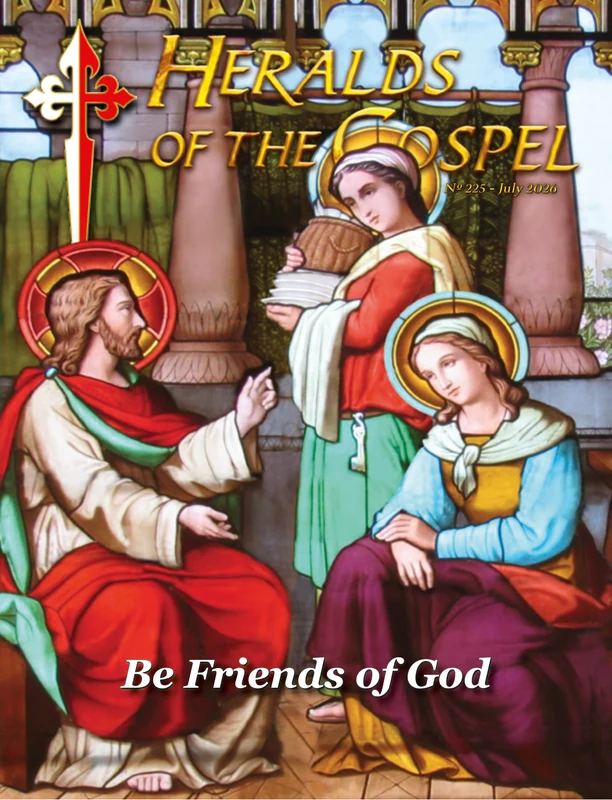 Heralds of the Gospel Magazine, Vol. 20, nº 225, July 2026
 Who are the Heralds of the Gospel?
 Help of Christians
 Christmas Carols





Opening the way for his brother
Alphonse Ratisbonne has become well known in the Catholic world for his prodigious conversion. But what almost no-one knows is that his brother, Theodore, preceded him on the path to the Faith.The work of grace in Alphonse’s soul was fulminating; in Theodore’s heart it crept in gently. Like the dawn, Our Lady’s light snatched away the darkness that dominated Alphonse’s spirit all at once; with Theodore, God acted gently, illuminating his interior like the rays of twilight, little by little. However, we can well believe that Theodore’s spiritual combat in the process of his conversion paved the way for Alphonse, also, to one day enter the bosom of the Holy Church.In the soul of Theodore Ratisbonne, the grace of conversion crept in gently, illuminating his interior like the rays of twilight
First criticisms of Judaism
Theodore Ratisbonne belonged to the Cerfberr family, based in Strasbourg, France, and his father was president of the Israeli consistory. His entire childhood upbringing was shaped by the Jewish traditions and customs, although he had no real religious instruction. His mother was the only person who, through her example, taught him moral principles. Because of this, her early death shook him to the core and inclined his character towards more serious matters. “The name Jew made me blush,” he confessed. In fact, his attendance at the synagogue and Jewish assemblies produced serious criticisms in his soul, on noting a lack of dignity in those who gathered there. “The Messiah, why has he not yet come?” he thought, and little by little, he came to discard even the belief in his coming. And since his father did not force him to take part in the Jewish rites, he ended up distancing himself from the religion.From doubt to scepticism
With his mother gone, his soul began to feel a tremendous emptiness. He longed to love and be loved, and he sought to be understood, because he no longer understood himself. He stayed for a time in Paris, but the bitterness deep within his heart only grew: “I knew of no man, no book that could instruct me in eternal things.” As a result of family tradition, he had always been horrified of Christianity, considering it idolatry; at the same time, Judaism had become a source of shame for him: “The synagogue was like a barrier between me and God.”
At the bottom of this abyss of disbelief, however, sadness invaded his soul and he remembered the God of his childhood. “O God! If You really exist, let me know the truth, and I swear in advance that I will consecrate my life to You.” In fact, the storm had subsided: the moment of grace had arrived.In his search for the truth, the young Theodore went from the synagogue to complete scepticism, until he recalled the God of his childhood…
Between the God of the Jews and the God of the Christians
Determined to leave Strasbourg, he set off for Paris to finish his law studies there. He wanted to find masters who would fill the void in his soul. But when he had only just begun his studies in the French capital, a strange feeling began to torment him and an inner voice told him: “You must go back to Strasbourg!” “Why? Go back to Strasbourg?” he thought. He had just left! Would it not look strange to return without even having started to carry out his plans? But the voice was ringing in his mind like a bell: “Strasbourg!” No longer able to resist the clamour of his conscience, Theodore returned to his city. When he arrived, he was approached by an unknown young man who invited him to take part in a course then being administered by a great philosopher, a professor of the highest repute, called Monsieur Bautain. Little did he know that this young man would soon become his best friend and, later, his brother in the priesthood. The course content was entirely new to Theodore. The lecturer taught universal truth from the Holy Scriptures, which gave strength and virtue to his discourse. Like an iceberg before the sun, all the resistance in Theodore’s heart began to fade. Christianity penetrated his soul without consulting reason… In spite of everything, an arduous struggle began for him, not with rational criteria, but with the remnants of Judaism ingrained in his soul. “I believed in Jesus Christ and yet I was unable to invoke Him, to pronounce His name, so deep and inveterate is the Jewish aversion to this sacred name.”
Progressing from light to light
When he finished his law studies, his father placed him as headmaster of the consistory’s Jewish schools. Helped by two friends of his race who had also attended Monsieur Bautain’s course, he reformed the teaching and began giving lectures to help educate the children. The auditoriums filled up to hear the presentations, such was the power of preaching the truth. A blessing accompanied all these endeavours. And, just as had happened with them, the synagogue began to be Christianized without knowing it… Even with this progress, the aborning faith in his heart needed more solid nourishment. He needed to take steps towards the Catholic Church. The first time he attended a solemn Mass, Theodore thought he had arrived in Paradise. The hymns, the prayers, the priest presiding, the Blessed Sacrament… everything seemed to come from Heaven! What he had heard about the greatness of the Temple and worship in Jerusalem found its true fulfilment on that altar. There were the true worshippers of God! From the beginning of his lessons with Monsieur Bautain, Theodore began to read the Holy Scriptures. One day, at nine o’clock in the evening, he finished the Old Testament and turned to the first pages of the New Testament: the Gospels! Unable to sleep, he read the Gospel of St. Matthew one night and St. John the next. In the midst of these graces, the requests for him to marry resurfaced. His parents wanted him to wed a lady from Vienna’s high society, which awakened in him new dreams of living an opulent life full of pleasures. He wished to go to the Austrian capital, but… he felt bound by an inexplicable force. Finally, God’s grace helped him to stand firm, and he joined a small society with a group of friends in which each of them pledged to live chastely, abandoning themselves to the hands of Providence. Theodore was baptized and made his First Communion a few months later. He needed little explanation about the Eucharist: his faith had adhered to the words of Our Lord Jesus Christ without being bound by purely rational criteria. His heart had permitted itself to be captivated by the Sacrament of Love!Eternal farewell to the synagogue
At a certain point, the members of the consistory began to realize that Theodore had changed. His daily attendance at church was seen by everyone and there was no way to hide his religion. The Jews began to pressure him to publicly confess his true faith and pushed to have him removed from office. But only the president of the consistory could dismiss him, and that was his father. Theodore realized that he had to let go of every natural affection, and the words of Our Lord Jesus Christ enlightened his mind: I have come to bring a sword to earth (cf. Mt 10:34). The time had come to separate himself from his family, the world and the synagogue.His father, already troubled by various suspicions, invited him to a private conversation and asked him if he was a Christian. “Yes, I am a Christian, but I worship the same God as my parents, the God of Abraham, Isaac and Jacob, and I recognize that Jesus Christ is the Messiah, the Redeemer of Israel,” he said. After a few moments of silence, his father burst into tears. Theodore also began to cry, heartbroken to see him for the first time in such a state… In response, his father declared that, of all the evils he had endured in his life, this was the worst and the only irreparable one… Aghast at such blindness, Theodore tried to console him in a filial fashion. But a terrible despair arose in his father’s heart, and he would have cursed his son if he had not left the room.“I am Christian, but I worship the same God as my parents, the God of Abraham, Isaac and Jacob, and I recognize Jesus Christ as the Messiah”

Consecrated to the service of the Church
Having left the world behind, Theodore set out to fulfil a burning desire: to become a priest. “I do not know when this desire was formed in me or how it entered my soul; today it seems to me that it came with life itself,” he would later declare. At a college founded in Molsheim by Bishop de Trevern, he spent two years studying theology. It was a difficult period, full of disillusionment and disappointments, but nothing shook his vocation. He nourished hopes in his soul of seeing the conversion of his father. Back in his hometown, he found him on the verge of death. Despite his initial resistance to Christianity, towards the end of his life he had shown an interest in the Catholic religion, but it was already getting late. As he lay dying, Theodore remained at the foot of the bed praying for his soul. Suddenly, some Jews entered and thew themselves upon Theodore to drag him out of the room. Thinking they were going to murder him, he cried out: “Jesus, save me!” At that very moment, the dying man expired. Death took him before his conversion.At Christmas 1830, Theodore was ordained a priest and, shortly afterwards, made Vicar of Strasbourg Cathedral. Moved by great zeal for the conversion of his blood brethren, he founded the Congregation of Our Lady of Sion in 1842, of which he became missionary and superior general. A glorious battle still awaited him: the conversion of his brother: “Only one of the family did I hate: my brother Theodore,”2 Alphonse later confessed. But while he was trying to forget about his brother, Theodore was praying for him…Ordained on Christmas of 1830, he later founded the Congregation of Our Lady of Sion, out of zeal for the conversion of his blood brethren
Divine predilection will redound in glory!
History tells us of beautiful conversions that have taken place among the most diverse peoples. But how moving it is to contemplate the intervention of Our Lord Jesus Christ, often through the mediation of His Blessed Mother, in favour of those of His same race and blood!
Notes
1 All the biographical information in this article has been taken from Theodore Ratisbonne’s own account compiled in: HUGUET, Jean-Joseph. Célèbres conversions contemporaines. 3.ed. Paris: Périsse Frères, 1882, p.133-160.
2 LA MADONNA DEL MIRACOLO. Rome: Postulazione Generale dei Minimi, 1971, p.12.