 Heralds of the Gospel Magazine, Vol. 20, nº 227, September 2026
 Heralds of the Gospel Magazine, Vol. 20, nº 226, August 2026
 Heralds of the Gospel Magazine, Vol. 20, nº 225, July 2026
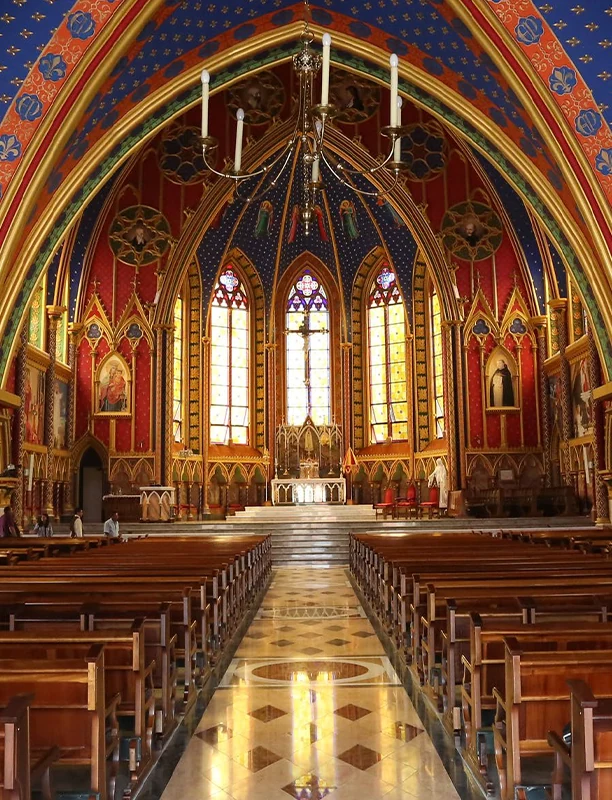 Who are the Heralds of the Gospel?
 Help of Christians
 Christmas Carols








Master and disciple: two persons, just one scene
In human interaction there are different degrees of vitality, by which one person can stimulate or influence another, resulting in mutual dependence. This is what happens in the dealings between a teacher and an apprentice or a master and his disciple, in which the superior needs the inferior to transmit his knowledge and, in a certain way, to complete his own mission. This is what happened in the middle of the 13th century in Italy with a renowned artist called Giovanni Cimabue. Meeting a young shepherd known as Giotto di Bondone, and discerning in him a marvellous artistic gift, Cimabue began to transmit his knowledge to him. Together, they started a new school of art that survived the centuries. They were two people with a single vocation; their lives were part of the same scene, they formed a single work in the divine plan of creation. From the encounter of the renowned Giovanni Cimabue with the young shepherd Giotto di Bondone, arose a new school of art
“Giotto and Cimabue”, by José María Obregón - National Art Museum, Mexico City
An artistic treasure…
Built under Hellenistic influence, the chapel of the Scrovegni family palace became known because of Giotto. In fact, it houses the greatest remaining legacy of his work: over a hundred frescoes that depict, in the light of the Gospel and the piety of the time, episodes in the life of Mary Most Holy and of Jesus Christ, beginning with their ancestors from the Old Testament. One aspect that sparks artistic interest in Giotto’s frescoes is the fact that he changed the traditions of medieval representations in order to give more drama and realism to the scenes, implementing the characteristics of Italian Renaissance classicism, of which he is considered a precursor. In the Scrovegni Chapel, the Allegories of Virtues and Vices draw attention for their strong symbolic expression. These representations contrast the virtues of prudence, fortitude, temperance, justice, faith, charity and hope, with the vices of despair, envy, infidelity, anger, inconstancy and frivolity, with a dramatic vivacity that was innovative for its time.2 As was common in medieval decoration, Giotto painted a magnificent fresco of the Last Judgement, in which a certain character stands out: Enrico Scrovegni, owner of the palace and responsible for having the artist decorate the setting. He appears surrounded by Angels while, kneeling, he offers the model of the chapel to the Virgin Mary. The scene unfolds at the foot of an eloquent cross that separates the good from the bad; salvation from eternal condemnation. With his art, Giotto had a discreet concern to do good to souls; his frescoes uplift the beholder to the supernatural world, to the invisible and the eternal
Final Judgement”, by Giotto di Bondone - Cappella degli Scrovegni, Padua (Italy)
…or a catechesis?
Thus it would not be too bold to say that in this small chapel Giotto had a discreet concern to do spiritual good to souls, a desire that was not restricted to his time. The work as a whole uplifts the beholder to the supernatural world, to the invisible and the eternal, seeming even to shorten the distance between Heaven and earth. This however, is done with simplicity, as can be seen in the picturesque representations of the characters, in the gestures, sentiments and attitudes portrayed, all in a perfect harmony and a pleasant play of colours and forms, so different from the materialistic, pragmatic and lacklustre world of our days. For Giotto, radicality is in colours, which he uses with mastery, dressing the figures in light, with a diaphanous and virginal appearance. In his frescoes even the animals evoke, in a candid reality, the innocence and vivacity of the medieval soul.In the presentation of Mary, a marked contrast
From an artistic point of view, his work is an authentic treasure and the Church has benefited from his illustrations in all subsequent centuries. Let us examine, for example, the fresco of the presentation of Our Lady in the Temple. It displays such unction and symbolic value that we easily pass from mere observation to reflection, and from reflection to contemplation. Giotto was the painter of the transparency of a divine grace, which first illuminated his soul, and was then reflected in his works
Fresco of Giotto in the Cappella degli Scrovegni, Padua (Italy): The Presentation of the Blessed Virgin in the Temple
Judas face to face with Jesus Christ: a masterpiece
In the fresco representing the kiss of Judas, “one of the most amazing things that a human brush has ever painted,”3 we see the contrast between Truth Incarnate and the most execrable betrayal. In this scene Our Lord is serious, looking at the infamous one, who, taking advantage of the intimacy he had as an Apostle, embraces the Redeemer and with a kiss hands Him over to His executioners. It is clear that Giotto wanted to represent in Jesus Christ the summit of all intellectual and moral qualities, and in Judas the symbol of every abjection. And how successful he was!A soul gilded by grace
In short, Giotto was the painter of the transparency of a divine grace, which leads us to believe that this grace first illuminated his soul, ‘gilding’, as it were, his interior, and was then reflected in his frescoes. A statue of the Italian painter, by Italo Vagnetti - Piazza Giotto, Vicchio (Italy)
Notes
1 This article is based on four oral presentations given by Dr. Plinio Corrêa de Oliveira in the 1980’s, and partly transcribed in: CORRÊA DE OLIVEIRA, Plinio. Obra-prima da piedade católica [Masterpiece of Catholic Piety]. In: Dr. Plinio. São Paulo. Year V. N.46 (Jan., 2002); p.31-34.
2 Cf. BELLOSI, Luciano. Giotto. Firenze: Scala, 1981, p.52.
3 CORRÊA DE OLIVEIRA, op. cit., p.35.