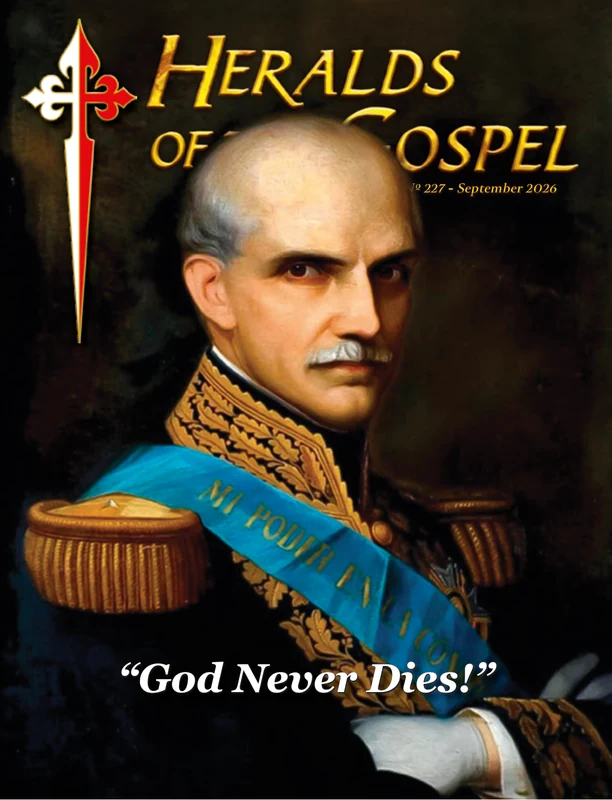
 Heralds of the Gospel Magazine, Vol. 20, nº 227, September 2026
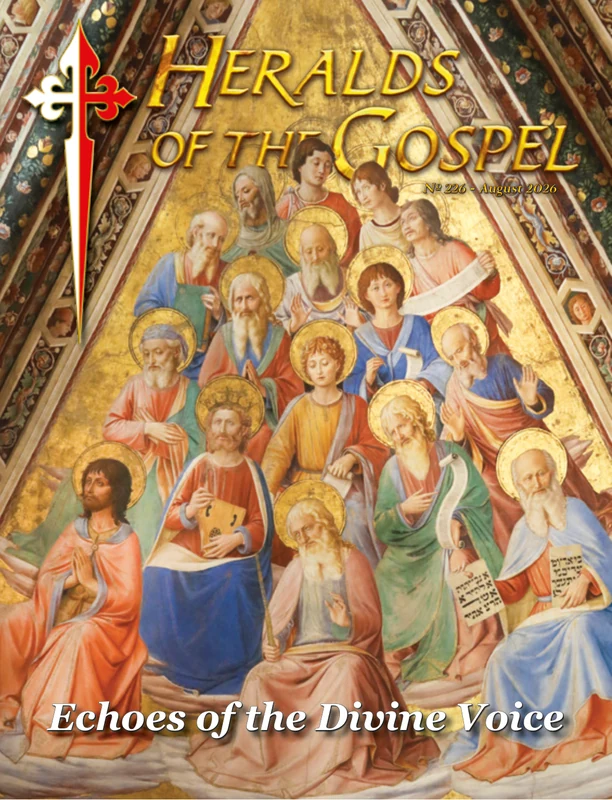 Heralds of the Gospel Magazine, Vol. 20, nº 226, August 2026
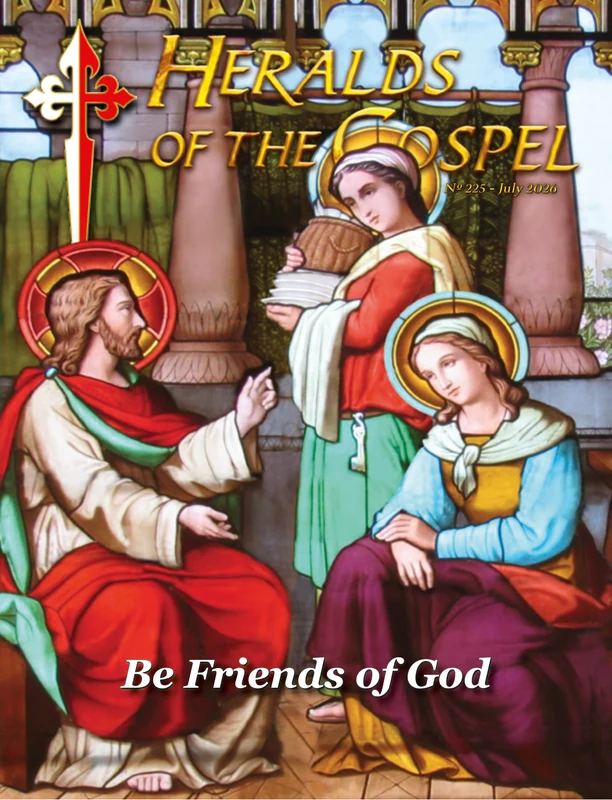 Heralds of the Gospel Magazine, Vol. 20, nº 225, July 2026
 Who are the Heralds of the Gospel?
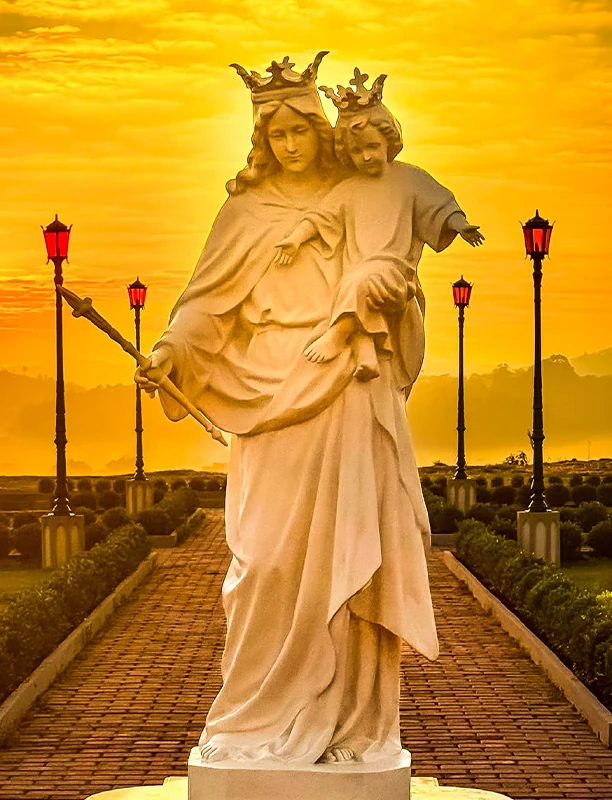 Help of Christians
 Christmas Carols






Gospel of the Twenty-Third Sunday in Ordinary Time
“Now great multitudes accompanied Him; and He turned and said to them, ‘If any one comes to Me and does not hate his own father and mother and wife and children and brothers and sisters, yes, and even his own life, he cannot be My disciple. Whoever does not bear his own cross and come after Me, cannot be My disciple.
For which of you, desiring to build a tower, does not first sit down and count the cost, whether he has enough to complete it? Otherwise, when he has laid a foundation, and is not able to finish, all who see it begin to mock him, saying, “This man began to build, and was not able to finish.”
Or what king, going to encounter another king in war, will not sit down first and take counsel whether he is able with ten thousand to meet him who comes against him with twenty thousand? And if not, while the other is yet a great way off, he sends an embassy and asks terms of peace. So therefore, whoever of you does not renounce all that he has cannot be My disciple’” (Lk 14:25-33).
I – Moorings and Weights in the Spiritual Life
In June of 1783, the Montgolfier brothers, Joseph-Michel and Jacques-Étienne, sons of a Lyon paper manufacturer, successfully flew a giant cloth balloon, 32 metres in circumference, before the thunderstruck eyes of their countrymen. Filled with hot air supplied by burning straw, the spectacular invention soared some hundreds of metres and travelled two to three kilometres in just ten minutes. Three months later, they repeated the performance in the Park of Versailles, before Louis XVI, Marie Antoinette and the assembled royal court of France. Balloon production has greatly improved since that time, but the principle of operation—based on one of the most elementary laws of physics—remains unchanged: being lighter, hot air tends to rise. As it is being filled, the balloon remains anchored to the ground. Then the moorings are then undone allowing the apparatus to rise; the ballast is gradually discarded so that it may ascend higher. This is a beautiful image of the soul’s flight toward God. “Heated’’ by the practice of the virtues, especially charity, it begins its spiritual ascent and starts to “fly”. Yet, as a result of sin, there are moorings that tie it to earth and weights that impede its journey toward perfection. It becomes necessary, then, to cut the one and cast off the other in order for the human spirit to soar toward the transcendent and eternal. Like our body, the soul suffers the harmful effects of a type of spiritual law of gravity by which it feels drawn to what is commonplace, trivial, and demands the least effort. Even for consecrated persons there are moorings and ballast which are at times more difficult to release than those of the simple faithful. If religious fail to correspond to the invitation of grace to live on a higher plane, they can experience a type of vertigo and vehemently cling to earthly things. To help overcome these impediments in religious institutions, the Holy Spirit has raised up various forms of spirituality over time that intensify detachment from material goods. The radicality of some is astonishing. The Theatines, for example, live from alms as many others do, with the difference that their members may not ask for them, but must wait for them to be offered spontaneously.1 In view of our evil inclinations, Christ taught us that self-denial and abnegation are indispensable in being His true disciples. This is the lesson of this Sunday’s liturgy. "St. Francis of Assisi Renounces Earthly Riches," by Giotto di Bondone - Basilica of St. Francis, Assisi, Italy
St. Francis Takes God as His Father
After leading a worldly life, Francis of Assisi (1182-1226) decided to renounce everything to espouse “lady poverty”, in strict imitation of Our Lord Jesus Christ. When his wealthy father, Peter Bernardone, complained to the bishop of his son’s excessively generous alms-giving, Francis handed over to him even his rich garments, subsequently using only a poor tunic. In this way he chose to take God as his Father, responding to Our Lord’s bidding to him in the chapel of St. Damian, to restore the house of God which was in ruins, referring to the lamentable state of the Holy Church at that time.II – To Hate One’s Father and Mother?
“Now great multitudes accompanied Him; and He turned and said to them.”
Jesus should be loved with a most perfect love
“If any one comes to Me and does not hate his own father and mother and wife and children and brothers and sisters, yes, and even his own life, he cannot be My disciple.”
“The enemies will be one’s relatives”
Now, how can father and mother and brother and sister represent obstacles to our salvation? To fittingly answer this question, another passage of the Gospel, related to that which we are commenting on today must be called to mind: “Do not think that I have come to bring peace on earth; I have not come to bring peace, but a sword. For I have come to set a man against his father, and a daughter against her mother, and a daughter-in-law against her mother-in-law; and a man’s foes will be those of his own household” (Mt 10:34-36). Regarding these verses of St. Matthew—even more incisive, under some aspects, than those of St. Luke—Romano Guardini comments: “The message of Jesus is the message of salvation. He proclaims the love of the Father and the coming of the Kingdom. He calls men to peace and unity in goodwill. Nevertheless, His word does not begin by producing union, but rather division. The more deeply Christian a man becomes, the more his life differs from others who do not want to become Christians, or in the measure that they refuse to be so. [...] This is the reason for the division between father and son, friend and friend, or among those who dwell in the same house.”6True meaning of the verb hate
Guardini goes on to astutely add that the requirement to hate our relatives when they draw us away from God “is anti-natural, and awakens the temptation to hold fast to our natural relatives and abandon Jesus.”7 It is with the objective of clarifying the need for man to do violence against himself to be a true disciple of Christ, that the Vulgate, St. Thomas, St. Gregory the Great and many other commentators employ the radical term hate: “Gregory expounding this saying of Our Lord says that ‘when we find our parents to be a hindrance in our way to God, we must ignore them by hating and fleeing from them.’ For if our parents incite us to sin, and withdraw us from the service of God, we must, as regards this point, abandon and hate them.”8 Therefore, love for sisters and brothers, daughters and sons, father or mother is natural, legitimate and even a duty; but these persons must be repudiated with all our strength, if they impede us from following Christ. Once again, St. Thomas clarifies this: “We are commanded to hate, in our kindred, not their kinship, but only the fact of their being an obstacle between us and God. In this respect they are not akin but hostile to us, according to Micah 7:6: ‘A man’s enemies are they of his own household.’”9 And further on he adds: “By the commandment of God (Exodus 20:12) we must honour our parents—as united to us in nature and kinship. But we must hate them in so far as they prove an obstacle to our attaining the perfection of Divine justice.”10 Thus the matter is placed in its proper balance. And the Holy Church can teach this doctrine with full authority, since it was she who evangelized the pagan peoples and consolidated the fundamental principles of a monogamous and indissoluble family in the world, by its preaching and through the administration of the Sacrament of Marriage, instituted by Our Lord Jesus Christ. Thus, women and children were given a place of dignity in society, ending the abuses of the ancient world, such as the “right” of the father to kill his children or the husband to abandon his wife. Therefore, she simultaneously emphasized that everything, even the family, is subject to God’s service and glory. With regard to the verb hate, Fr. Duquesne adds a further clarification “The expression ‘to hate’ does not mean that we should do or desire them evil; but it highlights the ardour, courage and strength with which we must resist them, if they are an impediment to our salvation, drag us into evil, discourage us from assuming the state to which God calls us, if they want to enlist us in that which God has not called us, if they prevent us from embracing the true Faith, and if they make an effort to keep us or introduce us in error.”11 On the contrary, there are numerous examples that show how the support in families toward the sanctification of their members is invaluable, and in a certain sense unsurpassable: St. Monica, whose tears and prayers obtained the conversion of her son; St. Basil the Elder and St. Emilia, parents of St. Basil the Great, St. Gregory of Nyssa, St. Macrina and St. Peter of Sebaste; and Blessed Louis and Zélie Martin, parents of St. Thérèse of the Child Jesus. Family support is invaluable and in a certain sense unsurpassable in attaining holiness
Blessed Louis and Zélie Martin, parents of St. Thérèse of the Child Jesus (centre, at eight years of age)
The reward will come in eternal glory
“Whoever does not bear his own cross and come after me, cannot be My disciple.”
III – Lucidity and Prudence
Teaching by parables is a constant element in divine didactics. Our Lord uses two at this moment, to show the crowd that following Him does not only demand effort and self-denial, but also lucid planning and careful execution, that is, “prudence and determination in counting the cost that this will entail.”14 These two images were chosen with divine wisdom—it could not be otherwise—to perfectly illustrate the instruction of the previous verses. In this regard, Maldonado comments: “Christ offers the parables of the tower and the war, in preference to other themes, in order to deal with difficult and costly undertakings—building towers and engaging in warfare—which require diligent preparation.”15The calculations of building a tower or engaging in warfare
“For which of you, desiring to build a tower, does not first sit down and count the cost, whether he has enough to complete it? Otherwise, when he has laid a foundation, and is not able to finish, all who see it begin to mock him saying, ‘This man began to build, and was not able to finish.’”
“Or what king, going to encounter another king in war, will not sit down first and take counsel whether he is able with ten thousand to meet him who comes against him with twenty thousand?”
Peace treaty with the Supreme Sovereign
“And if not, while the other is yet a great way off, he sends an embassy and asks terms of peace.”
The only calculation permitted of the true disciple
“So therefore, whoever of you does not renounce all that he has cannot be My disciple.”
 Following Our Lord means imitating His example and practicing His virtues
"Our Lord Carries His Cross with Our Lady and St. Dominic Guzman” by Fra Angelico - Museum of San Mark, Florence
IV – Disorderly Attachments Rob Our Peace of Soul
Today’s Gospel clearly shows how this radical and complete detachment is the cornerstone of our interior life, whether in building a family, being part of the clergy or in being consecrated to God in a religious institute. From this standpoint, we can view the liturgy for the twenty-third Sunday in Ordinary Time as an invitation to detachment: “Whoever does not bear his own cross and come after Me, cannot be My disciple.” This does not imply that we must be flogged, crowned with thorns or nailed to the cross, as was Our Lord Jesus Christ. The cross which He asks of us is mostly that of being detached from earthly things, just as an eagle who soars unencumbered in the sky better contemplates the sun. As we have so often experienced in life, disorderly attachments produce affliction, doubt and apprehension which rob our peace of soul. Therefore, even those who are not called to religious life should carry out all their actions, including their business dealings and the administration of possessions, with a heart set on God. This detachment is the condition for intimately accompanying Our Lord Jesus Christ. In doing this, the soul will experience true happiness—a foretaste of the joy it will have in Heaven. ◊Notes
1 Constitutions, art. 26: “We, the Clergy Regular, should live from the Altar and the Gospel, while the faithful spontaneously provide for us, without asking any alms from the laity, either directly or through the intercession of another. All our hope should be placed in the word of Christ the Lord, who says: ‘Seek ye first the Kingdom of God and His justice and all these things shall be added unto you.’”
2 GOMÁ Y TOMÁS, Isidro. El Evangelio explicado. Barcelona: Casulleras, 1930, v.III, p.283.
3 The two translations are correct, since the Greek verb μισεω, just like its Hebrew equivalent śānā’, encompasses a wide range of meanings from love less and detest, to hate (cf. BALZ, Horst e SCHEIDER, Gerhard (Eds.), Diccionario exegético del Nuevo Testamento. 2.ed. Salamanca: Sígueme, 2002, col.295).
4 ST. THOMAS AQUINAS. Summa Theologica, II-II, q.101, a.4, resp.
5 BALZ e SCHEIDER, op. cit., col.295.
6 GUARDINI, Romano. O Senhor. Rio de Janeiro: Agir, s/d., p.293.
7 Idem, ibidem.
8 ST. THOMAS AQUINAS, op. cit., II-II, q.101, a.4, ad.1.
9 Idem, II-II, q.26, a.7, ad.1.
10 Idem, II-II, q.34, a.3, ad.1.
11 DUQUESNE. L’Évangile médité. Lyon-Paris: Perisse Frères, 1849, v.III, p.104.
12 Idem, p.106.
13 Idem, ibidem.
14 GOMÁ Y TOMÁS, op. cit., p.282.
15 MALDONADO, SJ, Juan de. Comentarios a los cuatro Evangelios. Evangelios de San Marcos y San Lucas. Madrid: BAC, 1951, v.II, p.642.
16 ST. CYRIL OF ALEXANDRIA. Commentaria in Lucam¸ sermo 105: PG 72, 796.
17 ST. AUGUSTINE. Quæstiones Evangeliorum, l.2, c.31: PL 35, 1343.
18 Cf. ST. GREGORY THE GREAT. Homiliarum in Evangelia, hom. 37, c. 6: PL 76, 1277-1278.
19 DUQUESNE, op. cit., p.119.
20 ST. AUGUSTINE, apud ST. THOMAS AQUINAS, Catena Aurea.
21 Idem.
22 GOMÁ Y TOMÁS, op. cit., p.285.
23 ST. BEDE, apud ST. THOMAS AQUINAS, Catena Aurea.