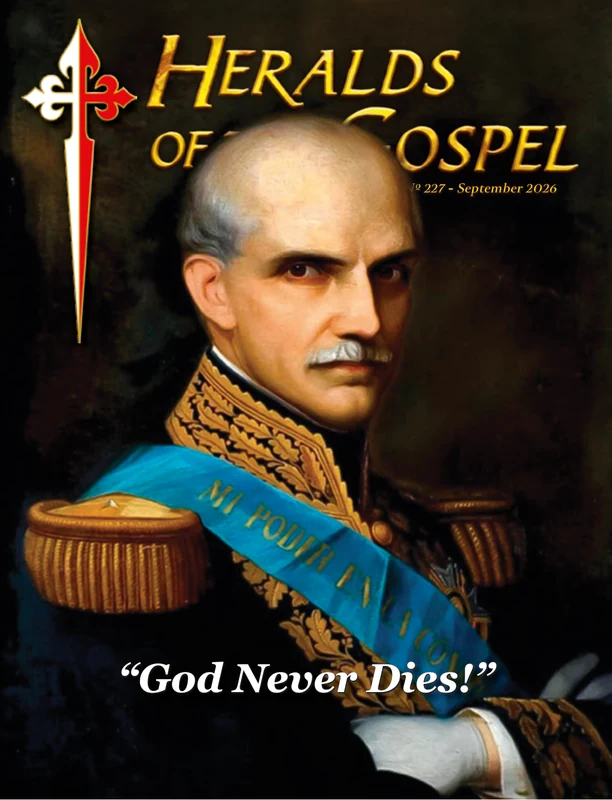
 Heralds of the Gospel Magazine, Vol. 20, nº 227, September 2026
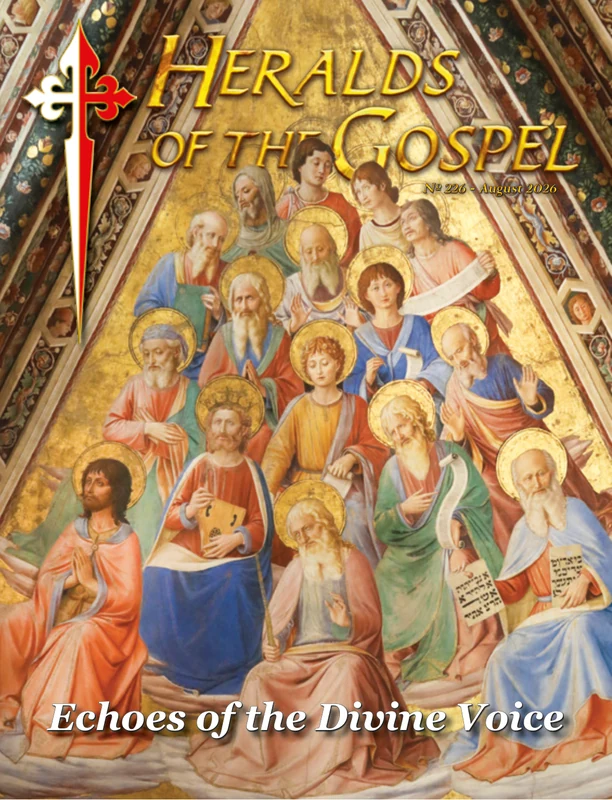 Heralds of the Gospel Magazine, Vol. 20, nº 226, August 2026
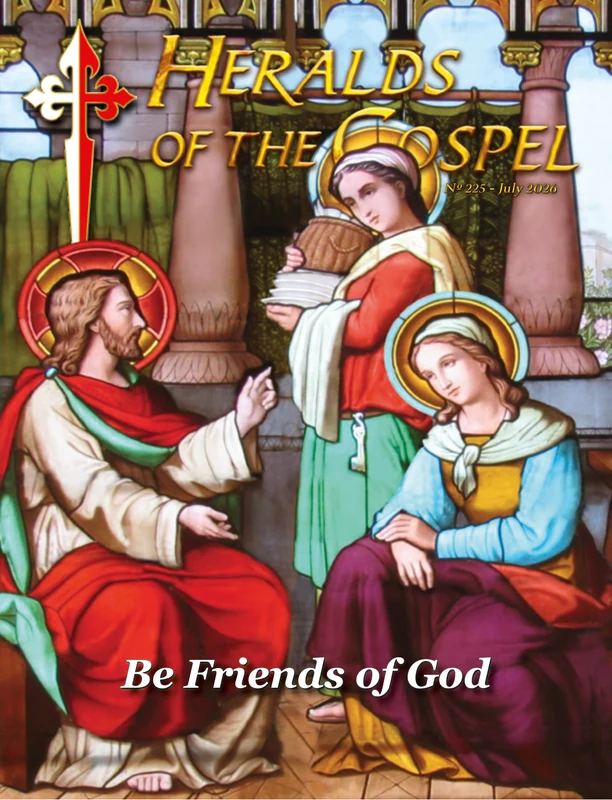 Heralds of the Gospel Magazine, Vol. 20, nº 225, July 2026
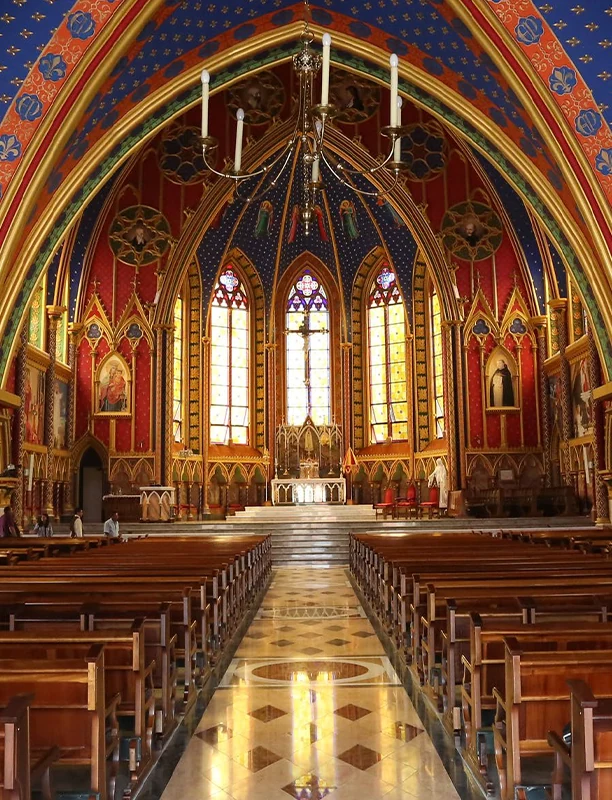 Who are the Heralds of the Gospel?
 Help of Christians
 Christmas Carols






Padre Pio persecuted
The monastery of San Giovanni Rotondo was part of the Archdiocese of Manfredonia, headed by Archbishop Pasquale Gagliardi. While enthusiasm for Padre Pio was growing among the faithful, this prelate and some canons of the village, unfortunately displeased by the situation created by the stigmatic monk’s fame, spread the most deplorable calumnies against him. And the worst was yet to come. Convento de San Giovanni Rotondo (Itália), em 1953
Example of resistance to persecutions
Brunatto began to investigate the far-from-exemplary life of Padre Pio’s persecutors. He managed to gather a great deal of evidence in this regard and immediately proceeded to Rome to inform the Holy See. Nevertheless, his efforts yielded little results. In fact, there he only found the support of St. Luigi Orione and of Cardinals Pietro Gasparri and Merry del Val. Brunatto realized that hostility to Padre Pio did not come only from a simple Bishop of Manfredonia and a few canons. Padre Pio and Emmanuele Brunatto (at right), em 1924
A “bombshell book”
After some time, Cardinal Merry del Val commissioned Brunatto to carry out an investigation into the licentious habits of certain personalities of the highest religious sphere, a task he successfully completed. Armed with the information obtained, he decided, by way of pressure to free Padre Pio, to circulate a Letter to the Church, in which he made public the terrible moral life of the persecutors of his spiritual father, some of whom held high ecclesiastical offices. However, this time the result was not favourable: in response, a decree was published which obliged Padre Pio to celebrate his Masses only within the walls of the monastery, and not in a public church, and deprived him of all other faculties of ministry. If Brunatto had combined his impetus with wise diplomacy, perhaps the outcome would have been different… His friend and auxiliary, the lawyer Francesco Morcaldi, also lacked sagacity. He was persuaded by certain authorities to hand over several documents in his possession, which had served as a basis for the drafting of the Letter to the Church, in exchange for a supposed “liberating measure”, that was never taken, regarding Padre Pio. The book “The Antichrists in the Church of Christ”, published in 1932
Prelude to a new persecution
The Franciscan Saint was able to live in peace for another thirty years. Miracles and healings did not cease and the devotees multiplied; however, he was far from being rid of his persecutors… The economic situation of the Capuchins in Italy was critical. This was especially so in Foggia, where the religious had deposited large sums of money in the hands of a famous banker, Giuffrè, who went bankrupt. Everything they had handed over to him was lost. Padre Pio had never been involved in this affair and advised his brothers in the habit against it. Since he sought the Kingdom of God and His justice, he confided that the rest would be given him in addition (cf. Mt 6:33). In fact, donations came pouring in and with them the Saint was able to maintain a hospital he had built, the Casa Sollievo della Sofferenza, the property for which had been donated by Emmanuele Brunatto himself. In the meantime some of Padre Pio’s confreres began to misappropriate the donations intended for him. The news reached the Vatican, and Msgr. Mario Crovini was commissioned to investigate this situation, which unfortunately was real. The culprits received some sanctions. However, as soon as the mission was over, Pope John XXIII gave his consent to a request from the General Minister of the Capuchins: an apostolic visitation which would put an end to Padre Pio’s “incapacity” to govern the hospital. As soon as this decision was taken, some of Padre Pio’s confreres began to “investigate him”, placing tape recorders in several private places, such as his cell and even his confessional: a true sacrilege! However, they claimed they were obeying orders coming from very high places.Bias and injustice on the part of the visitators
The apostolic visitor, Msgr. Carlo Maccari, went into action on July 29, 1960. The first person he visited was Michele De Nittis, one of the canons of San Giovanni Rotondo who had savagely slandered Padre Pio in the 1920s. Emmanuele Brunatto and Padre Pio in 1924, in Santa Maria delle Grazie Monastery, San Giovanni Rotondo (Italy
The “White Book”
On October 3 the Vatican published Msgr. Maccari’s stipulations regarding Padre Pio, which, it was claimed, were aimed at “protecting the Church from deleterious forms of fanaticism.”3 Condemnations followed one after another and everyone – especially Brunatto – feared that Padre Pio would be deposed from the governance of the hospital. Putting himself at risk to defend his spiritual father, Emmanuele Brunatto sent a passionate letter to the Holy Office, in which he claimed to be ready to “turn the infernal cabal, which has already lasted for a third of a century, on its head if anyone touches Padre Pio’s liberty, or if modifications are made to the structure of his work [the hospital] without his and our consent.”4 In the meantime, the condemnations did not cease. Having no other alternative, he decided to make public the fact of the tape recorders placed in Padre Pio’s confessional. It was not long before a Cardinal of the Holy Office came to visit him in order to restore peace. They came to an agreement: Brunatto would cease the publications and they would keep Padre Pio in the governance of the hospital. Nevertheless, once again they did not keep their word: in the same month Padre Pio’s superiors obliged him to sign a document dispossessing him of the property. As a last resort, Padre Pio’s advocate gathered all the documents he had accumulated from the 1920s until the 1960s and made a compilation, called the White Book. However, its publication was delayed due to the death of Pope John XXIII. Brunatto only sent a copy of the document to the UN Secretary General, the President of the Italian Republic and the new Pope, Paul VI. In fact, it did not take long for the Pontiff to take the initiative to liberate the Capuchin Saint in 1964. However, since Brunatto was not aware of it, he felt obliged to publish his polemical work, which had enormous repercussions, above all among the ecclesiastical authorities gathered for the Second Vatican Council.A mysterious death
A year later, on the night of February 9 to 10, 1965, Emmanuele Brunatto was found dead in his house, the victim, according to the authorities, of a heart attack. However, some of his companions raised other hypotheses, such as strychnine poisoning. It is worth mentioning that his dinner used to be bought every day in a nearby restaurant. It goes without saying that this man, defender of the truth and persecutor of the enemies of the Church, came to be hated as much as Padre Pio himself, for in reality God was hated in them. Yet, we know that as long as there are men on earth who are living representatives of God and integrity, they will always be the object of persecution and hatred by those who plot iniquity. And it is precisely for this reason that the Lord will never deprive His Church of the presence of “Emmanuele Brunattos”, persecutors of evil who know how to unmask, at the opportune moment, the enemies of truth. ◊Notes
1 The decree stated that the convent of San Giovanni Rotondo belonged to the Diocese of Foggia, but it was in fact part of the Archdiocese of Manfredonia.
2 CHIRON, Yves. Padre Pio: Le stigmatisé. Paris: Perrin, 1999, p.202.
3 Idem, p.280.
4 Idem, p.290.