 Heralds of the Gospel Magazine, Vol. 20, nº 227, September 2026
 Heralds of the Gospel Magazine, Vol. 20, nº 226, August 2026
 Heralds of the Gospel Magazine, Vol. 20, nº 225, July 2026
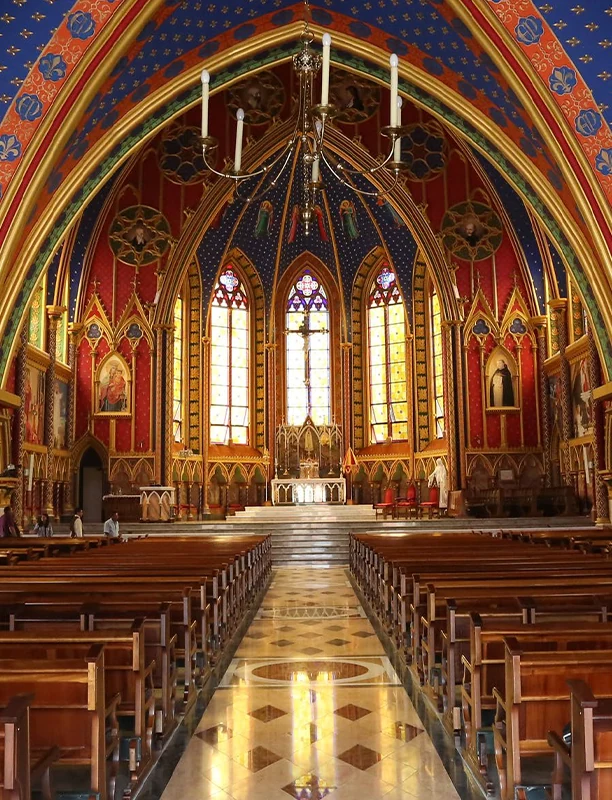 Who are the Heralds of the Gospel?
 Help of Christians
 Christmas Carols








The royal family’s “ray of sunshine”
This princess was born on May 3, 1764, at the Palace of Versailles, the last child of the Dauphin Louis de Bourbon and his wife Marie-Josèphe de Saxe. Orphaned at the age of three, she received an excellent education from the best preceptors of the time. Her formation was thorough, assuring her ample learning in the sciences, in which her love of geometry and algebra stood out. Her first battles were to master her own temperament, which was exuberant, full of vitality and marked by pride. Her sister Clotilde’s patience and affection in correcting her by reminding her of the obedience of the Child Jesus helped her overcome the obstacles of her aggressive character, to the point where her brother the Count d’Artois referred to her as the “ray of sunshine”1 in the family. Several opportunities to marry failed, allowing Élisabeth to choose the celibate path. At the age of fifteen she consecrated herself to God, living with great purity of customs and ardent piety. Her active charity, chaste joy, perfect kindness and faithful friendship earned her a high reputation throughout France, as being an “angelic and modest soul.” She was influenced in this direction by one of her aunts, Madame Louise, a Carmelite in Saint-Denis and a mainstay of morality in the decadent French court. When he recognized his sister’s religious ideals, and in view of the fact that she declined the prestigious post of superior of the Imperial Remiremont Abbey, Louis XVI granted her a small palace, Montreuil, near Versailles. The princess soon transformed the house according to her tastes. She remodelled the gardens and set up various work areas, which she later used to contribute to charitable services for the poor peasants who worked in the region. She assembled a small, well-selected court and organized life in the manner of a convent, with fixed times for prayer and activities. However, she never stopped attending Versailles, fulfilling her duties as the king’s sister. In the midst of the moral laxity of the time, she kept her chastity intact. Perhaps that is why she later showed she had the perceptiveness to realize where events were heading. Although she was not interested in political issues, she was extremely devoted to her country and to her brother, whom she always wanted to serve, lending a helping hand whenever circumstances required it.The storm looms large on the horizon
On May 3, 1789, Madame Élisabeth came of legal age and, two days later, she attended the opening of the Estates General, the beginning of the Revolution. On May 29, she wrote her impressions with great insight: “Everything is going worse than ever. […] The monarchy will only be able to regain its lustre by means of a coup de force; my brother will not do so, and he will certainly not listen to my counsel.” The skies over France began to cloud over. The storm was already brewing at the beginning of the autumn when Versailles was invaded and the royal family was forced to move to Paris. Although there was no shortage of opportunities for the princess to retreat with her aunts to Bellevue Castle near Meudon, she chose to share in her brother’s fate, following the drama of the royal family step by step, right up to the infamous imprisonment in the Tuileries.Sagacity and secret correspondence
Even in times of heightened persecution and surveillance, Élisabeth managed to set up a network of communication with her older brothers in exile, the Count d’Artois and the Count of Provence, urging them to promote foreign intervention in France. In this she opposed the King’s instructions, who softly asked for the suspension of any attempt at a counter-coup. One of her letters to the Count d’Artois was intercepted and handed over to the National Assembly for examination. In it, the princess warned Artois not to expect a strong resolution from the king, who was advised by ministers in complicity with the Assembly, and that there was nothing to hope for without outside help. She recommended that he act on his own, exhorting him to rally the sovereigns of Europe, since, she said, “Louis XVI is so weak that he would sign his own condemnation if anyone demanded it.” Brought back to the Tuileries after the unsuccessful escape from Varennes, vigilance around the royal family became stricter. Even so, Élisabeth resumed her secret network of contacts. She and the monarch were offered other opportunities to leave France, but all were refused. On her part, out of loyalty to her brother. On his part, due to his insecurity…
Madame Élisabeth during the invasion of the Tuileries Palace, by Jean-Baptiste Vérité
Against the constitutional church
A worthy daughter of the Church’s first-born nation, Élisabeth strongly opposed the Civil Constitution of the Clergy and any measure reducing royal or Church prerogatives. Thus, she renounced the spiritual direction of the French priests, most of whom had taken the oath, and called in a priest of Irish origin, Fr. Edgeworth de Firmont, who accompanied her to the end. Seeing Louis XVI attend ceremonies and receive the Sacraments at the hands of these disloyal ministers, she remained adamant in her position of fidelity to orthodoxy. Her absence in such circumstances was a tacit disapproval of the monarch’s behaviour. It must be considered that, due to their condition, the royalists of France, at home or in exile, observed her attitudes step by step, relying on them to maintain their loyalty to the royal cause, since the king sadly disappointed them at every turn.In the Temple, the final torments
Imprisonment in the Temple Tower brought the royal family new torments, which Élisabeth endured with patient resignation throughout the two years she stayed there. However, once again she did not remain inert. Making the most of every minute to influence her brother and sister-in-law, she prepared them for the worst, building them up through the serenity and piety she showed in such abstruse circumstances. The king came to admire his sister’s spirit, once acknowledging in a comment to his lawyers the heroic choice she had made in staying with him: “She has clung to my misfortunes as others once clung to my prosperity…” Under this beneficial influence, Louis XVI freed himself from the Enlightenment leanings he had received in his youth, returning to the integrity of the Catholic Faith. And thanks to Élisabeth, he was able to confess to Fr. Firmont on the eve of his execution. On the night of May 9, 1794, eleven men suddenly came to the cell to take Élisabeth away, warning her she would not return to the Temple. When she said goodbye to her niece, she counselled her: “Be brave. Always hope in God. Never forget the advice of your parents!” Élisabeth was taken to the Conciergerie where, amid apprehension, she hoped to meet her sister-in-law again… She was unaware, however, that Marie Antoinette had been guillotined months before.An iniquitous trial for an innocent princess
At the Conciergerie, she is interrogated by the fierce Fouquier-Tinville. When asked her name and status, she replied: “Élisabeth of France, your king’s aunt!" in reference to the Dauphin Louis XVII. The whole enquiry was conducted in the most malicious way possible, trying to make her blurt out some compromising reply that would justify the sentence passed beforehand. With shrewd answers and avoiding any lies, the princess evaded all incriminations. Thus, when asked if she corresponded with enemies of the French Republic and with her brothers in exile, she replied that she had only ever been acquainted with “friends of the French.” She emphatically denied false accusations, always with a calm spirit. In the end, she was taken to a cell, where she fell asleep. The night before, when the guards who would take her to her new prison had presented themselves at the Temple, she had dressed hurriedly, not realizing that instead of choosing one of the mourning dresses she had been wearing since Louis XVI’s assassination she had randomly picked a white dress, which seemed to rejuvenate her. This detail will strike a chord with the crowd attending her execution; everyone would see her as radiant. It is true that the immaculate white dress concentrated the light; however, this phenomenon was more due to the inner transformation that suffering had wrought in her soul: “the certainty of liberation, the grace of martyrdom had transfigured her.”2
“Madame” Élisabeth - Palácio de Versailles (França)
At the foot of the guillotine, the last court ceremony
Along the route to the square of the guillotine, some people from her circle of acquaintances escort her. Two young ladies make a reverence and ask: “Bless us, Madame!” Arriving at the scaffold, Sanson, the executioner, on his own initiative, sets up a stool at the foot of the stairs for the ladies to sit on, especially the princess. He also takes care to place them with their backs to the guillotine, so that they do not have to watch the others die. The first to be called is Madame Crussol d’Amboise. She stands up and solemnly bows to Élisabeth, asking her permission to embrace her, to which the latter replies: “With pleasure, madame, and with all my heart!” All the ladies in the group imitate her and the gentlemen take their leave with a deep bow. The princess is serene and radiant, repeating to those who are called: “Courage! And faith in God’s mercy!” The crowd watching the scene remains silent. When her turn comes, Élisabeth steps impassively onto the blood-red, slimy dais, where she must walk to the plank on which she will be guillotined. Perhaps she has never walked on a nobler stage, adorned with the lights of fidelity. The oblique, heavy blade falls from a height of two and a half metres over her head, and finally the blood of the princess mixes with that of her faithful followers: “It is the Blood of France and the blood of France.” At the foot of the guillotine there was a daily mob of women called lécheuses de guillotine, who took satanic pleasure in watching the executions: with each head that fell, they howled and screamed, adding to the atmosphere of terror. However, when the princess’ head fell, they were panic-stricken and fled; at the same time, a pervasive fragrance of roses spread throughout the square, as several witnesses attested. Furthermore, the drum that was supposed to mark the fall of the blade did not sound, because the officer in charge of giving the order had fainted… Meanwhile, on the very night of May 10, an order from the Committee of Public Safety was issued to all the press forbidding them to report any details of the event.
The execution of Madame Élisabeth, by Carlo Lasinio
Notes
1 The historical information in this article is taken from the work: BERNET, Anne. Madame Élisabeth. Sœur de Louis XVI. Celle qui aurait dû être roi. Paris: Texto, 2018.
2 Idem, p.424.
3 Idem, p.429.