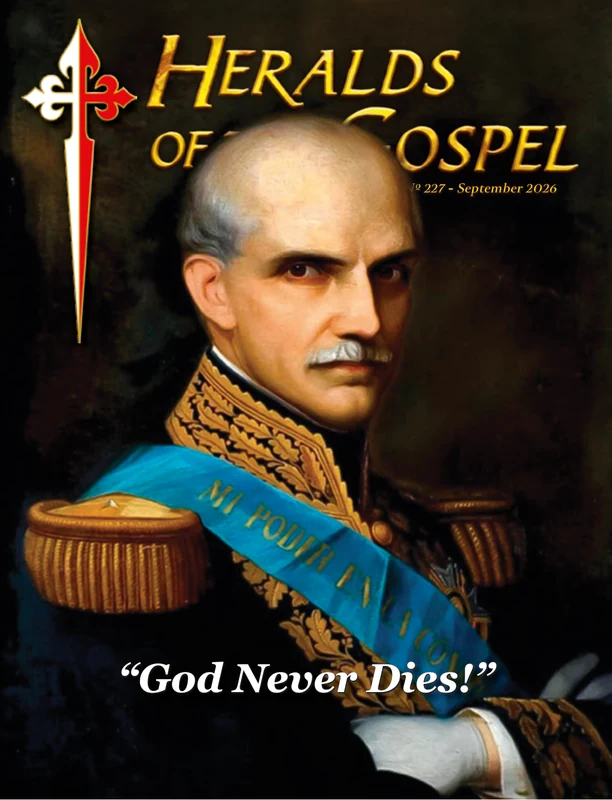
 Heralds of the Gospel Magazine, Vol. 20, nº 227, September 2026
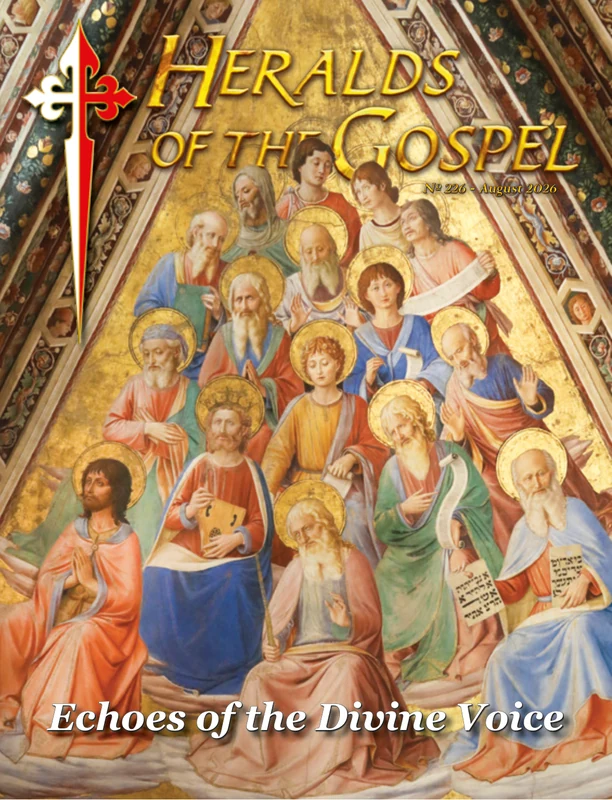 Heralds of the Gospel Magazine, Vol. 20, nº 226, August 2026
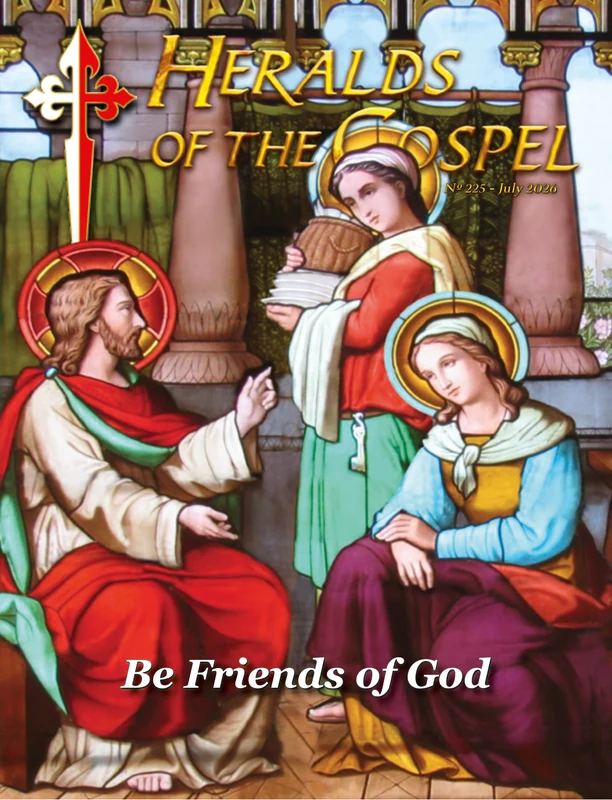 Heralds of the Gospel Magazine, Vol. 20, nº 225, July 2026
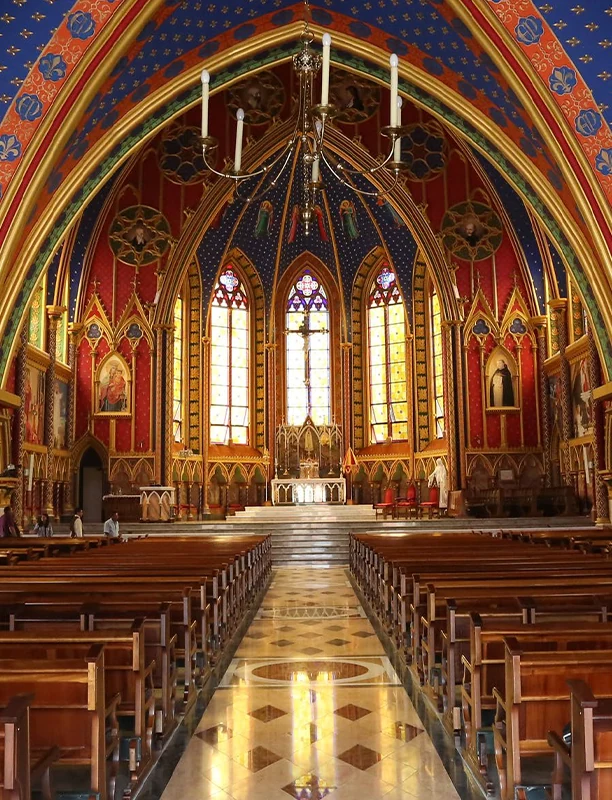 Who are the Heralds of the Gospel?
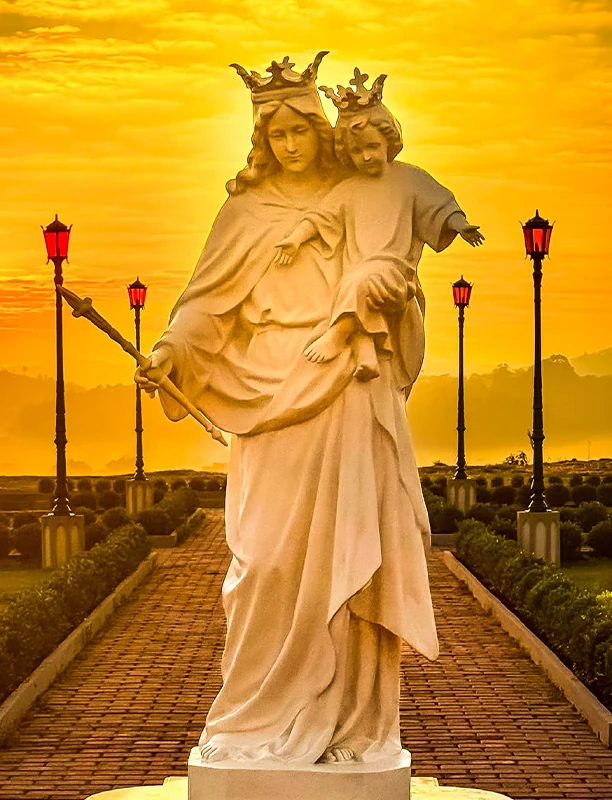 Help of Christians
 Christmas Carols








A child in touch with spiritual realities
When the light of reason begins to appear in the child, the first perceptions of the outside world awaken, and an inclination is immediately born: the search for its origin, that is, its parents. Parents become the axis of all its analyses and the term of comparison between good and evil: everything that comes from them is good, and whatever opposes them is evil.Now, the supernatural life received in Baptism follows the same process in an even more sublime way. The soul faithful to grace constantly seeks God, the Divine Absolute who created it and in whom it finds its paradise. Everything is then defined in terms of Him and, for this reason, the innocent soul is inerrant in discerning good and evil, because it has the Most High as archetype. It is worth noting, however, that this process does not only involve a movement of the intellect. Reason understands the good, but it is the will that is inclined to it, desires it and loves it.1 Thus, in the search for the Absolute, charity becomes the soul’s motor, establishing a divine friendship between God and the creature,2 in which the Holy Spirit is the interior teacher. In Msgr. João’s childhood, this intimate relationship with God was as discreet as it was profound. The motions of grace were clothed in a childlike simplicity, so that from a very young age, spiritual realities were natural to him.In order to get to know Msgr. João, it will be necessary to lift the veil that covers the mysteries of grace in the springtime of his life
Silent contemplation
As an only child, his early years were spent in isolation, which engendered in his soul a great propensity for contemplation. He was particularly attracted by the harmony of the starry firmament, which he observed at night sitting on his bedroom windowsill, as he himself recounts in the third person in one of his works: “Everything spoke of mystery… All the more so, for a child! This silent contemplation went on for one, two, or even three hours… Over the lapse of time, the constellations changed position, altering the configuration of the celestial dome. Yet unaware of the earth’s rotation, the Author imagined that the stars had ‘travelled’ […]. Impressed, he asked himself: ‘How does all of this work? How is it set in order? What power must lie behind the ‘travelling’ of the stars!’”3 It was the seed of faith manifesting itself in his innocent heart, helping him to understand the mystery of the order of the universe, for by faith, “we understand that the world was created by the Word of God, so that what is seen was made out of things which do not appear” (Heb 11:3). In this way, grace opened up the horizons of his soul, accustoming him to discover the Divine Craftsman in His work: “I learned to live in relationship with what God has created, in a conversation not of words but of soul, with all the beauties He has placed in the world.”4These long hours of solitude were a providential circumstance, which served to prepare him to undertake the mission to which God was calling him, as Dr. Plinio said to Msgr. João himself: “Every man, in order to carry out great deeds, needs to go through a period in which he is totally isolated, recollects himself and is able to reflect, alone, on the problem of life. You had an enormous advantage: that of being very isolated in your childhood. If you had not gone through that isolation, you would not be who you are today.”5João soon learned that he had to vigorously object to everything opposed to the Supreme Good he had glimpsed when contemplating the starry sky

Energetic opposition to evil: an addition to the contemplative temperament
As his contact with the supernatural world grew, the need to identify with God emerged in João’s soul, while a keen insight, born of the gifts of the Holy Spirit, led him to discern the evil that existed in the world. The Revolution began to threaten the paradise that his springtime innocence had built within him, and it was necessary to resist it radically in order to choose the path of good. It was then that one of the most striking episodes of his childhood occurred. When he was around six years old, he was playing quietly and innocently under a table during a family gathering at his home. Two of his uncles were there, his father’s younger brothers, typical examples of the agitated state of spirit that has characterized humanity since the beginning of the 20th century. Both of them drew near the boy and, brutally disturbing his peace, began playing a series of rough games with him, boxing his ears and taunting him with all kinds of insults.Outraged to see that good was always considered weak and that evil always won, he decided to turn the tables and firmly told one of his uncles: “Look, either you stop that or I will kick the china cabinet!" In fact, there was an antique piece of furniture in the living room, holding some treasured family possessions. As the uncle did not stop his aggressions, the little boy did not hesitate to carry out his threat and the glass came crashing to the floor. Seeing what had happened, the relatives turned against the uncle who, from then on, never dared to provoke the child again. However, João had realized that if he remained calm and peaceful in the face of evil, the whole world would come crashing down on him. He then made the decision to adopt a more assertive character. In reality, it was not properly speaking a change in his contemplative and serene temperament, but an addition to it. For a soul in the state of grace, God is “the first rule, whereby even human reason must be regulated”6 and so little João understood that he had to energetically object to everything that opposed this Supreme Good. And such was his integrity of spirit that this decision marked out a straight path for his whole life, from which he would never deviate.Coming face to face with the pervasive power of evil and the moral crisis of the world, he conceived the ideal of fighting for a society in which virtue and harmony reigned
The search for the Absolute becomes an ideal
The Heavenly Father wants from each soul a constant growth in the virtues because, as an eminent 20th-century theologian teaches, “the life of grace can never be exhausted; it is not possible for a life that has roots in the bosom of God to wither for lack of nourishment; rather, it grows constantly, as a reflection of the divine nature, until the moment when it leaves the progression of time and enters the repose of eternity.”7 To this end, He allows the just to encounter obstacles and sufferings, which will only increase their merits and strengthen their will towards perfection. In Msgr. João’s journey, there was no shortage of trials through which Providence wanted to strengthen his virtues, and for this his innocence had to be placed in a state of pugnacity. One of these trials particularly marked the beginning of his youth, when he was about fourteen years old.One day he was walking through the streets of the Ipiranga neighbourhood in São Paulo when he came across a boy he knew, only seven years old, who was smoking. The scene wounded his moral sense, and he did not hesitate to question the offender, expressing his astonishment. The boy merely made a gesture of defiance with the smoke coming from the cigarette. Young João then said to him: “I will tell your father!”, to which the child replied by trying to push the lit end of the cigarette into his eye. He turned his face away, but could not prevent the ember from burning his lower left eyelid. This episode convinced him of the pervasive power of evil, and it further confirmed his determination to be a great warrior for good.In his soul glimmered the certainty that somewhere in the world there must exist a selfless and virtuous man, whom he ardently desired to meet

Maternal preparation
Without realizing it, the young João was being prepared by Mary Most Holy to one day give himself entirely to her as a son and slave. Very gently, Our Lady wrapped him in her virginal mantle, preserved his purity, increased his faith, strengthened his love and established an indissoluble bond with him, sublime and mysterious, which would blossom in the future into an ardent devotion. Without a doubt, it was the Virgin Most Powerful who inspired in the depths of his soul the inner certainty that there existed somewhere a man, “who he would one day encounter, entirely virtuous, selfless and motivated by pure love for God.”11 When he retired at night, absorbed in these thoughts, he would kneel at the foot of his bed and, amid tears, pray insistently to Our Lady: “My Mother, I want to meet him; I want to meet him! Help me to find him.”12 And he would offer up to forty Hail Marys for this intention, pleading so fervently that “he saw, on several occasions, the silhouette of a robust, strong and majestic man, wearing a habit with a cream-coloured cape. Although he could not distinguish his facial features, he understood that this was the man he had been waiting for, the one who would reform the world.”13 And so two years passed… As João mystically envisaged that man, he began to love him, and grace moved him to seek his presence.14 For in him, all the longings that had been pent up in his soul since childhood were realized!
A vocation emerges on the horizon
One day in 1956, when he was sixteen, one of his teachers at President Roosevelt Public High School surprised the students with an unusual question: “Does anyone here doubt the existence of hell?” A few students came forward. He then asked them to come to him at the end of class. Young João did not doubt the existence of this place of torment, but he wanted to know how to prove it, as discussions on the topic often arose among his relatives. So he decided to listen to the explanation. The teacher presented the classic proof that the penalty must be proportionate not only to the offence, but also to the dignity of the offended. Now, when it comes to an offence against God, an infinite Being, as sin is, there must necessarily be an eternal punishment. Impressed by such a clear and simple argument, João took the opportunity to explain to his teacher his aspiration to found a youth society. The teacher invited him to visit him at his home to discuss the project. On the appointed day, however, the conversation turned to Protestantism, Luther’s depravity and, above all, the immaculate holiness of the Church founded by Our Lord Jesus Christ… While the teacher was talking, a grace struck like a flash in his soul, leading him to conclude: “The Catholic Church is the only true religion. I will belong entirely to the Church.”15And this grace, having fallen onto the good soil of a generous soul, soon began to bear fruit. Everything in his life took on meaning, everything took on light; innocence had found its dwelling place in the Holy Church! The only thing missing was to meet that good man whom he had to follow… The next morning, he awoke early and went to the Church of St. John Climacus, near his home, where he made a general Confession, attended Mass and prayed the entire Rosary. From then on, he never let a day go by without receiving Communion and offering Our Lady a crown of roses. After two months of attending meetings at that teacher’s house, the latter invited him to meet his mentor, the founder of the Catholic group to which he belonged. This encounter took place on July 7, 1956, in the Basilica of Our Lady of Mount Carmel. ◊He prayed so fervently to meet him that he began to see the silhouette of a robust and majestic man, but without distinguishing his facial features

Notes
1 Cf. ST. THOMAS AQUINAS. Summa Theologiæ. I-II, q.10, a.1.
2 Cf. Idem, II-II, q.23, a.1.
3 CLÁ DIAS, EP, João Scognamiglio. Mary Most Holy: The Paradise of God Revealed to Men. Houston: Heralds of the Gospel, 2020, v.I, p.35.
4 CLÁ DIAS, EP, João Scognamiglio. Talk. Caieiras, 17/2/2005.
5 CORRÊA DE OLIVEIRA, Plinio. Conversation. São Paulo, 4/9/1990.
6 ST. THOMAS AQUINAS, op. cit., II-II, q.23, a.6.
7 SCHEEBEN, Matthias Joseph. As maravilhas da graça divina. Petrópolis: Vozes, 1952, p.318.
8 CLÁ DIAS, EP, João Scognamiglio. The genesis and development of the Heralds of the Gospel movement and its canonical recognition. Doctoral thesis in Canon Law – Pontifícal University of St. Thomas Aquinas. Rome, 2010, p.171.
9 Idem, p.169.
10 “If you love your neighbour in God and care about his happiness, your first thought will be to lead him to enjoy the happiness in which you are abundantly immersed by grace” (SCHEEBEN, op. cit., p.298).
11 CLÁ DIAS, Mary Most Holy: The Paradise of God Revealed to Men, op. cit., p.55.
12 Idem, p.56.
13 Idem, ibidem.
14 According to the Angelic Doctor, union is the effect of love (cf. ST. THOMAS AQUINAS, op. cit., I-II, q.28, a.1).
15 CLÁ DIAS, Mary Most Holy: The Paradise of God Revealed to Men, op. cit., p.58.