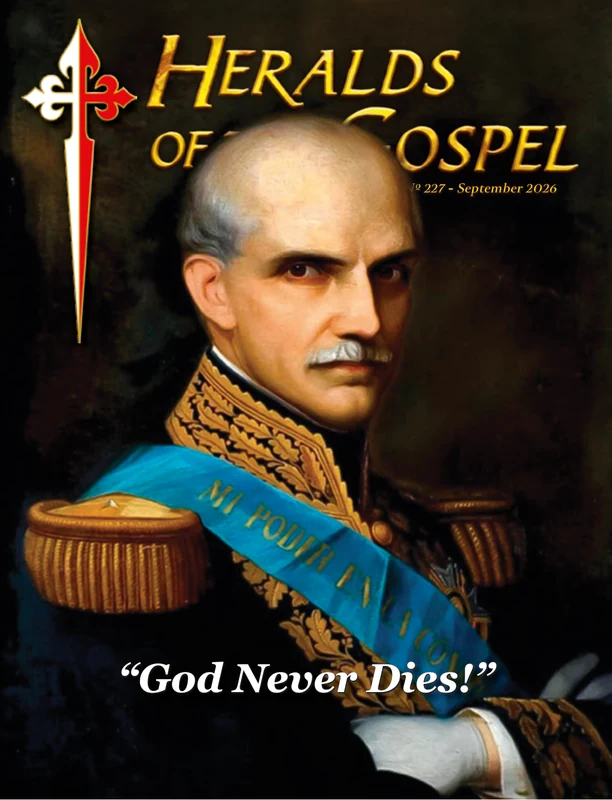
 Heralds of the Gospel Magazine, Vol. 20, nº 227, September 2026
 Heralds of the Gospel Magazine, Vol. 20, nº 226, August 2026
 Heralds of the Gospel Magazine, Vol. 20, nº 225, July 2026
 Who are the Heralds of the Gospel?
 Help of Christians
 Christmas Carols






“Lord, am I not the constant ‘yes’?”
June 7, 1978. At the end of a filial tribute prepared by his disciples in celebration of the anniversary of his Baptism, Dr. Plinio delivered an emotional and profound praise of the Church. He compared the Mystical Spouse of Christ to Jesus Himself who, amid the general reviling during the Passion, looked at each member of the faithful and asked the question: “My son, do you, at least, love Me?”Transfixed with love, Dr. Plinio continued: “One of us might answer: ‘But, Lord, what a question! Why do I exist if not for this? What crime have I committed before You, Lord, that You should even ask this question? Am I not the constant “yes”, the uninterrupted “yes” of every hour of the day and night, ready to receive everything You want to give?’”1 Here, in his own words, is one way to epitomize this man’s existence: a constant “yes”, renewed in every period of his life.Faithful to his first graces, little Plinio contemplated and loved the Holy Church and all that flowed from her into Christian Civilization
“Yes” to innocence and to the marvellous
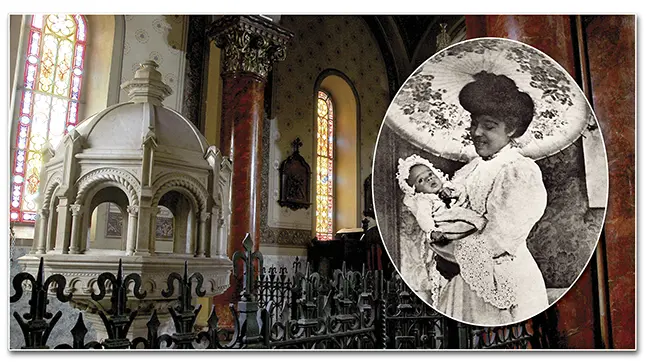
On Gaudete Sunday in 1908 – celebrated on December 13 that year – Dona Lucilia Corrêa de Oliveira gave birth to little Plinio in the city of São Paulo. She was the first school where her son would learn to love God; indeed, “the greatest of universities cannot replace the role of a mother.”2 In the “Lucilian university,” Plinio was enchanted by innocence and the Catholic Faith, and he received a careful moral and intellectual education. Gifted with the charism of discernment of spirits, he contemplated his mother’s goodness, elevation and balance, which predisposed him to receive, during visits to the Sacred Heart of Jesus Shrine,3 graces of profound penetration into the spirit of the Holy Church and of Our Lord.4 At the age of four, during a family trip to Europe, he marvelled at the fruits of the Most Precious Blood of the Saviour that had sprung forth in Christendom. His “yes” to these early graces was wholehearted: “From an early age, looking at the Catholic Church, not only at her but what flowed from her into sacred Christian civilization, I took everything as certain, infallible, indisputable.”5 On November 19, 1917, Plinio received his First Communion, which had been opened to children shortly before by the exhortation of St. Pope Pius X. In the Blessed Sacrament, he would obtain the strength to remain faithful to his initial “yes” and to all subsequent ones: “I understood well that the ‘Bread of the strong’ would help me to walk a hard road, the road of fidelity, the road of a duty that many times would cost blood of the soul.”6A “No” to evil which prepared for the sweetest “yes” in his life
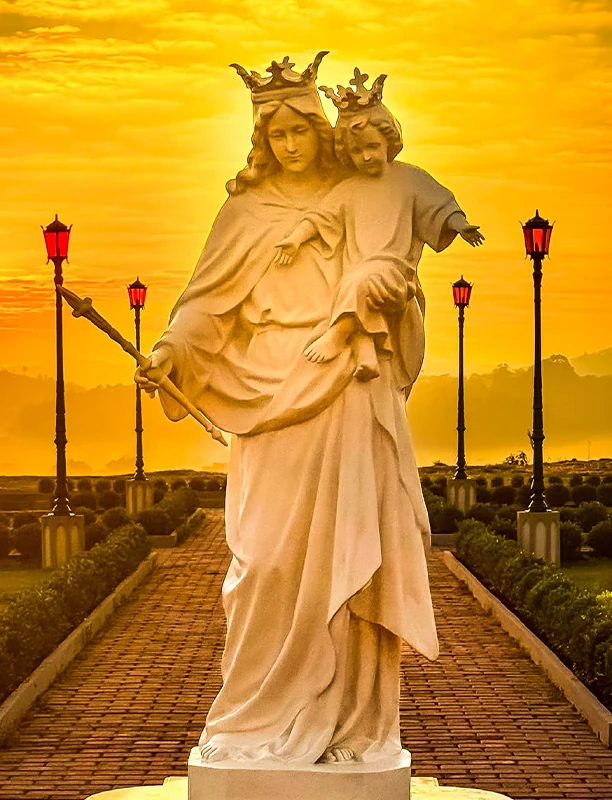
In February 1919, Plinio was enrolled in the prestigious St. Louis School, run by the Jesuit priests. Having lived until then in an exclusively family environment, his mentality clashed completely with the environment he found among the students: the formulas of good manners, still taught with care at that time, were rejected and ridiculed; brutality reigned; immoral conversations had become unscrupulously commonplace. Later, he understood that the mentality propagated by Hollywood cinema was the vehicle which, throughout the world, created this spontaneous, impure and pleasure-seeking way of being, characterized by contempt for the values of the Christian past. He concluded: “Deep down, it was a religious fight: to be or not to be as Our Lord had determined.”7In view of his steadfastness, opposition from his classmates became widespread, even turning violent: during recess one day, Plinio was hit hard on the head with a stone. The charge of deep hatred, set on destruction, brought a brutal warning: if he did not give in to the modern world, the persecution would be harsh, until the end. He then made a firm decision: “Whatever happens to me, I will be against this world. I will be in favour of purity, the Church, hierarchy and dignity, even if I have to be the least of men, trampled, crushed, pulverized!”8 It was another “yes,” proclaimed in the form of a “no” to evil. However, the trials were followed by the greatest of graces: to experience the mercy of Mary Most Holy.9 Devotion to the Mother of God, the core of his spirituality, began before a statue of the Virgin Help of Christians. And Plinio gave her the sweetest and most filial “yes” of his entire life.“Whatever may happen to me, I will be against this world. I will be in favour of purity, the Church, hierarchy and dignity”
“Yes” to holiness: the struggle for purity and entry into the Catholic Movement
The fight thickened when he entered the Faculty of Law at Largo São Francisco in 1926. As is normal at his age, he was assailed especially by temptations against his virginal purity. He resisted alone, isolated in the circles of high society, where it was considered ridiculous and contemptible for a young man not to frequent places of sin.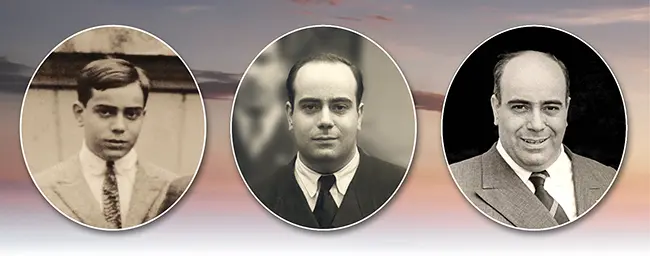
“Yes” to obedience: the youngest and most voted deputy in Brazil
In 1932, the provisional government called national elections to give Brazil a new Constitution. In São Paulo, the Catholic Electoral League was founded, with Dr. Plinio as its secretary-general, and his name was proposed by the Metropolitan Archbishop Duarte Leopoldo e Silva, to the list of candidates for deputy. Overcoming many doubts, Dr. Plinio realized that obedience to his prelate was, in essence, a new “yes” to the divine will. The elections, held on May 3, 1933, brought a resounding result: the Catholic leader was the youngest and most voted deputy in the history of Brazil, garnering more than double the number of votes received by the runner-up!The “yes” to failure…
However, a phase begins in which Providence will demand of him the repeated acceptance of failure, including that of mysteriously not being re-elected for a second term, thus ending his political career.Upon reaching the age of thirty, Dr. Plinio begins to notice a dangerous infiltration in Catholic circles, which rebels against traditional forms of piety and virtue. Innovations surreptitiously gain ground, even among members of the clergy… While multiplying reports to the Holy See on the situation, he writes a book to denounce the errors: In Defence of Catholic Action. Released on June 3, 1943, with a preface by the Apostolic Nuncio, Archbishop Benedetto Aloisi Masella, the publication brings about, as expected, the end of Dr. Plinio’s influence in Catholic circles, until then dazzling. His activity was methodically nullified by those promoting the heterodox tendencies, leading to a long and terrible ostracism.With each battle won in order to fulfil the will of God, Providence asked for more and greater sacrifices of Dr. Plinio, which he readily offered
“Yes” to spiritual fatherhood for the weakest
Throughout the 1950s, Dr. Plinio devoted himself almost exclusively to the formation of a small number of followers, known as the Catolicismo group because of the monthly magazine of the same name that he founded. Dr. Plinio then gave Providence a new “yes”: to be the spiritual father of a generation broken by centuries of revolutionary process, which he would lead with admirable patience and kindness. This fidelity blossomed in a historic encounter: on July 7, 1956, the young João Clá was introduced to him on the steps of the Basilica of Carmel.14 From that date onwards, the course of both their lives would change. At last, Dr. Plinio had found a disciple willing to fight with the same dedication, generosity and love!“Yes” to being an expiatory victim for his mission and work
In the following years of his life, particularly noteworthy events include the publication of his prophetic book Revolution and Counter-Revolution on April 5, 1959 and the founding of the Brazilian Society for the Defence of Tradition, Family and Property (TFP) on July 27, 1960. And since we are here to consider the history of Dr. Plinio’s “yeses”, two facts demand our attention. The first refers to the grace of Genazzano, received on December 16, 1967,15 when the Mother of Good Counsel herself gave her “yes” to her faithful son, with the interior promise that he would fulfil his vocation entirely.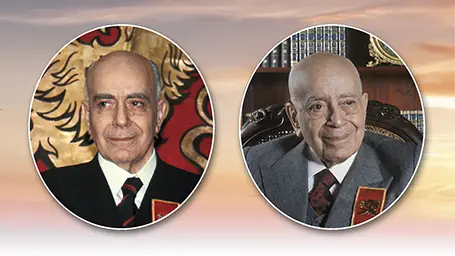
The final and reparative “yes”
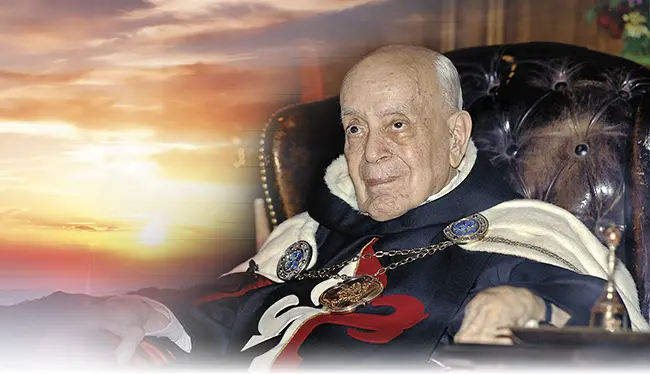
At the twilight of his life, Dr. Plinio could present himself to the just Judge with his hands full of spiritual fruits: countless battles fought for the Holy Church and Christian civilization; thousands of conferences and lectures given, numerous books and articles published, in which he had expounded Catholic doctrine with complete accuracy; a flourishing institution, with spiritual children scattered across all continents; an existence marked by adamantine fidelity. Thus he closed his eyes to this world on October 3, 1995.However, his existence far exceeds the personal sphere. The history of mankind is marked by a long sequence of infidelities: the “nos” and “maybe tomorrows” of so many called souls, whose lack of correspondence was the main factor in the astonishing advance of evil in recent centuries. Did not this defection of the elect constitute a kind of conscious and deliberate “immense sin”? And was Plinio Corrêa de Oliveira’s constant “yes” not then an “act of immense virtue,” repairing past denials and pledging a new era of graces never before imagined? The future will tell…Was Plinio Corrêa de Oliveira’s constant “yes” not an “immense act of virtue”, making reparation for the past and pledging a new era?
Notes
1 CORRÊA DE OLIVEIRA, Plinio. Conference. São Paulo, 7/6/1978.
2 CORRÊA DE OLIVEIRA, Plinio. Conversation. São Paulo, 12/5/1980.
3 Located in the Campos Elíseos neighbourhood, in São Paulo.
4 In this regard, see the article A Prophet for Our Times in this issue.
5 CORRÊA DE OLIVEIRA, Plinio. Conference. São Paulo, 1967.
6 CORRÊA DE OLIVEIRA, Plinio. Conversation. São Paulo, 22/11/1982.
7 CORRÊA DE OLIVEIRA, Plinio. Notas Autobiográficas [Autobiographical Notes]. São Paulo: Retornarei, 2010, v.II, p.527.
8 CORRÊA DE OLIVEIRA, Plinio. Conference. São Paulo, 1954.
9 This story is told in more detail in the article The World for Mary: the Apex of Devotion, in this issue.
10 Located in Praça do Patriarca, São Paulo.
11 CLÁ DIAS, EP, João Scognamiglio. O dom de sabedoria na mente, vida e obra de [The Gift of Wisdom in the Mind, Life and Work of] Plinio Corrêa de Oliveira. Città del Vaticano-São Paulo: LEV; Lumen Sapientiæ, 2016, v.II, p.81.
12 CORRÊA DE OLIVEIRA, Plinio. Conference. São Paulo, 20/4/1973.
13 Idem, ibidem.
14 Located on Martiniano de Carvalho Street, in São Paulo.
15 See the articles The World for Mary: the Apex of Devotion, and The Triumph Obtained by Blood, in this issue.
16 This episode is described in greater detail in the article The Triumph Obtained by Blood in this issue.