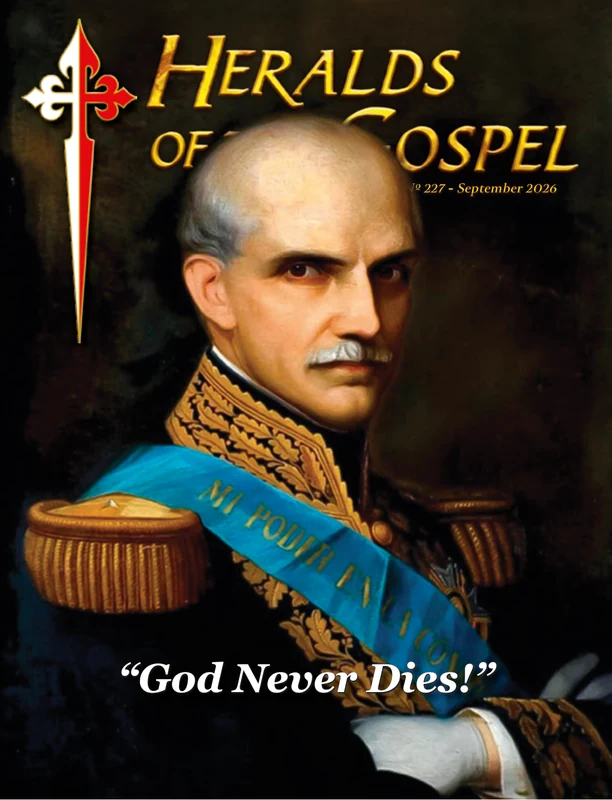
 Heralds of the Gospel Magazine, Vol. 20, nº 227, September 2026
 Heralds of the Gospel Magazine, Vol. 20, nº 226, August 2026
 Heralds of the Gospel Magazine, Vol. 20, nº 225, July 2026
 Who are the Heralds of the Gospel?
 Help of Christians
 Christmas Carols








A man reduced to only half of his natural movement left an unforgettable lesson for history, defeating the “invincible” English naval forces in Cartagena de Indias.

Life at sea
How would a fifteen-year-old react after such a misfortune? Surely he would suffer an irreversible trauma and abandon the career that he had hardly had the opportunity to begin. But this was not the 21st century. Blas de Lezo was already contemplating many other adventures. If his life dated back to medieval times, modern man would reckon it among the legends; however, as he was born in February 1689,2 we can list him among the heroes and accurately narrate here his fascinating story. Blas learned to move around nimbly on a very awkward wooden leg, which soon earned him his first nickname: “anka-motz” in the Basque language or, in Spanish, “pata-palo,”3 peg-leg. After being trained to walk and even to ride horseback with it, he was admitted back on board. His name reappears in history during a mission to defend the city of Peñíscola, where he took part in the burning of an English ship with sixty cannons. In August 1705, he was summoned to the aid that the Franco-Spanish navy would render to the city of Barcelona, besieged by the opponents of Philip V. There we see him at the helm of a small vessel, surrounded by English ships. The daring officer ordered the use of “red bullets”, lead balls heated in the ship’s furnace. He set fire to an enemy ship and escaped the siege amid clouds of smoke. Thirsting for feats beyond mere duty, Don Blas de Lezo was assigned as a ship’s lieutenant, at the age of only eighteen, in defence of the Fort of Santa Catalina in Tólon, from which he spotted a powerful English fleet approaching. Providence seemed to be testing the courage of the lame young man, who this time had the misfortune of losing his left eye. But he also survived this dangerous injury, which could have cost him his life. Did he abandon a career so exposed to what some would call “unwarranted” risks? No. In 1714, he was at the helm of the seventy-cannon ship Nuestra Señora de Begoña, also known as Campanela, with which he took part in the bombardment of the city of Barcelona during the civil war raging in Spain. In one of those raids, Blas lost the movement of his right forearm, as bones and tendons were destroyed. That “mediohombre [half-a-man]”, pursued and so often grazed by death, nevertheless did not consider himself sufficiently incapacitated to be excused, in conscience, from duty and adventure.
Cartagena de Indias
On March 11, Blas set foot on dry land. At a glance, he took in the formidable Bay of Cartagena and the sorry state of the fortifications. There was no time to lose. This city, the key point of Spanish colonization in Latin America, had been the target of a series attacks and threats.4 And the forecasts for the future were not encouraging. A Spanish spy, known by the nickname of El paisano, had obtained very reliable and precise information in Jamaica that the English intended to overthrow Spanish trade and dominion, with Cartagena de Indias as one of their main targets.
Guendulain Palace, Navarra (Spain)
First threats
On March 13, 1740, a small English squadron appeared on the horizon and opened fire to draw the defenders out of their positions and show their strength. But Edward Vernon, commander of the English fleet, knew that it was not yet the opportune moment for the assault. He was waiting for reinforcements and merely wanted to reconnoitre the city. During this waiting period he entrusted his men with other missions in the vicinity, so that the echo of small conquests would resound loudly in the British Parliament to the honour of his name. The fleet then returned to Jamaica for the last preparations before the attack on Cartagena de Indias. There it received considerable reinforcements, bringing it to “a total of more than one hundred and seventy ships and thirty thousand men.”6 Meanwhile, repairs and additions to the fortifications of Cartagena continued. Wooden bastions were erected, walls extended and the enormous iron chain that prevented entry to the bay was inspected. Eslava, who “was not yet fully convinced of the eventuality of the English attack,” completed the work that Don Blas de Lezo been carrying out for years but “even so, without acknowledging his efforts.”7
National Portrait Gallery, London
The English assault begins
The probable storm became reality: on March 13, 1741, the sails of nearly one hundred and eighty vessels billowed on the horizon. The English fleet approached and hemmed in the entire coast right up to just south of the city. Along the way it opened fire on the walls, destroying the batteries of Chamba, San Felipe and Santiago. Blas de Lezo was in the Fortress of San Luis de Bocachica, an important edifice that defended the entrance to the bay to the south. From there he asked Eslava for three hundred men. The latter grudgingly sent him one hundred and fifty, ordering them to return to the city on the following day… On March 20 the most feared possibility materialized: the English initiated a landing to assault the Fortress of San Luis, incomparably more vulnerable by land. With a large contingent of Jamaican natives – about a thousand of them – they began to set up a first camp and a battery. As they continued their land advance, Vernon ordered his forces to bombard the fortress. They were often driven back by artillery from the ramparts and the battery of San José, which was also steadily firing from behind the opening called the Bocachica. In one day this battery was rendered completely useless. However, to the amazement of the invaders, it opened fire again on the next day, for it had been rebuilt during the night under the orders of the indefatigable Blas, using earth and remnant ship parts! At a quarter past seven on the morning of April 2, 1741, the Spanish had a great surprise. The trees in the direction of Tierrabomba disappeared in an instant, and the astonishing scene of twenty twenty-four-pounder cannons and forty mortars was unveiled. Blas, weeks before, had insisted with Eslava that all the trees on the island be cut down, in order to avoid this type of ambush… However, as on so many other occasions, his advice had fallen on deaf ears. Eslava then convened a council of war on the flagship Galicia. During the heated debate among the officers, a cannonball carried away the very table on which they were working, wiping out everything in its path. Eslava was slightly wounded, but Blas de Lezo added a few more decorations to his body already so honoured by enemy fire: he had one of his hands and a thigh badly injured by shrapnel. In his diary, in which he makes very little mention of his deeds and is even more laconic about his pain, he only notes: “At nine in the morning I was wounded in a thigh and a hand.”8 He refused to be evacuated and continued to debate with Carlos Desnaux on how best to abandon his position in San Luis. Before long the English had conquered the entrance to the bay, reaching the last line of defence of the Spanish. The latter were abandoning and destroying fortresses which, according to Eslava’s opinion, were untenable positions. Blas, not without reason, was indignant, as he wanted to make the enemy pay dearly for every position that they had to abandon. To add to the altercations between the two commanders, Eslava ordered the sinking of the last two ships that remained, to obstruct the passage of the English, which was of no use at all. However, even though he foresaw these disasters and sometimes let a few barbs slip from his pent-up anger, Blas maintained intact his obedience to the legitimately constituted authority.Unexpected victory
In the meantime, Vernon was already singing victory. He sent the frigate Spence, commanded by Captain Lowes, to England with news of the imminent capture of Cartagena. There, “imminent” was interpreted as “indisputable”. The cannons of the Tower of London roared, the belfries sounded and commemorative coins were distributed, on which Blas de Lezo – with two legs… – was depicted kneeling before the British commander. On the back of the coin read the inscription: “The pride of Spain humbled by Admiral Vernon.” On April 20, 1741, however, a mysterious episode occurred that spelled the end of the English invasion. Vernon decided to take the Fortress of San Felipe de Barajas, despite the reluctance of the infantry commander, Wentworth, who judged such an enterprise impossible. In the dead of night, two groups advanced through the dense woods: one aimed to reach the castle from the north; the other, from the south. However, the result was disastrous. The guide of one of the garrisons, a Spanish deserter, led them in circles all night through the forest. When they reached the foot of the fortress it was already daylight and the surprise effect had been lost. Even so, they continued the operation. They placed the ladders in the most strategic positions, but they soon realized that they were not high enough, as Blas de Lezo had ordered a trench to be dug around the wall.

The anonymous hero
The enemy sails disappeared over the horizon and at last Cartagena had time to contemplate the price of victory among its still-warm ruins. The refulgent heroism of Blas de Lezo would be readily recognized by those closest to him. So many services rendered to his homeland, his king and – why not say it? – his religion, could not be completely ignored. However, the natural echo of his honour was stifled. The first to write about the victory to the Spanish court was the prelate of Cartagena, Bishop Gregorio de Molleda. Contravening his mission of pastor and of defender and proclaimer of the truth, this cleric sullied himself with the culpability of a thinly veiled defamation. In his hasty account of the defence of Cartagena de Indias, all praise was given to the famous figure of the Viceroy Sebastián de Eslava who, despite the scandalous revolts of a certain Blas de Lezo, achieved brilliant success… Eslava himself then painted his own version of the story, in which Blas took on the appearance of a criminal: “May he be punished for his conduct,”10 he wrote to the king.