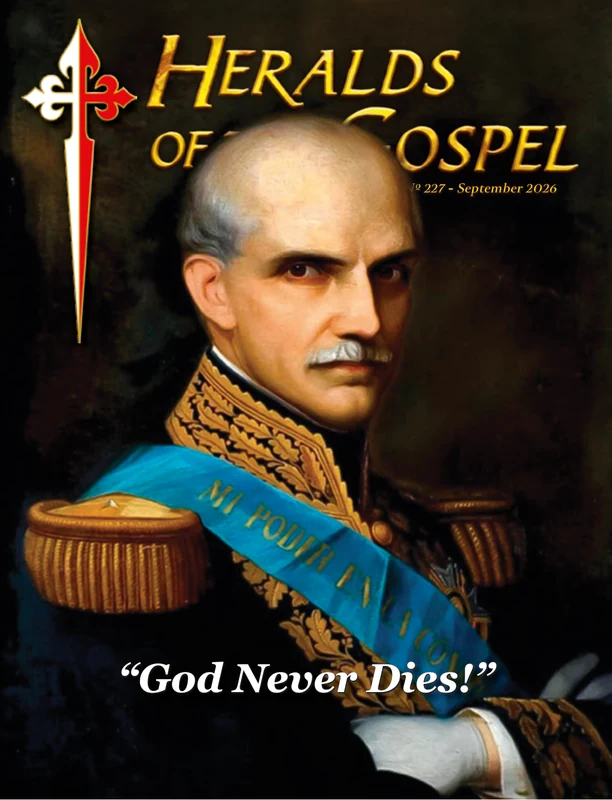
 Heralds of the Gospel Magazine, Vol. 20, nº 227, September 2026
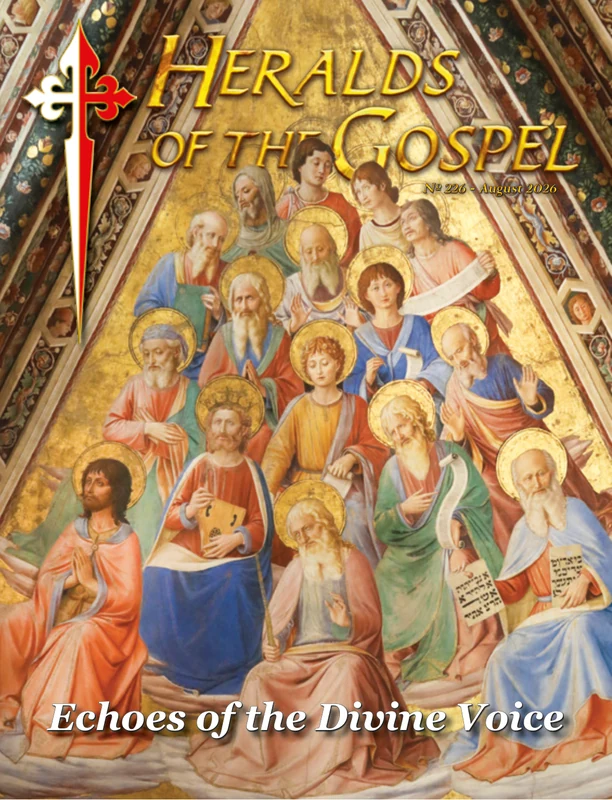 Heralds of the Gospel Magazine, Vol. 20, nº 226, August 2026
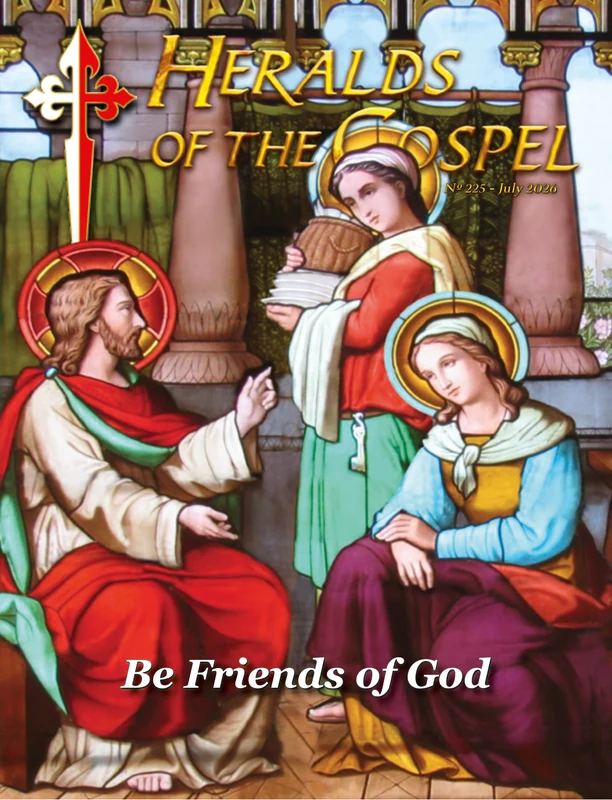 Heralds of the Gospel Magazine, Vol. 20, nº 225, July 2026
 Who are the Heralds of the Gospel?
 Help of Christians
 Christmas Carols








Fraud has been a part of human life ever since the Fall in Paradise: original sin arose precisely through a deception of the Serpent, and its ravages did not end there…
After Sarah laughed at the divine promise that she would bear a son in her old age, she lied to God, denying that she had committed so frivolous an act (cf. Gn 18:10–15).
Joseph’s brothers misled Jacob by suggesting that his favourite son had been devoured by a wild beast (cf. Gn 37:33). Finally, the deicide itself was brought about by the duplicity of Judas, the traitor par excellence.
While dissimulation is ubiquitous in history, aversion to it seems no less universal. St Augustine’s famous remark is well known: “I have had experience of many who wished to deceive, but not one who wished to be deceived”.1
There are, of course, many levels of distortion of the truth. The worst of them all is, without doubt, that of a religious nature, for, as he remarks in another work, it constitutes the “first and capital lie, far to be fled from”.2
Under this prism, on July 14, 1269, St. Thomas Aquinas delivered a sermon on the following passage from the Gospel of St. Matthew: “Beware of false prophets, who come to you in sheep’s clothing but inwardly are ravenous wolves. You will know them by their fruits” (7:15–16).
This sermon became known by the Latin opening words of the first verse: Attendite a falsis prophetis.3
How to discern a false prophet?
Aquinas’ intention with the sermon is crystal clear: to warn his listeners against the snares of evildoers, in particular their most harmful kind, that of false prophets. Thus, to better understand them, he begins by defining the nature of the true prophet.
The term prophet admits four meanings: 1) the person who is the object of divine revelation; 2) the one who understands the revealed things; 3) the one who announces the revealed things; 4) the one who performs miracles, like Elisha, who, even after death, “prophesied” (Sir 48:14), that is, “performed prophetic miracles” (1.2.4).
Christ Himself was considered a prophet by the Jews because of the wonders He performed (cf. Lk 7:16).
Having established this standard, how then to identify a false prophet? The Angelic Doctor offers four criteria for falsehood: of doctrine, of inspiration, of intention, and of life.
First of all, false prophets do not teach, they misguide. Authentic prophecy is centred on truth. By distorting it, the heretic Arius gained followers, intending to “correct” the very doctrine of Christ (cf. 1.3.1).
Now, how many in history, even to our day, have not followed the same paths, propagating a morality antagonistic to the Gospel? False prophets!
The pseudo-prophets are also relativists: “they affirm that good is evil and that evil is good” (1.3.1).
Here Aquinas refers not only to the publicists of blatant error, but also to the subtle manipulators of truth, who act according to personal convenience.
This is the case of the one who utters false praise to minimize the real achievements of his neighbour, or the one who, under an adulterated interpretation of the consecrated vocation, “prevents others from entering religious life” (1.3.1). This is an “erroneous and treacherous teaching”.4
Falsity of inspiration is yet another clear indication for discerning prophecy.
This occurs when the subject is no longer moved by the Divine Paraclete, but by the devil – as Jeremiah points out: “the prophets prophesied by Baal” (Jer 2:8) – or by his own spirit, conduct harshly rebuked by the Lord: “Woe to the foolish prophets who follow their own spirit, and have seen nothing!” (Ez 13:3).
From this perspective, St. Thomas unmasks the buffoons self-proclaimed as wise: they arrogantly repeat the lucubrations of the sophists, while at the same time belittling the Faith. False prophets!
Disdaining them, Aquinas asserts: “An old woman today knows more about things pertaining to Faith than all the philosophers of old” (1.3.2.b).
As for intention, the judgement is severe. Grasping at profit, at temporal advantages or fame are unmistakable signs of bad faith, as in the Machiavellianism of Simon Magus (cf. Acts 8:9-24).
The Angelic Doctor compares this sin to adultery, for such dissimulation adulterates the Word of God.
Finally, unlike Christ, who “began by acting and teaching” (Acts 1:1), the false prophet “teaches one thing but lives another” (1.3.4). The conduct of the true prophet is always congruent with his message.
Sheep’s clothing: the tricks of false prophets
False prophets disguise themselves as sheep in order to conceal their malice under the mask of virtue. By this trickery, they will “deceive many” (Mt 24:5), even forming an “evil generation” (Mt 16:4).
While the true sheep hear the voice of the Good Shepherd (cf. Jn 10:27), the imposters make a masquerade of holiness. The purpose is clear: to delude the good. To this end, they use four fictitious “garments”: adoration, righteousness, penance, and innocence.
With the “garment” of adoration, the wolves dressed up as sheep usurp the place of the Shepherd.
As they strive, in their prayers, to be seen by men (cf. Mt 6:5), they end up demanding for themselves the worship exclusive to God; consequently, they can well be called “false Christs” (Mt 24:24).
The “garment” of righteousness is sewn in the Pharisaic model, which requires a stage to strut about: “Beware of practicing your piety before men in order to be seen by them. Thus, when you give alms, sound no trumpet before you, as the hypocrites do” (Mt 6:1-2).
The “garment” of penance is a sham of virtue, pure outward show. Fasting does not serve for mortification of the flesh or spiritual progress, but for public display.
Circumspection is necessary, for “it may belong to boasting that a person uses a poorer garment than his station requires” (2.2.3).
Pride is not only adorned with sumptuous garments, but can pose as false poverty, under the guise of austerity.
Finally, there is the “garment” of innocence. Wolves feign purity, but they are like “whitewashed tombs […] full of dead men’s bones and all uncleanness” (Mt 23:27).
Wolves are hypocrites: how to unmask them?
The hypocrite is a predator: just as the wolf pursues the flock, he plunders the goods of body and soul. The wolf’s wrath shows itself merciless: it seeks to scatter the sheep (cf. Jn 10:12), sparing no effort to seize them; its voracity is insatiable (cf. Acts 20:29).
The sheep’s main precaution consists in discernment, whose golden rule the Divine Master bequeathed to us: “By their fruits you will know them.”
If “the fruit of the Spirit is love, joy, peace” (Gal 5:22), the fruit of these beasts can only be rottenness. Charity does not reside in them, but rather unbridled ambition: they always want the first places (cf. Mt 23:6).
Furthermore, “out of the abundance of the heart the mouth speaks” (Mt 12:34).
The words of these charlatans reflect their inner selves. They may even utter truths, articulate eloquent speeches, but sooner or later, the mask will fall.
The evil pack, always lurking to take in the unwary, is recognizable by its actions.
It reveals itself through agitation and impatience because, as the Book of Proverbs teaches, “the fruits of the wicked is trouble; […] The learning of a man is known by patience” (15:6; 19:11).
The wolves in sheep’s clothing will continue to exist until the definitive coming of Christ. They “will arise and show signs and wonders, to lead astray, if possible, the elect. But take heed; I have told you all things beforehand”(Mk 13:22-23).
If the machinations of these false prophets are tremendous, even greater must be the antidotes to combat them. For us, everything is defined by faithfulness: “this is the victory that overcomes the world, our faith” (1 Jn 5:4).