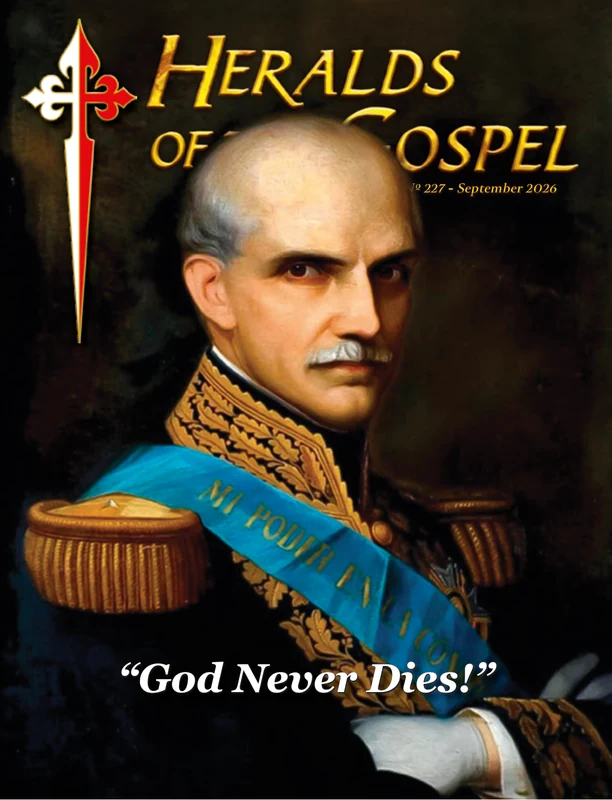
 Heralds of the Gospel Magazine, Vol. 20, nº 227, September 2026
 Heralds of the Gospel Magazine, Vol. 20, nº 226, August 2026
 Heralds of the Gospel Magazine, Vol. 20, nº 225, July 2026
 Who are the Heralds of the Gospel?
 Help of Christians
 Christmas Carols







Having concluded his mandate as congressman,1 Dr. Plinio resolved to employ the ample influence he still enjoyed in the Catholic milieu, as well as other resources still at his disposal, to proceed vigorously with his apostolate.
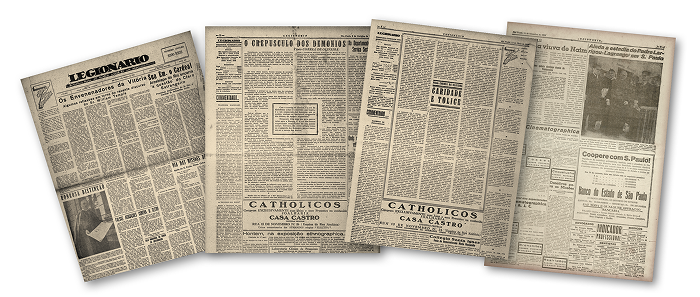
One of these resources was the modest newspaper Legionário.
Published semi-monthly since 1927 by St. Cecilia Parish for the circulation of the internal news of the community and the local Marian Congregation, it had enjoyed frequent contributions from Dr. Plinio since his entry into the Catholic Movement.
In 1933, some Congregation members had asked him to become the director of the paper, so that his prestige as congressman would favour it. He readily agreed.
But since pressing duties in the Legislative Assembly kept him in Rio de Janeiro much of the time, assuming the effective directorship of the paper was absolutely unviable. So he said to them:
“You may put my name on it right away. When I am no longer congressman, I’ll start exercising the office. For the time being, it is impossible to do everything at the same time.”
Accordingly, on the expiry of his mandate, he assumed direction of the paper, convinced that this seemingly insignificant publication could, in fact, become excellent, as long as he formed “a good team of writers, and made effective use of the paper for the Catholic objectives that I had at heart.”2
But how would it be possible to transform a simple semi-monthly publication, restricted to the ambit of the religious life of a São Paulo parish, into a weekly of broad scope that was capable of wielding influence, as he wished, over Catholic public opinion across all of Brazil?
The idea was to offer potential readers a point of reference that was entirely unheard of until then both within the Catholic and the public press, by an analysis of all contexts and events, whether in the religious or the temporal sphere, entirely moulded by the teachings of the Magisterium of the Church.
First public tribune of his prophetism
As soon as Dr. Plinio assumed directorship, the Legionário began to cover the most varied topics: from national and international politics – without endorsing any of the ideologies in vogue − to advanced apologetics, aimed at equipping Catholics to boldly defend their Faith.
Turning to themes related to world history seen from a vantage point not found in contemporary manuals, and even economic, social or philosophical topics that were of interest to the faithful at large or affected the great conflicts the Church faced at that time.
Dr. Plinio determined that this vast subject matter should be “dealt with in a polemical style. Writing with the point of a sword and keeping up a continual debate on virtually every front. […] It was the Counter-Revolution’s bombardment of the Revolution.” 3
Transformed rapidly into an influential weekly newspaper of international repercussion, Legionário became the podium from which Dr. Plinio revealed to the world the exceptional prophetic charism granted him by Providence.
He courageously exposed the nascent Nazi-fascist peril in Brazil, so that Catholics would not let themselves be deluded by false solutions; and later decried, as the first president of Catholic Action in São Paulo, the incipient errors to which no one had yet entirely opened their eyes, which threatened to change the immaculate face of the Holy Church.
Let us bear in mind that, contrary to what is typically believed, the essence of the prophetic mission consists not merely in making predictions, but primarily in pointing out to men the ways of Providence, and in contemplating the vision that God has of events.4
As we will see, this is the preeminent characteristic of Dr. Plinio’s prophetism, despite the fact that he also made predictions… and how many of them!
With the words of a true prophet who foresaw the forthcoming steps of the Revolution, Dr. Plinio unveiled to the general public that which his discernment made clear to him, and made bold prognostications that were often fulfilled to the letter, tearing away the label of “unrealizable” that any analyst would have imputed to them a priori.
In this way, his opinion took on more and more weight in the minds of both the good and the bad.
What nobody expected… happened
It would be impracticable to provide here an exhaustive list of so many previsions that were published and ultimately proven true.
However, one of these prophecies, the successive developments of which created a momentous impact for having been considered altogether unlikely at the time, serves as a sample.
As many think even today, wide sectors of the public held the opinion that Nazism and Communism were antagonistic and irreconcilable ideologies.
Impugning this opinion ever since the rise of German National Socialism and its counterparts in other nations starting from the 1930s, Dr. Plinio always pinpointed a mysterious unanimity of doctrines between the two systems, especially with regard to their unconfessed hatred of the Catholic Church, under the guise of apparently disparate aims.
This constant denunciation was especially eye-catching when, in the first edition of 1939, Legionário published the following lines:
On the threshold of 1938, the major ideological positions into which humanity was distributed numbered four: Catholicism, Liberalism, Communism and Nazism. […]
While all the camps define themselves, an increasingly clear process is underway. It is that of the doctrinal fusion of Nazism with Communism. In our view, 1939 will see the consummation of this fusion.5
Anyone considering these words through the prism of natural knowledge alone would think that this time Dr. Plinio had gone too far, and risked falling into discredit.
That he would underscore the philosophical affinities between the German and Russian dictatorships was admissible, but the mere hypothesis of an official alliance between national socialists and bolshevists seemed pure insanity.
It was not by chance, as its author recalled decades later, that the article created a hullabaloo among readers of widely varied leanings. But… it was a prophet who spoke.
The “rending of garments” was followed, a few months later, by generalized stupefaction, when the prognostication was fulfilled to the letter with the signing of the famous Molotov-Ribbentrop Pact6 in August, which took all of the Western powers by surprise and left public opinion baffled on the eve of the outbreak of the Second World War.
Dr. Plinio’s prophetic lucidity became even more evident from the benefits that both powers would garner with the curious treaty. It is needless to underline how much all of this greatly bolstered the prestige of Legionário and its director in the eyes of its readers.
Week by week, Dr. Plinio would microscopically analyse a wide assortment of news related to the world conflict, singling out nuances that no one had noticed, and from there drawing the most audacious conclusions, whose accuracy would soon be proven true.
“Qui vivra verra”
A further example is afforded by another event closely related to the one just described.
Dr. Plinio had been denouncing, long before the war broke out, various tactics in English politics which, in his view, aimed to favour the surrender of the British Empire in the face of the expansionist advances of the Third Reich.
He spared no invective against Lord Chamberlain’s nefarious pacifist diplomacy, which culminated in the shameful signing of the Munich Agreement.7
With this enormous moral defeat, which strengthened Nazism, several signs made it clear to Dr. Plinio that conspiracies were being hatched in England with a view to a collaborationist policy towards Germany, and that the success of these intrigues would leave all of Europe, and consequently the world, in the hands of Hitler’s neo-pagan ideology.
Amid this turbulent political-belligerent scenario in which the drama unfolding could change the destinies of humanity, in May 1941 the plane piloted by the second-ranking official of the National Socialist regime, Rudolf Hess,8 crashed on British soil – a sensational episode, whose deepest motives remain shrouded in mystery.
In his summary for 7 Dias em Revista [The Week in Review] commenting on the episode, Dr. Plinio did not hesitate to relate it to the pro-Nazi manoeuvres mentioned above:
The matter is too confusing, or has become too confusing, for one to form a clear idea about it. […]
It seems indisputable that Mr. Hess did not “flee” Germany [according to the hypothesis officially put forward by the Nazi regime] but rather undertook a journey for essentially political aims.9
Masterfully, Dr. Plinio also ably alluded to how the events in question corroborated the suspicions that had been uphelp over the previous months, based on the scant information gathered from news agencies, and planted a question in the readers’ minds.
It is worth emphasizing that it is only in recent decades that historians have come to regard, as the most plausible hypothesis, what Dr. Plinio had foreseen regarding an event that decisively altered the course of the Second World War.
He would comment years later:
Churchill said that never have so many owed so much to so few, referring to the airmen who defended London [from the Nazi air raids].
The fact of the matter is that the farmers who apprehended Rudolf Hess and took him to the tiny police station where he was detained could well feature on the list of the few to whom so many have owed so much.10
However, even more surprising than all this was the consequence Dr. Plinio associated with the capture of Hitler’s heir.
Just as the world had come to regard the sinister Nazi-Communist alliance as the norm, the same article pointed to an unexpected twist on the horizon:
As everyone can see, German-Russian collaboration is reaching its peak, with the active intervention of Russia on the side of Germany in Asian politics. “Legionário” has long foreseen everything that is unfolding.
And just now, when this collaboration seems to have reached its zenith, permit us to suggest something further to our readers, something that will undoubtedly cause them surprise: given the footing of these relations, it is just as possible for them to be of long duration as it is for Germany to suddenly strike Russia.
And this, without the Nazi-Communist symbiosis ceasing to be perfectly real. “Qui vivra verra” [Time will tell].11
Once again unthinkable in the eyes of any political or military commentator, Dr. Plinio’s words reverberated widely.
Barely a month later, at a moment when no one was envisioning a rupture of the Molotov-Ribbentrop Pact, Germany launched the invasion of Russia with Operation Barbarossa, introducing the world conflict into a new and excessively cruel phase.
Summoned to give an explanation
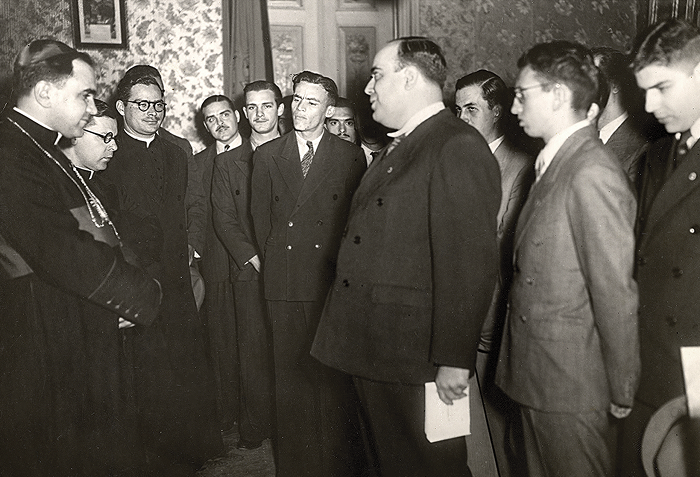
Such was the impact produced by the fulfillment of the prevision made in Legionário, that the then Archbishop of São Paulo, Dom José Gaspar d’Afonseca e Silva, decided to clarify the question, perhaps judging Dr. Plinio to be overly informed.
He summoned him to the Episcopal Palace and, during the conversation, asked him how he had known about the episode before it happened. With simplicity, he replied:
Your Grace, I do not know how to explain it. I only know that, in thinking over the matter, this idea came naturally to my spirit. I realize that it was not within reach of my intelligence.
This unpretentious response shows how Dr. Plinio possessed a certain notion of the limits of his natural qualities and the extent to which he received supernatural aid; a notion that could be classified, in other words, as profound humility.
But, above all, it denotes a characteristic of the gift of wisdom and the charism of prophecy.
The prophet does not always have, right away, a clear awareness that the action of the Holy Spirit in his soul corresponds to such lofty gifts.
According to the teaching of St. Thomas, his mind can be enlightened by a prophetic instinct, and in this case, his position with regard to the things he knows “is sometimes such that he is unable to distinguish fully whether his thoughts are conceived of Divine instinct or of his own spirit.”12
In fact, Dr. Plinio made these previsions not based on rules that were known to him; but because by means of this instinct, he cast his eye on events and saw them as God sees them.
St. Thomas13 is accurate in saying that this prophetic knowledge is the highest kind of supernatural knowledge that man may have on this earth.
While it is yet imperfect as compared to the beatific vision, which has infinite dignity because it is the vision of the essence of God,14 such knowledge is superior to that obtained through imaginative visions or other analogous wonders, to which the figure of the prophet is readily associated.
Often, when making such analyses under the influence of his prophetic instinct, Dr. Plinio did not immediately realize that this was a direct inspiration from the Holy Spirit, and attributed the source of his predictions largely to natural logic.
However, in the case described above and in countless others, the fact that his accurate predictions were confirmed, and the surprised reaction of others upon perceiving that this was not a natural phenomenon, led him to reflect on the existence of a special assistance of grace, and he eventually came to accept it.
He himself would explain many years later:
I realized that Our Lady had given me, in the natural order, certain gifts and certain natural talents, but that frequently the outcome of my thinking went further than my natural intelligence could reach.15